
There is a particular kind of Italian genius that has nothing to do with truffles or aged cheese or anything expensive, and pasta e fagioli is its purest expression. The name just means pasta and beans, and that is almost the entire ingredient list: a handful of dried beans, a little short pasta, a soffritto of whatever aromatics are around, and water. It is the dish an Italian grandmother makes at the end of the week, when the fridge is bare and the pantry is down to its last odds and ends, and somehow, from those scraps, she produces a pot of something so deeply satisfying that grown Italians get misty-eyed describing it.
This is cucina povera, the cooking of the poor, and it is where Italian food is at its most clever, because it turns almost nothing into comfort. Here is what pasta e fagioli actually is, when Italians reach for it, why every region makes it differently, the no-waste genius at its heart, and how to make your own. It is proof that the best comfort food is often the cheapest.
What follows is the dish of the nearly-empty pantry, why every region claims a different version, the no-waste philosophy behind it, why humble does not mean easy, and how to make it yourself.
The Dish of the Nearly-Empty Pantry
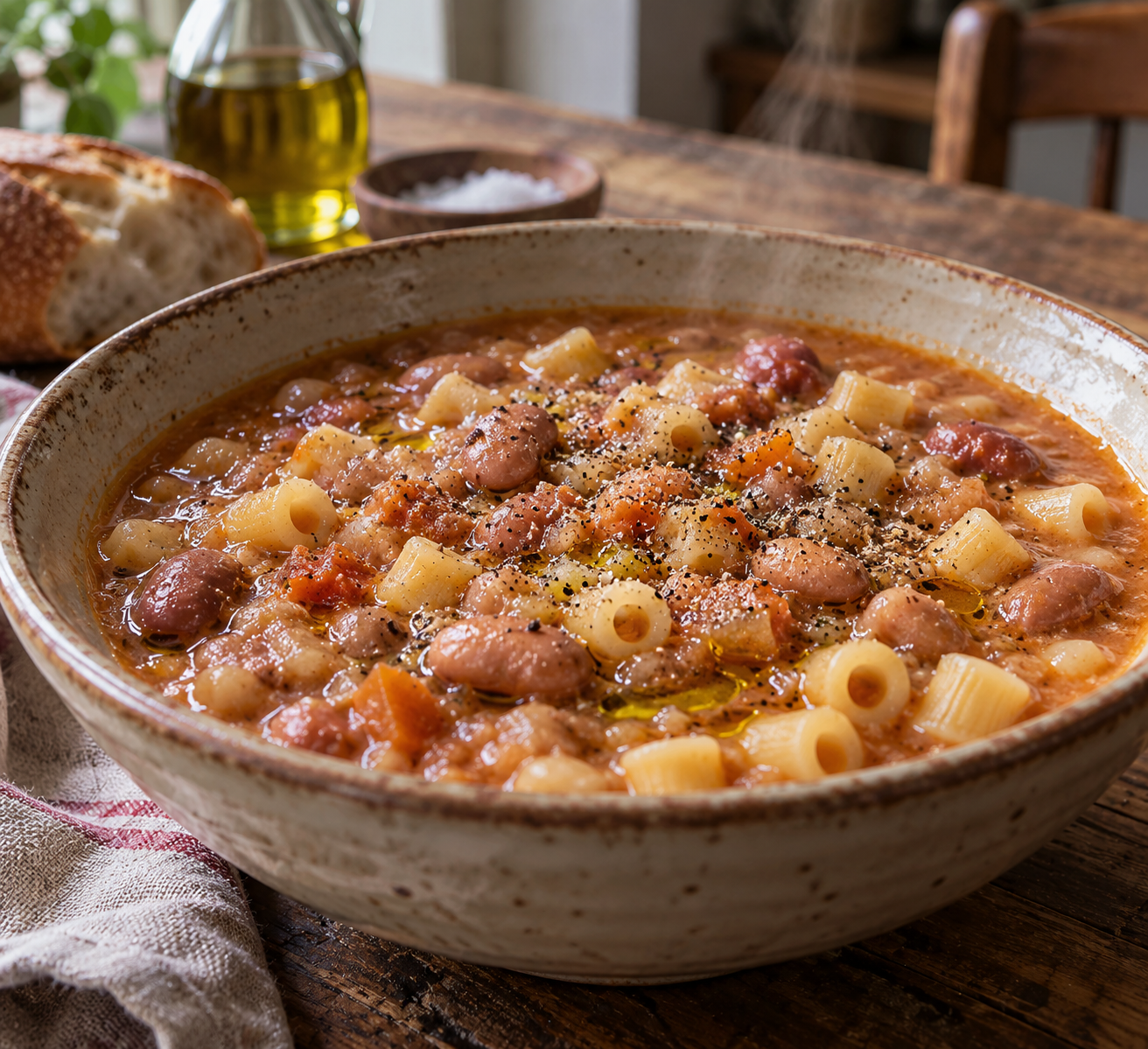
Pasta e fagioli, or pasta e fasule as it is known in the Neapolitan south, was born of necessity, the food of families who had to feed everyone on next to nothing and could not afford to waste a single crumb.
The beauty of it is how little it asks for. You need some dried beans, usually borlotti or cannellini, a bit of short pasta, an onion or a few cloves of garlic, a little olive oil, and perhaps a few extras if you happen to have them lying around, a rib of celery, a carrot, a tomato or two, a scrap of cured pork, a hard end of cheese. None of it is special, and none of it is expensive, and that is entirely the point. That is genuinely all. From that short, cheap list comes a hearty, warming, protein-rich, genuinely nourishing meal that can feed a whole family for the price of pocket change, which is exactly why it has survived for centuries as a bedrock staple of Italian home cooking, outlasting countless fancier fashions. Poverty invented it; love kept it.
What makes it more than just cheap, though, is that it is genuinely delicious, and that is the real magic of cucina povera. This was never food that people ate grudgingly because they were poor; it became food that people love and crave precisely because generations of cooks learned to coax extraordinary depth of flavor out of the humblest ingredients.
The starch from the beans and the pasta thickens the broth into something rich, glossy, and almost creamy without a drop of cream, the slow-cooked soffritto gives it a savory backbone, a parmesan rind lends it depth, and a good finish of raw olive oil ties it all together into something that tastes unmistakably generous. Nobody tasting a good bowl of it would ever guess how little it cost to make. It is proof of the idea at the heart of so much Italian cooking: that with the right technique and a little love, the simplest ingredients can taste like far more than the sum of their humble parts.
Every Region Makes It Differently
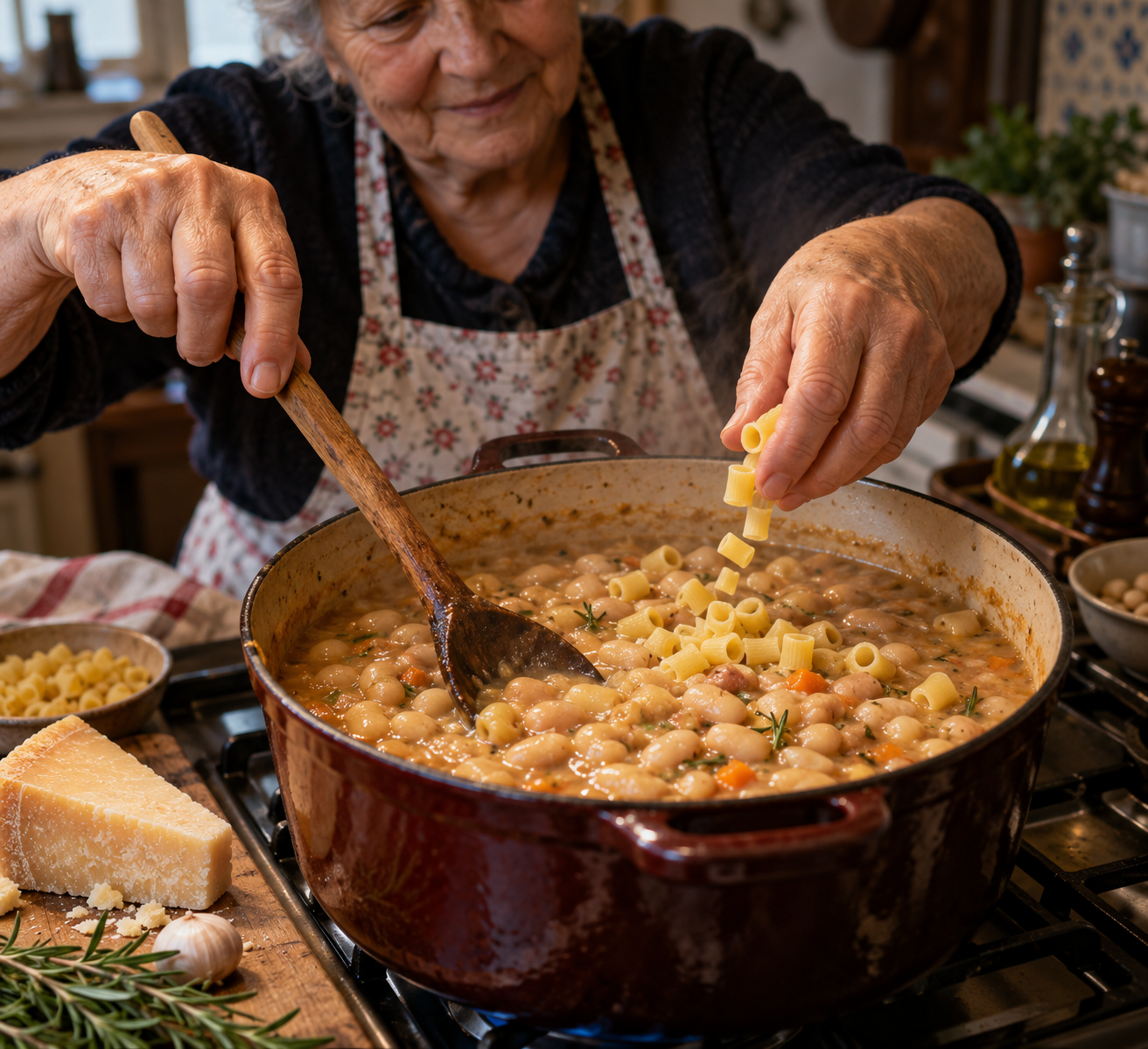
Ask ten Italians how to make pasta e fagioli and you will get ten passionate, slightly different answers, because like most beloved Italian dishes it varies enormously from region to region and from family to family, with everyone convinced their nonna’s version is the only correct one. The biggest divide is texture. In the north, particularly in the Veneto, pasta e fagioli tends to be thick and creamy, almost a bean stew with pasta in it, often made by blending some of the beans to create a velvety base. Head south toward Naples and the dish loosens and brightens, usually with tomato in the mix, becoming a soupier, more rustic affair you eat with a spoon rather than a dish a spoon could stand up in. Neither version is the real one, because they are both the real one, each perfected over generations in its own corner of the country.
The pasta changes too. Traditionally it is a small shape, ditalini being a classic choice, or even better, maltagliati, which literally means badly cut and refers to the irregular scraps and ends of pasta left over from making other shapes. That detail tells you everything about the spirit of the dish, because using up the ragged leftover bits of pasta rather than buying a fresh box is cucina povera in a single word.
Some families add a bit of pancetta or guanciale, some keep it strictly vegetarian, some swear by a sprig of rosemary, others by a chili. None of them is wrong. This is a dish defined not by a single fixed recipe but by a principle, beans and pasta and thrift and care, and the endless regional and family variations are not a sign of confusion but part of what makes it such a beloved, living thread running through all of Italian home cooking. Everyone owns it, and no one owns it.
When Italians Actually Eat It
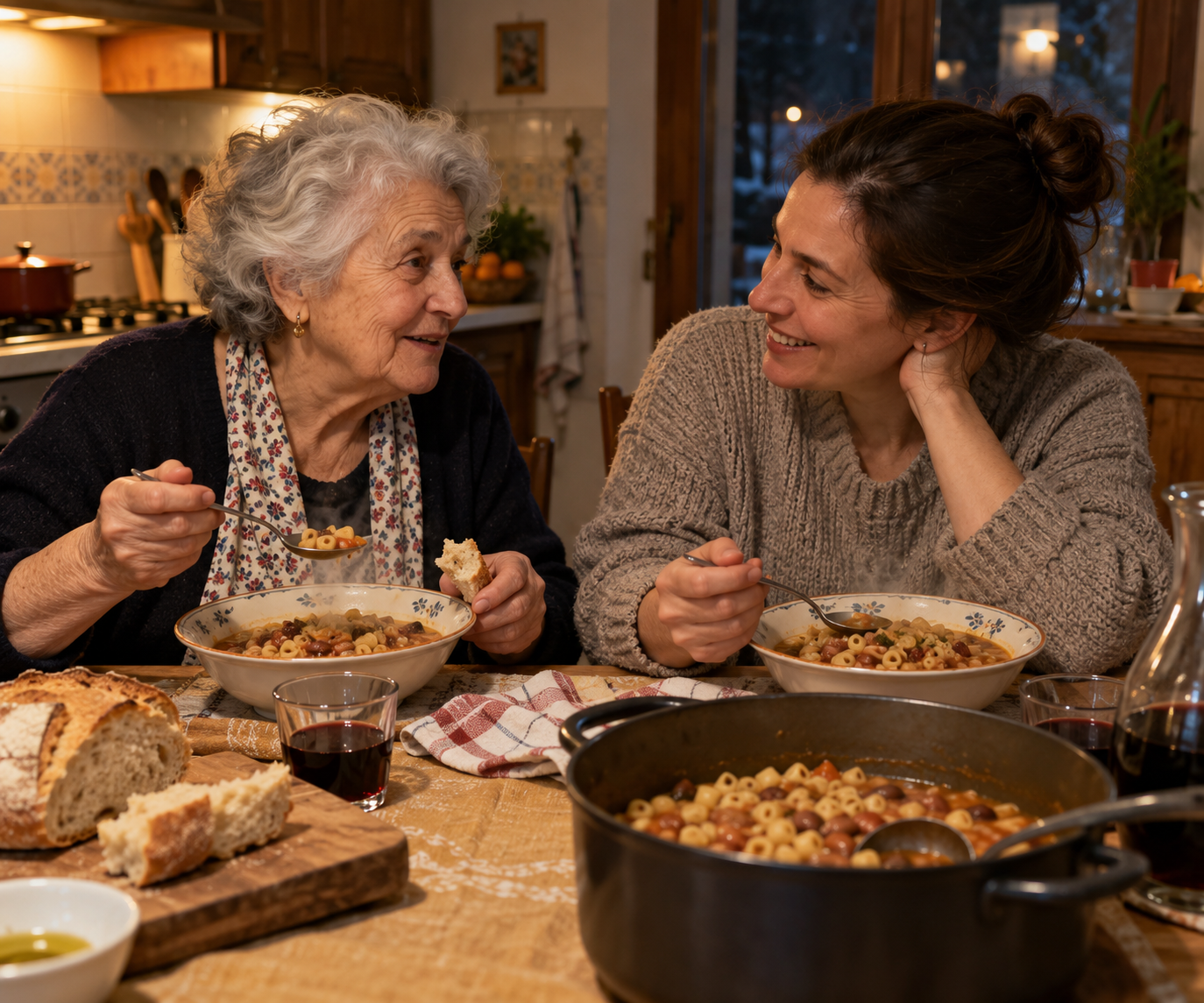
Pasta e fagioli is cold-weather food, the kind of dish that appears on Italian tables as the evenings draw in and a bowl of something warm and filling becomes the whole point of dinner. It is autumn and winter comfort, a one-pot meal that needs no second course, which is part of its charm, because it does the job of a whole dinner in a single humble bowl. In many homes it is a weeknight regular, a dish cooked often enough that children grow up with it woven into their sense of what home tastes like, which is exactly why it carries such emotional weight for Italians who have moved away.
There is also the happy fact that it is one of those dishes that is arguably better the next day, once it has sat overnight and the flavors have deepened and married, so a big pot cooked on Sunday quietly feeds people through part of the week. It reheats into something even more comforting than the night before, needing only a splash of water to loosen it back to the right consistency. For a dish that costs almost nothing and asks for ingredients most kitchens already have, that generosity, feeding a family cheaply, warmly, and repeatedly, is a large part of why it has never gone out of style. It is not restaurant food, and it is not special-occasion food; it is the humble, repeated, everyday food of real Italian homes, cooked on ordinary Tuesdays in ordinary kitchens, and that unglamorous ordinariness is precisely what makes it so deeply and permanently beloved. The dishes people miss most are rarely the fancy ones.
The No-Waste Genius at Its Heart
If there is one thing that defines pasta e fagioli beyond beans and pasta, it is the absolute refusal to waste anything, which runs through the whole dish like a backbone. The maltagliati pasta is only the beginning.
The water the beans cooked in is never thrown away, because it is full of starch and bean flavor and becomes part of the soup’s liquid, adding body and taste for free. A hard rind of parmesan, the kind most people discard, gets tossed into the pot to simmer, where it slowly melts and releases a deep savory richness that is one of the great secret weapons of Italian cooking. Even stale bread finds a home here, either toasted and rubbed with a cut clove of garlic to serve alongside, or torn into the bowl to soak up the last of the broth so that nothing, not a drop and not a crust, goes to waste. In a cucina povera kitchen, there is no such thing as garbage, only ingredients waiting for their turn.
This no-waste ethos is not a quaint add-on; it is the entire philosophy from which the dish springs. Cucina povera was not about deprivation but about ingenuity, about understanding that there is value and flavor in the parts that wealthier kitchens throw away, and about treating every scrap as something to be transformed rather than discarded. In an age when we are all being gently scolded to waste less food and cook more thriftily, pasta e fagioli turns out to be not some dusty peasant relic but a genuinely modern and useful lesson, a dish that was quietly practicing sustainability and zero-waste cooking centuries before anyone thought to put those words on a label.
The Italian grandmother scraping her pantry bare was not being virtuous for an audience; she was simply refusing to let anything good go to waste, and the result happened to be both frugal and delicious, which is the whole trick. Your grandmother, or someone’s grandmother somewhere, was quietly ahead of her time, and the proof is right there in the pot, in a bowl of something warm and thrifty and good that has outlasted every food trend of the last hundred years. We are only now catching up to what she always knew.
Humble Does Not Mean Easy to Perfect
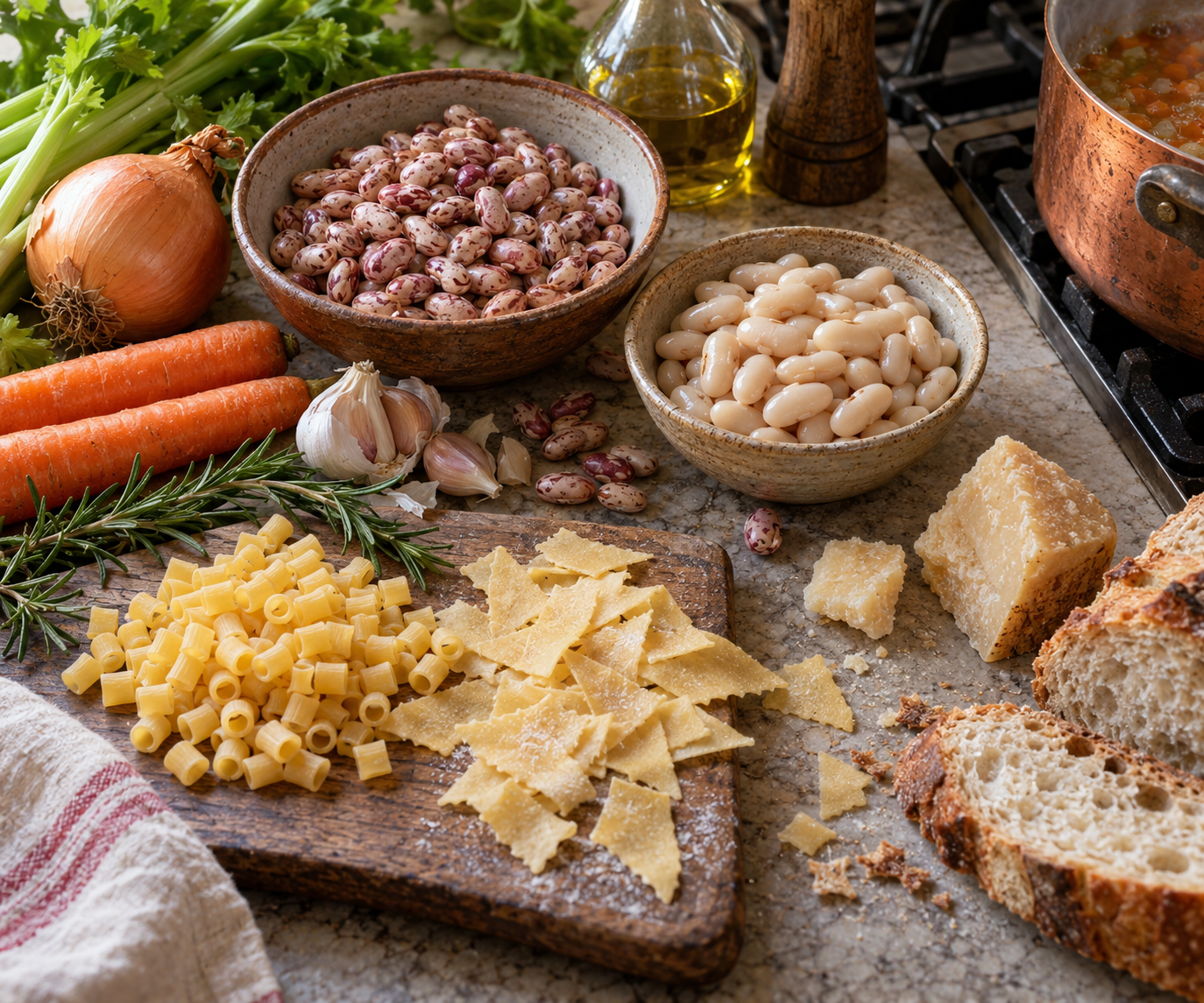
It would be a mistake to think that because pasta e fagioli is simple and cheap it is foolproof or unskilled, because the truth is that a truly great version depends on technique more than on ingredients. The foundation is the soffritto, the gently cooked base of finely chopped onion, and often celery and carrot, in olive oil, which must be cooked slowly and patiently to build the sweet, savory depth that flavors everything above it. Rush that step and the whole dish stays flat. Get it right, and you have built a foundation so savory and deep that even plain water simmered on top of it tastes like a rich, long-cooked broth. That alchemy, turning water into something that tastes like stock, is the quiet heart of the whole dish and the clearest proof that technique, not expense, is what makes it sing.
The other quiet skills are about texture and balance. Blending a portion of the beans and leaving the rest whole gives you the ideal creamy-and-hearty texture. Cooking the pasta right in the soup rather than boiling it separately means it releases all its starch into the broth and thickens the whole pot, which is exactly what you want and is half the secret of that rich, cream-free body, though it also means the dish keeps drinking up liquid and thickening as it sits, so leftovers almost always want a splash of water stirred in to loosen them back to life. A good pasta e fagioli is a living thing that keeps changing in the pot.
Knowing when to add the pasta so it is tender but not mushy, judging the final thickness, finishing with a generous drizzle of good olive oil and perhaps a dusting of parmesan and black pepper, these are the small touches that separate a merely fine pot from a transcendent one. It is humble food, made of the cheapest things in the kitchen, but it rewards patience and care far more than it rewards money, and that, perhaps, is the most Italian thing about it of all. Italian cooking has never been about expensive ingredients; it has been about treating simple, honest ones with respect, and no dish proves that quiet philosophy more completely than a good pot of beans and pasta.
Make It: Pasta e Fagioli
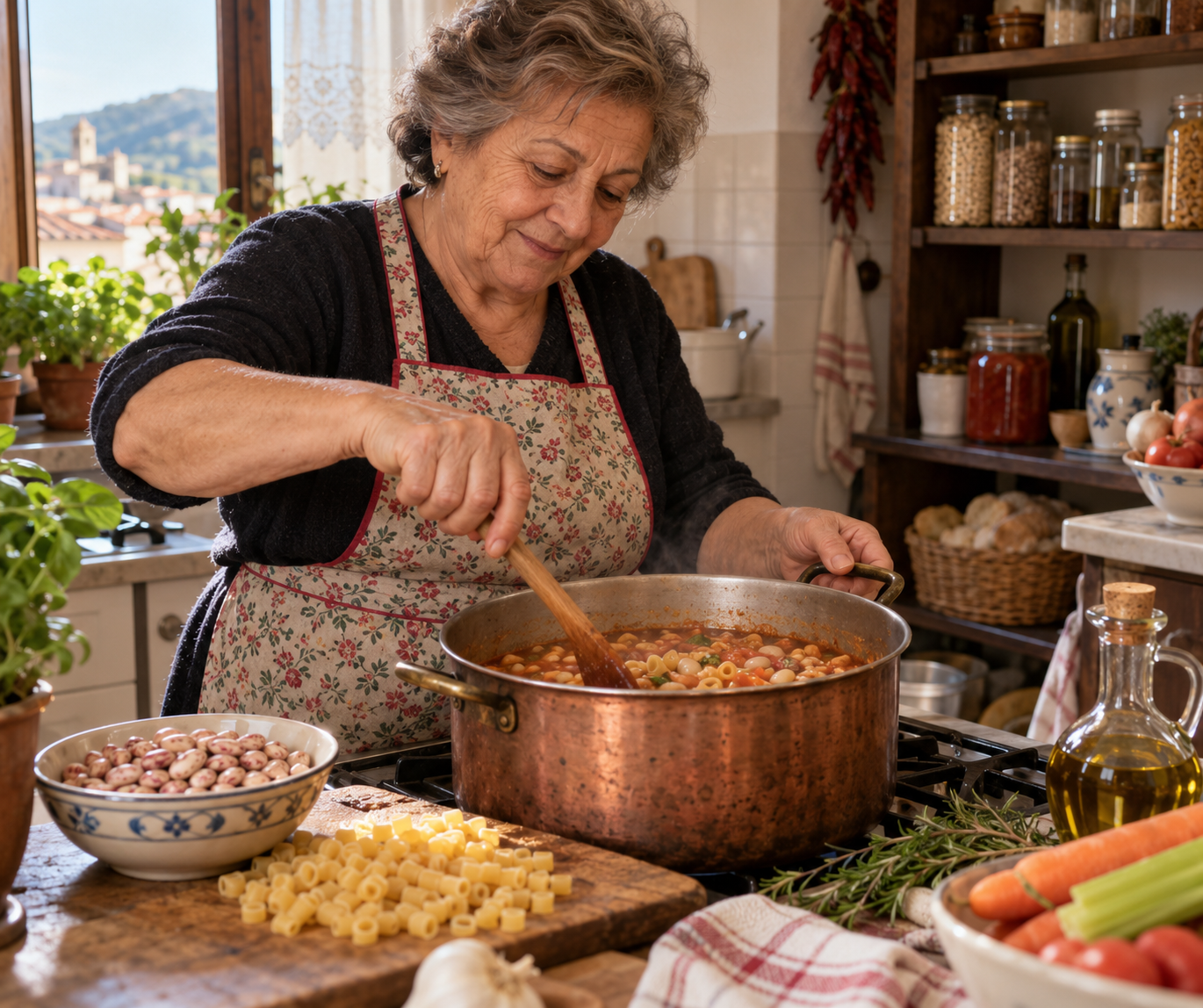
Here is a straightforward home version that honors the dish’s thrifty, forgiving spirit. It serves about four and welcomes improvisation based on what you have.
Ingredients
- 2 tablespoons olive oil, plus more to finish
- 1 onion, finely chopped
- 1 carrot, finely chopped
- 1 celery rib, finely chopped
- 2 to 3 garlic cloves, minced
- a handful of chopped pancetta, optional
- 2 tablespoons tomato paste (or a few chopped fresh or canned tomatoes)
- 2 cans borlotti or cannellini beans (or the equivalent cooked from dried), with their liquid
- a parmesan rind, if you have one
- 1 sprig rosemary
- about 4 cups water or broth
- 1 1/2 cups short pasta such as ditalini
- salt and pepper
- grated parmesan, to serve
Instructions
- Warm the olive oil in a heavy pot over medium-low heat and add the onion, carrot, and celery. Cook gently and patiently for about 10 minutes until soft and sweet, the soffritto that flavors everything.
- Stir in the garlic and the pancetta if using, cook another minute, then add the tomato paste or tomatoes and let it cook down for a couple of minutes.
- Add the beans with their liquid, the parmesan rind, the rosemary, and the water or broth. Bring to a gentle simmer and cook for 15 to 20 minutes so the flavors meld.
- For a creamier texture, scoop out a ladleful of beans and broth, blend or mash it, and stir it back in.
- Add the pasta to the pot and simmer until tender, stirring now and then so nothing sticks, adding a splash more water if it gets too thick.
- Fish out the parmesan rind and rosemary, season well with salt and plenty of black pepper, and serve each bowl with a drizzle of olive oil and a shower of grated parmesan. Toasted, garlic-rubbed bread is the perfect companion.

About the Author: Ruben, co-founder of Gamintraveler.com since 2014, is a seasoned traveler from Spain who has explored over 100 countries since 2009. Known for his extensive travel adventures across South America, Europe, the US, Australia, New Zealand, Asia, and Africa, Ruben combines his passion for adventurous yet sustainable living with his love for cycling, highlighted by his remarkable 5-month bicycle journey from Spain to Norway. He currently resides in Spain, where he continues sharing his travel experiences with his partner, Rachel, and their son, Han.