
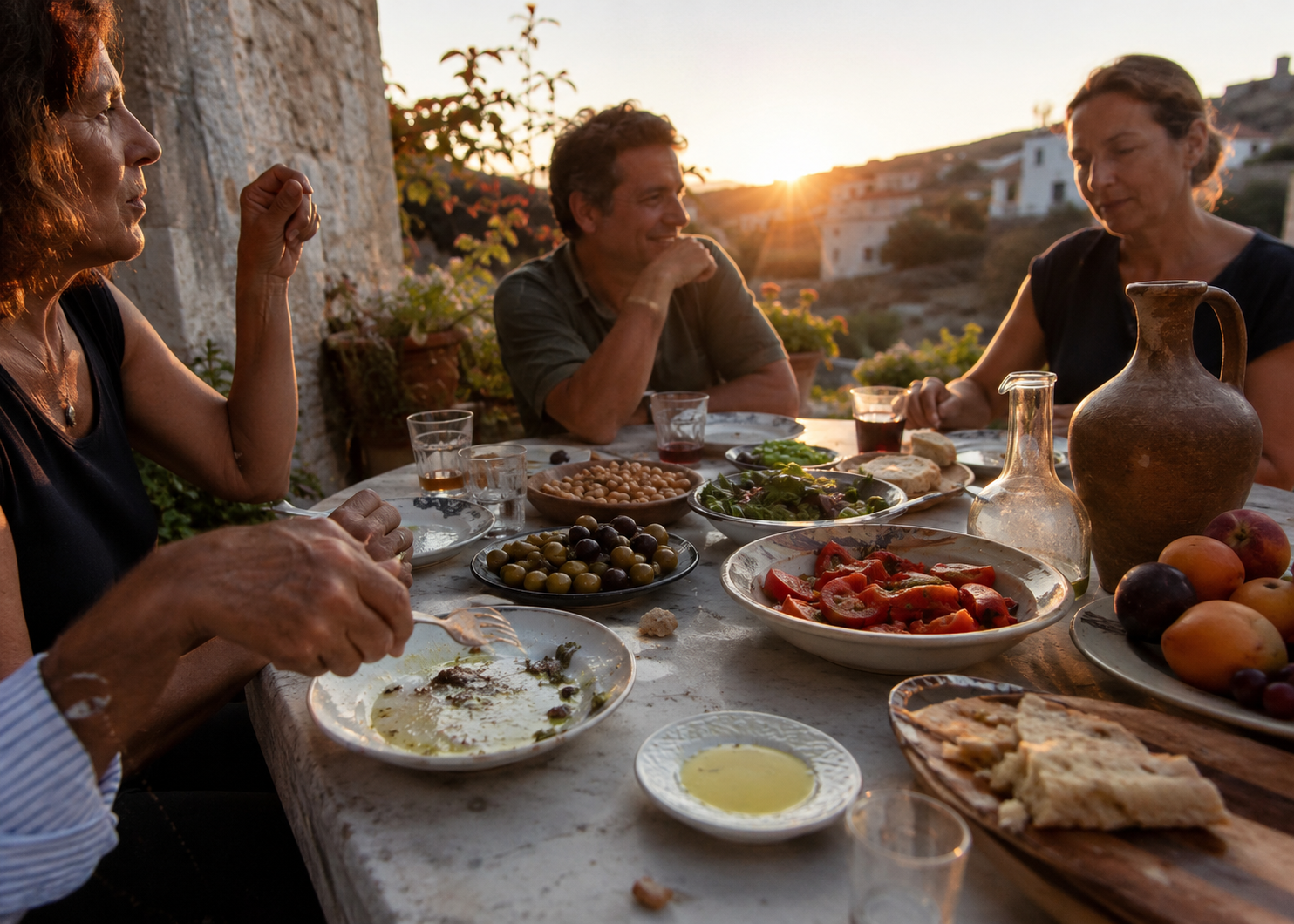
The first time many Americans are served a proper plate of food in Spain or Italy, a small disappointment flickers across their face. The plate looks underfilled. A modest piece of fish, a generous pile of greens dressed in oil, some good bread, and a lot of plain white china showing through. To an eye trained on the American dinner plate, where food is supposed to reach the rim and pile toward the center, it reads as not quite enough. Where is the rest of it?
There is no rest of it. That is the meal, and the empty space on the plate is not an oversight. It is, quietly, one of the reasons the people eating it tend to live longer than the people who find the plate too bare.
We had the same reaction when we first arrived, a quiet sense that lunch was somehow incomplete. It took a while to notice that we were never actually hungry afterward, and longer still to realize the plate had been right all along and our expectations were the thing that needed adjusting.
This is one of those differences that looks like less and is actually more. The European plate that strikes Americans as half-empty is arranged according to a completely different idea of what a plate is for, and that idea happens to be one of the most consistent predictors of a long, healthy life that researchers have ever found.
What Is Actually On The Plate
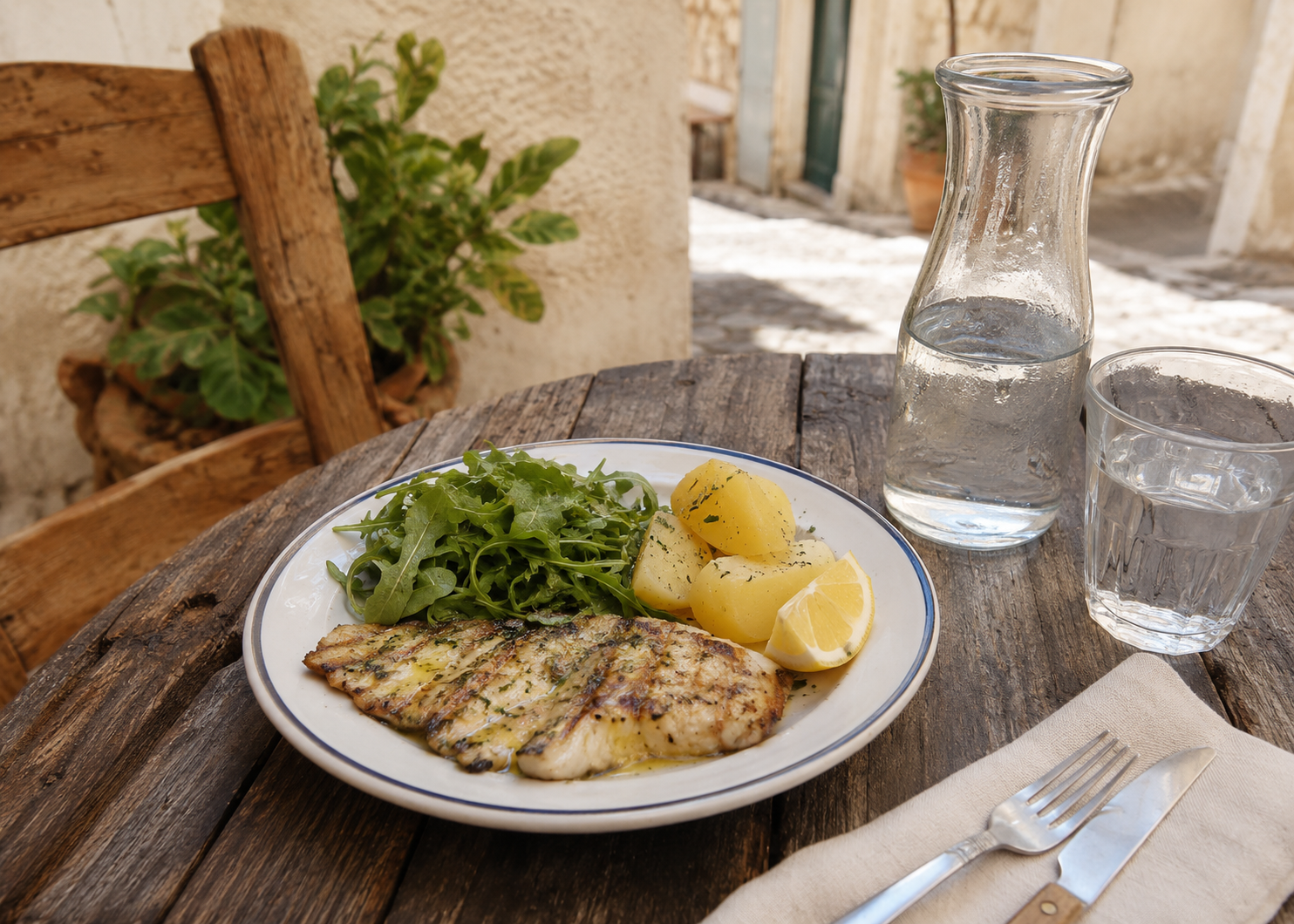
Start with what fills the European plate, because the composition matters more than the amount. The proportions are close to reversed from the American norm.
On a traditional Mediterranean plate, vegetables are the largest thing on it, often by a wide margin. Then come whole grains or good bread, beans or lentils, a real pour of olive oil, and finally a modest portion of fish, or a little meat, or some cheese, sitting off to the side as one element rather than the centerpiece. Fruit is dessert.
The American plate inverts that. A large piece of meat takes the center, a big mound of starch sits beside it, and vegetables, if they appear at all, are a small afterthought at the edge. Same plate, opposite priorities. The European version looks emptier because the two things that pile highest on an American plate, the slab of protein and the heap of starch, have been shrunk to make room for plants, and plants take up volume without piling up.
So the half-empty look is partly an illusion of arrangement. The plate is not holding less food so much as holding different food, spread out rather than stacked.
What A Real Plate Looks Like
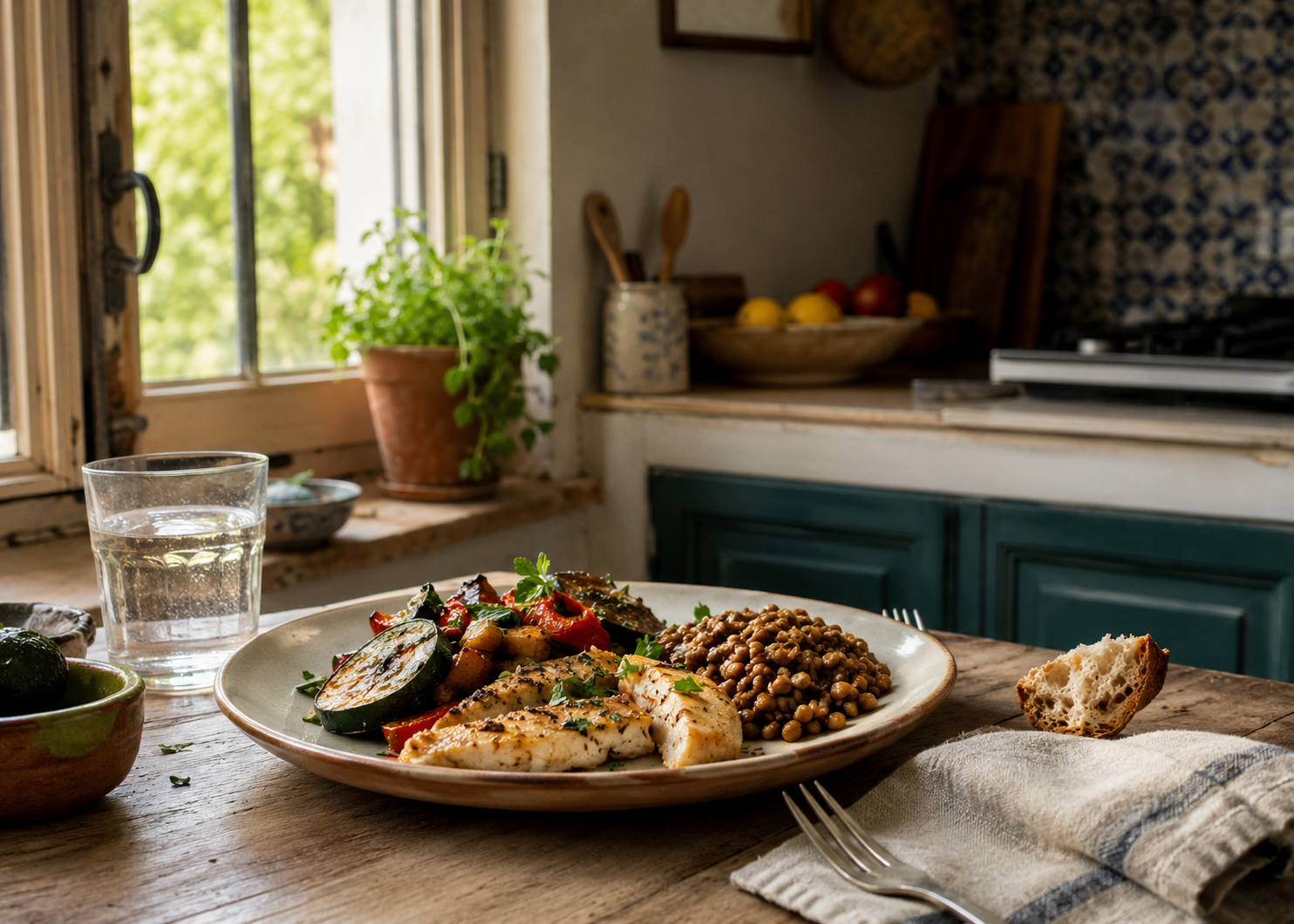
It helps to make this concrete, because “vegetables forward” is abstract until you see it on a table. Picture a typical Cretan or southern Spanish lunch.
There is a large dish of greens or a vegetable stew cooked slowly in olive oil, the oil pooling at the edges in a way an American might find alarming. There is bread, real bread, for dipping into it. There is a bowl of beans or lentils, or a salad heavy with tomato and onion and more oil. Off to one side, a piece of grilled fish or a little cheese, modest, not the thing the meal is built around. Fruit waits for after.
Add it up and the plate is full of food, plenty of it, but almost none of it is the meat-and-potatoes mass an American expects to anchor a dinner. The volume is there. It is just made of plants and oil and beans rather than a slab and a starch. That is the whole trick, and seeing it laid out makes the half-empty impression dissolve.
Half-Empty Is The Wrong Way To See It
The instinct to read the plate as lacking comes from a specific and fairly recent idea, that a meal should be dominated by a large portion of meat and a large portion of starch, with everything else optional. Measured against that, almost any traditional plate on earth looks sparse.
But the European plate is not a smaller version of the American one. It is a differently built thing. The space an American eye reads as missing food is space that a plate centered on vegetables and oil and legumes simply does not need to fill with a mountain of anything. The plate is not half-empty. It is correctly proportioned for a different and older idea of a meal.
That idea is not deprivation, and this is the part that surprises people most once they actually eat it. A plate built this way is satisfying. You get up from it full and content, not hungry an hour later, which is exactly the opposite of what “not enough food” would predict.
The Plate That Tracks With Long Life
Here is where the empty space stops being an aesthetic curiosity and starts being a longevity story, because this particular way of arranging a plate has been studied for seventy years and keeps producing the same result.
The modern science of the Mediterranean diet began in the 1950s and 60s with the Seven Countries Study, when researchers noticed that people on Crete and in southern Italy, eating exactly this kind of plant-forward, olive-oil-rich, meat-light plate, had strikingly low rates of heart disease and remarkable longevity despite being relatively poor. The emptier-looking plate was attached to some of the longest-living people in the world.
That early observation has held up through decades of much harder research. Large modern trials have found that people eating a Mediterranean-style diet, the one that produces the sparse-looking plate, have meaningfully lower rates of heart disease and other chronic illness. The pattern shows up again in the world’s longevity hotspots, where the oldest populations eat overwhelmingly plant-based, meat-light diets that would look thin on an American table. The plate that looks like not enough is one of the most reliably life-extending ways of eating that has ever been measured.
It Is The Pattern, Not A Magic Food
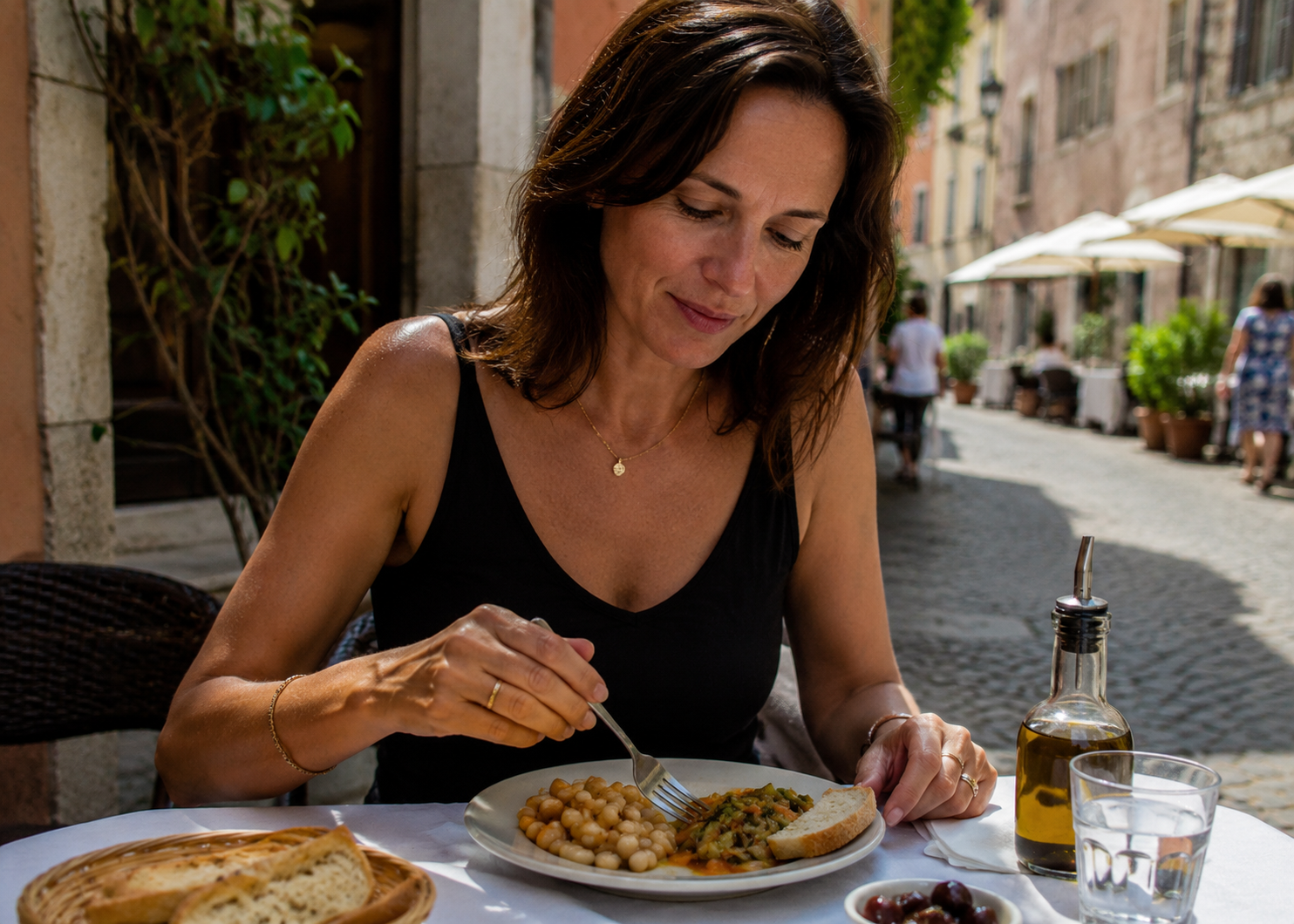
It is tempting to hunt for the single ingredient responsible, the olive oil, the tomatoes, the fish, and bottle it. That hunt misses the point, and it is worth being clear about why.
No one food on the European plate is doing the work. It is the whole composition that matters, the proportions themselves, plants dominant and animal foods modest, whole ingredients rather than processed ones, oil instead of butter, and a portion size that stops well short of stuffed. Pull out any single element and sell it as a supplement and the magic evaporates, because the magic was never in one item. It was in the arrangement.
This is why the longevity does not come in a pill and cannot be bought. The benefit lives in the shape of the plate, the ratio of plants to everything else, and that shape is a daily habit rather than a product. The emptier American plate looks the way it does precisely because the things that crowd a plate, the big protein and the big starch, are exactly the things this way of eating keeps modest.
The Bean Quietly Doing The Heavy Lifting
If you had to name the single food most associated with long life across the world’s longevity hotspots, it would not be a glamorous one. It would be the bean.
Legumes, the beans and lentils and chickpeas that sit so modestly on the Mediterranean plate, turn up at the center of nearly every long-lived population’s diet, and researchers studying those populations have pointed to them again and again as one of the strongest dietary predictors of a long life. They are cheap, filling, rich in fiber and protein, and eaten in real quantity by people who reach very old age in good health.
On the American plate, beans are a side dish at best, an afterthought, sometimes nothing at all. On the longevity plate they are a daily staple, often the protein the meal is built around. The humble legume is doing a quiet, enormous amount of the work, and it is exactly the kind of food the meat-centered plate pushes to the margins. The emptier-looking European plate has more room for it, and the people eating it are better off for the trade.
Why The Emptier Plate Still Fills You
The obvious worry about a plate that looks half-empty is that you will leave the table hungry. In practice the opposite happens, and the reason is straightforward.
A plate heavy on vegetables, beans, whole grains, and olive oil is full of fiber and water and slow-digesting food, the things that actually produce lasting fullness. It fills the stomach and then keeps you satisfied for hours, without the calorie density of a meat-and-starch pile. You can eat until genuinely full off the emptier-looking plate and still take in less than you would from the fuller one, because plants deliver satisfaction per bite without the same load.
The protein worry that the plate provokes in Americans is mostly misplaced too. Between the beans, the whole grains, the modest fish or cheese, and the smaller piece of meat, the European plate delivers plenty of protein for a healthy adult. The panic about needing a large slab of meat at every meal is a fairly recent and fairly local anxiety, and the longest-living populations on earth simply do not share it.
The American plate, by contrast, is calorie-dense and fiber-light, which is a combination that paradoxically leaves you hungry again sooner. More food on the plate, less staying power. The European plate looks like less and behaves like more, holding you over to the next meal in a way the heaped plate often fails to do.
Why The American Plate Got So Full
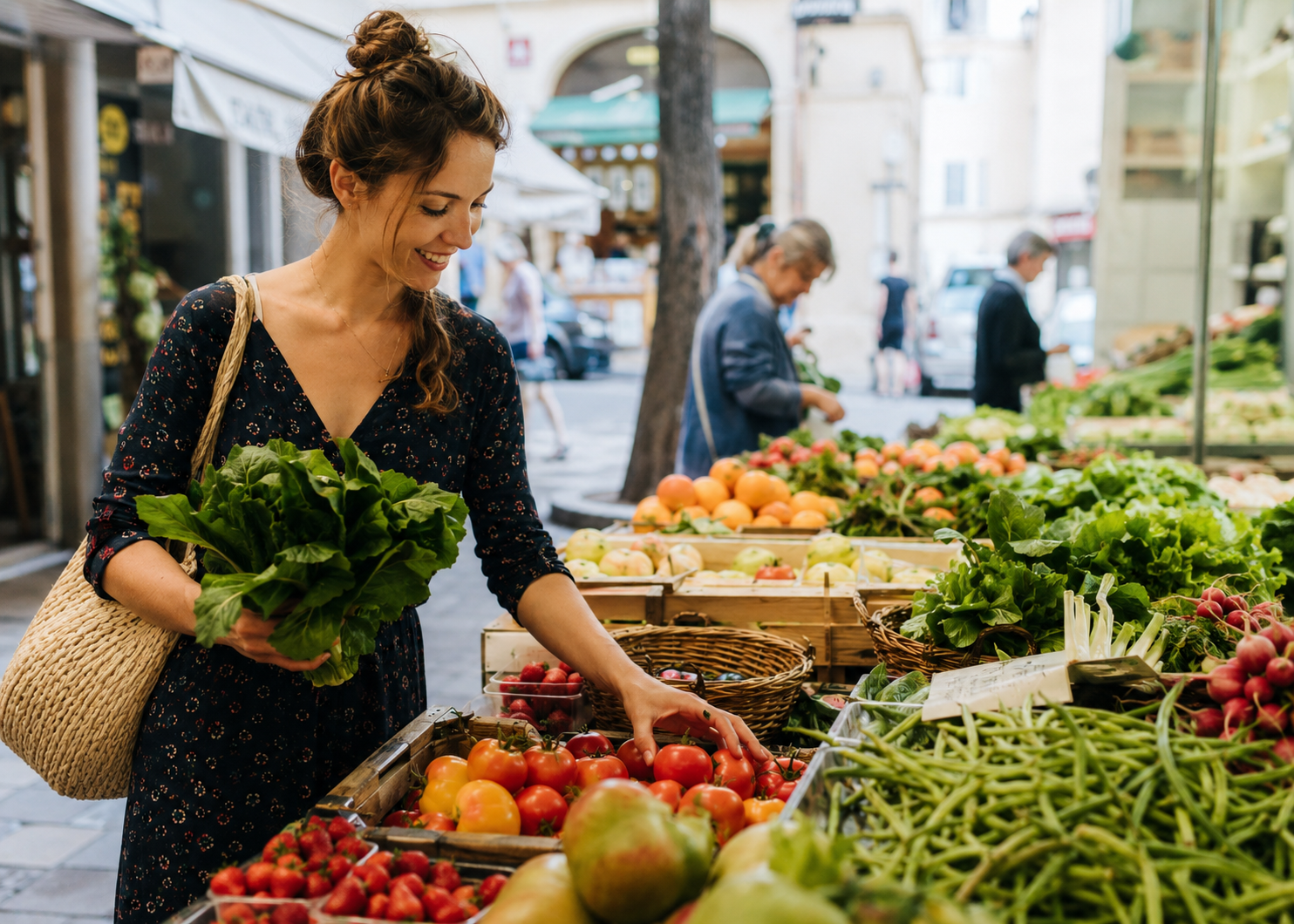
It is worth understanding how the American plate came to be piled the way it is, because it was not always so, and the change was not driven by appetite.
The meat-centered, starch-heavy, fill-the-plate dinner is partly a story of abundance and marketing. Cheap, plentiful meat became a symbol of prosperity, a full plate became a sign of a good provider and good value, and the restaurant industry learned that heaping portions sell. A plate that reached the rim signaled generosity, and over decades the rim crept outward. The vegetables got crowded to the edge not because anyone decided they mattered less, but because the protein and the starch were what abundance was measured in.
None of that was about health, and none of it tracked what actually keeps a body well over decades. The full American plate is a monument to abundance, not a design for a long life, and the two turned out to point in different directions.
What Actually Travels
You cannot move to a Greek island, and you do not need to. The useful part of the European plate is portable, and it is mostly about proportion rather than any specific recipe.
The shift is simple to describe and harder to do, which is to rebuild the plate so plants take the center and the meat moves to the side. Make the vegetables the largest thing, let beans and whole grains and good oil do real work, and treat the piece of meat or fish as one element rather than the main event. The plate will end up looking a little emptier, in the European way, and that emptier look is the visible sign you have got the proportions right.
None of that requires exotic ingredients or a diet plan. It is a change in the geometry of the plate, the same foods most people already have access to, simply arranged the way the longest-living populations on earth arrange them. The half-empty plate is not a sacrifice. It is the proportions that happen to come with a longer life, and they translate to any kitchen willing to move the meat off center.
The Space On The Plate
So the next time a plate arrives looking sparse to you in some Mediterranean kitchen, resist the reflex to see it as too little. That open space is not missing food. It is the room a culture leaves for vegetables and oil and beans instead of filling every inch with protein and starch, and it is the single most visible feature of the way of eating most consistently tied to a long life.
The American plate was built to look generous, and it succeeded, reaching the rim with all the things abundance is measured in. The European plate was built, mostly by accident and tradition, to keep people well into old age, and it succeeded at that. One plate fills the eye. The other adds the years. That is the quiet joke buried in it. The plate built to look like the least is the one delivering the most, and the plate built to look generous is the one quietly taking years off at the far end. When you understand which is which, the half-empty plate stops looking like less and starts looking like exactly enough.

About the Author: Ruben, co-founder of Gamintraveler.com since 2014, is a seasoned traveler from Spain who has explored over 100 countries since 2009. Known for his extensive travel adventures across South America, Europe, the US, Australia, New Zealand, Asia, and Africa, Ruben combines his passion for adventurous yet sustainable living with his love for cycling, highlighted by his remarkable 5-month bicycle journey from Spain to Norway. He currently resides in Spain, where he continues sharing his travel experiences with his partner, Rachel, and their son, Han.