

An American arrives at a beach on the Spanish coast, ready for a swim, and goes looking for somewhere to change. There is no changing room. There is no cabin, no stall, no building of any kind. Just sand, sea, and hundreds of people who have somehow all managed to get into their swimwear without one. Standing there in street clothes, the visitor realises they are missing a basic skill that everyone around them clearly possesses.
Across Europe, changing into and out of a swimsuit in the open air, with nothing but a towel for cover, is an ordinary, unremarkable competence. Europeans learn it young and do it without fuss. Americans, raised on beaches and pools stocked with changing rooms, frequently never learn it at all, and it shows the moment they land somewhere that expects them to manage on their own. The good news is that the technique is simple, and anyone can pick it up.
No Changing Rooms Here
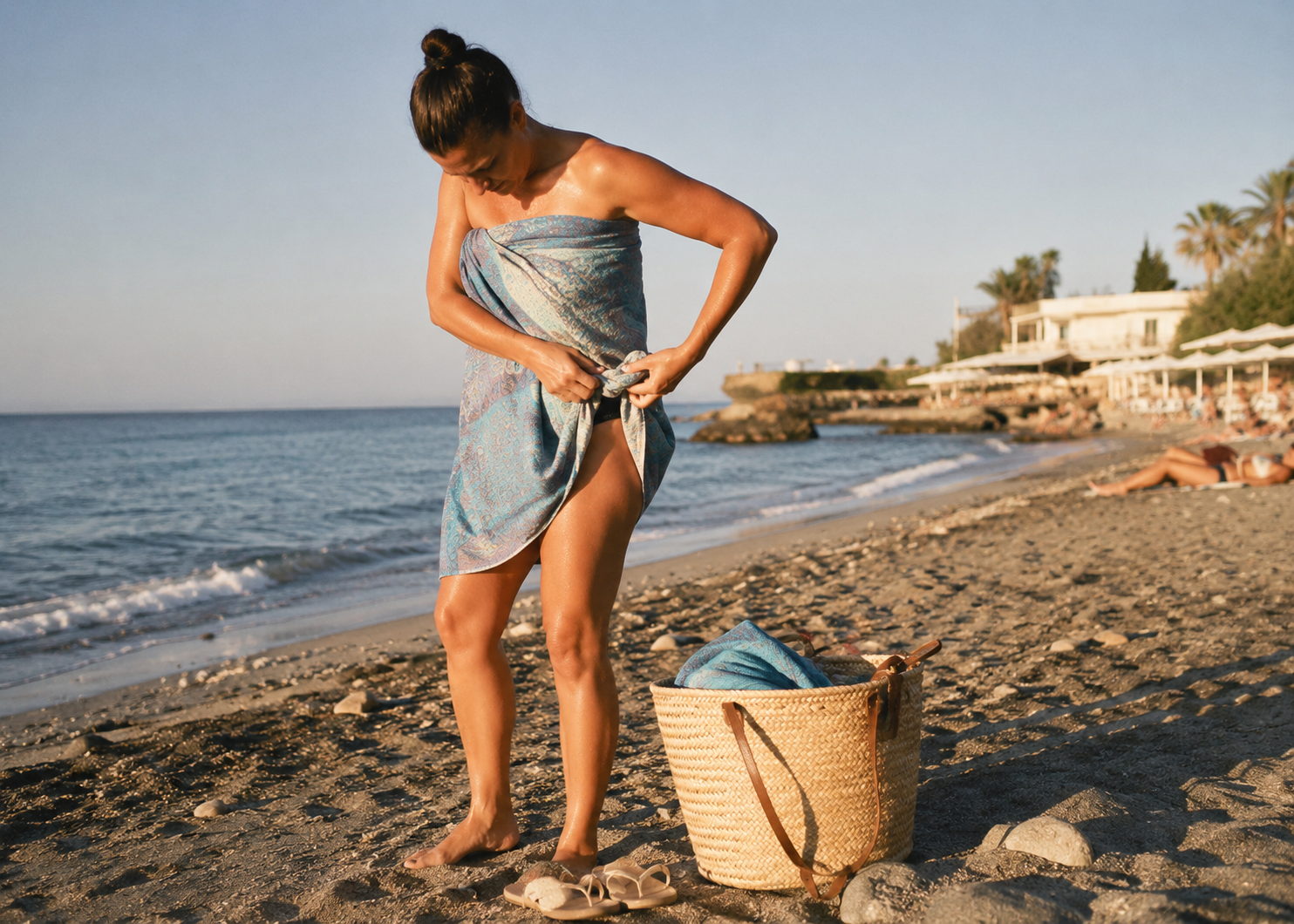
The first thing to understand is that the absence of changing facilities is the norm, not an oversight. Many European beaches, especially the smaller and more local ones, simply do not provide changing rooms, and even the larger ones often have very few. The expectation is that you will change yourself, discreetly, wherever you have laid your towel.
This catches Americans off guard because American beach and pool culture is built around dedicated changing spaces. Public pools have locker rooms, beaches have bathhouses, and the assumption is that getting changed happens indoors, in private, behind a door. Arriving at a European beach with that assumption baked in, a visitor can spend a frustrating few minutes searching for a facility that was never going to be there.
Once you accept that changing in the open is simply how it works, the problem shifts from where do I change to how do I change, and that is a far more solvable question. The locals are not exhibitionists and they are not uncomfortable; they have simply mastered a small piece of practical technique that turns a towel into a portable, private changing space. Learning that technique is the entire task, and it is not a hard one.
It is worth adding that this is not about European beaches being underfunded or basic. Even well-appointed, popular beaches often skip changing rooms, because the local expectation simply does not demand them. Why build and maintain cabins for a task everyone can accomplish with a towel in ninety seconds? The absence reflects a shared competence, not a lack of investment, and once you share the competence it stops looking like a gap at all.
The Towel Wrap, Step by Step
At the heart of it is the towel wrap, and doing it well comes down to a secure hold rather than acrobatics. The principle is to wrap a large towel around yourself, fasten it so it stays up on its own, and then change underneath it, all without ever exposing anything you would rather not.
For the lower half, the method is straightforward. Wrap the towel around your waist, high and snug, and secure it by rolling the top edge down over itself a couple of times, or by twisting and tucking the corner firmly into the waistband you have created. Done properly, this holds without hands, freeing both of yours to slide your swimsuit up underneath and your street clothes down and off. The trick is a tight, rolled band at the top; a loosely held towel is what leads to the frantic grabbing that gives the whole enterprise a bad name.
For changing a top half, or for more coverage, the same logic applies higher up, wrapping and tucking the towel under the arms across the chest. Many people combine steps, keeping a shirt on until the bottom half is sorted, then dealing with the top. The single biggest improvement most people can make is preparation: wearing your swimsuit under your clothes on the way to the beach, so that arriving only requires removing the outer layer, and doing the full change only on the way home when you are wet. That halves the problem before you start.
The Poncho and the Changing Robe

For those who want to remove the skill and luck from the equation entirely, there is an upgrade that has swept European beaches in recent years: the changing robe, also called a surf poncho or towelling poncho. It is the reliable, foolproof version of the towel wrap, and it is worth knowing about.
A changing robe is essentially an oversized, hooded poncho that you pull over your head, draping from your shoulders to below your knees. Underneath it you have a fully enclosed private space in which to peel off wet swimwear and pull on dry clothes, with no balancing, tucking, or anxiety involved. The design comes from surfers, who needed to wrestle out of wetsuits in exposed car parks without treating the neighbourhood to a show, and it has crossed over to ordinary beachgoers, swimmers, and open-water enthusiasts. A decent towelling one costs roughly forty to sixty dollars, around forty to fifty-five euros, and doubles as a towel and a warm layer.
For a nervous first-timer, the poncho is the great confidence-builder, delivering total coverage without requiring any technique at all. For the minimalist, the classic towel wrap remains free and packs smaller. Either way, the point is the same: a single piece of cloth, used correctly, becomes your changing room, and once you have one method you trust, the whole business of open-air changing stops being intimidating and becomes automatic.
Other Methods, Ranked
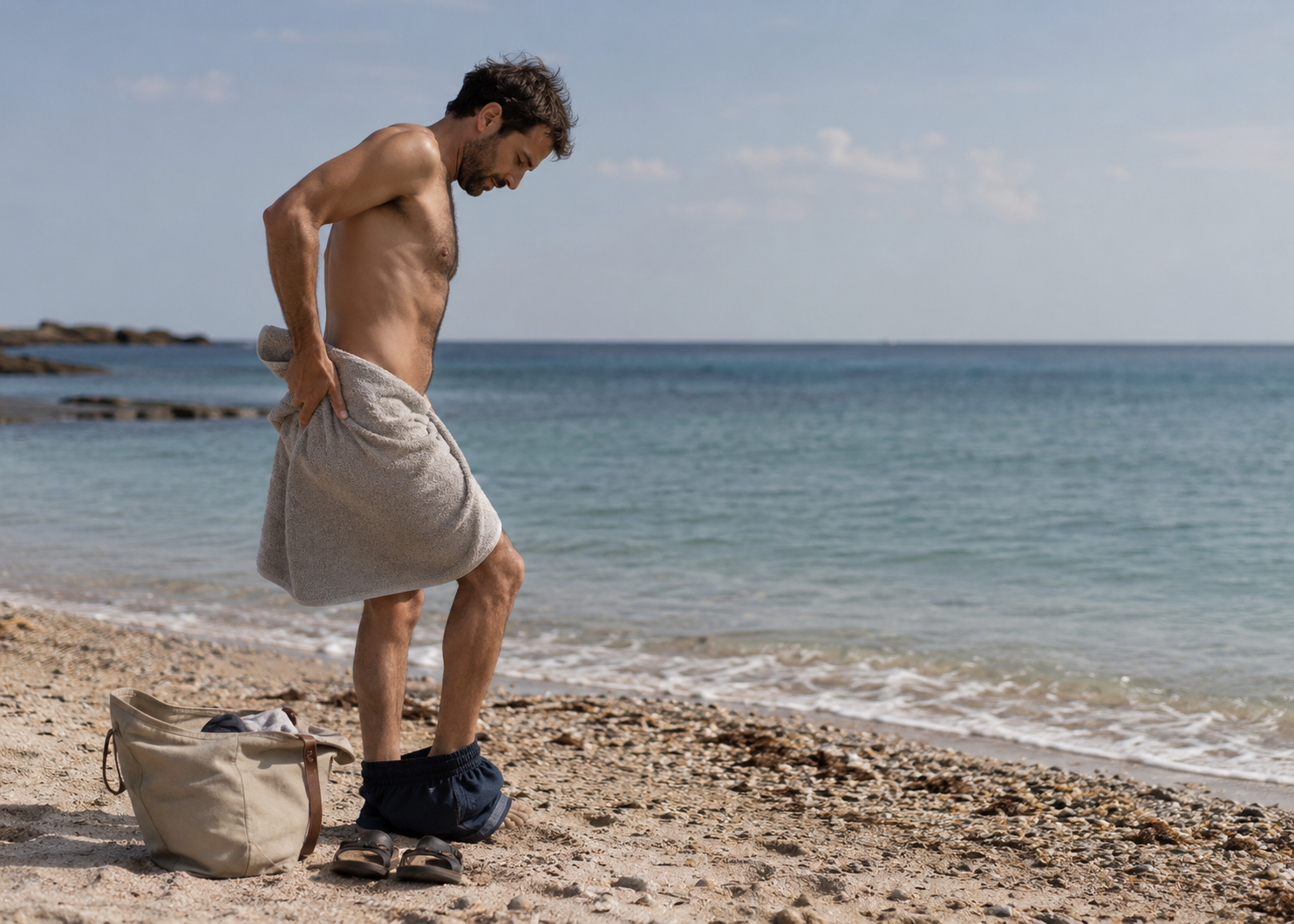
The towel wrap and the poncho are the two best options, but they are not the only ones, and it helps to know the alternatives, if only to know which to avoid. Beachgoers have improvised many ways to change in the open, and they vary a lot in how well they work.
The two-towel method uses one towel around the waist and a second for extra coverage or as a backup, giving more security than a single towel at the cost of carrying more. The towel-clip approach adds clips, pegs, or a towel with a built-in fastening to hold the wrap in place, which removes the risk of it dropping but limits how freely you can move underneath. Then there are the methods best skipped: the old manoeuvre of changing behind an open car door leaves you exposed from several angles depending on where you have parked, and hoping a passing crowd will screen you is a gamble that tends not to pay off.
The common thread among the good methods is that they secure the cover so your hands are free, and the common flaw among the bad ones is that they rely on luck or leave gaps. Whichever you choose, the aim is the same: a reliable enclosure you do not have to hold, so that changing becomes a calm two-handed task rather than a one-handed scramble. Get that principle right and the specific method barely matters.
Why Americans Struggle With It
It is worth being clear about why this trips up Americans specifically, because it is not a matter of nerve or modesty so much as simple lack of practice. Americans struggle with open-air changing because their beach and pool culture never required them to learn it. When there is always a changing room, you never develop the towel skill.
The result is what might be called the towel dance, the visibly awkward routine of a person who has not done this before: the towel held desperately in one hand while the other fumbles with a swimsuit, the constant near-slips, the anxious glances around to see who is watching. It is stressful precisely because it is improvised, an attempt to solve on the spot a problem that Europeans solved once, years ago, and never think about again. Surveys of beachgoers find that the towel-wrap method is a frequent source of stress and occasional embarrassment for those who rely on it without having practised it.
None of this is a character flaw; it is just an unlearned skill, and skills can be learned. The American who spends five minutes understanding the tuck, or who simply buys a poncho, immediately closes the gap. The awkwardness comes entirely from improvising under pressure, and it disappears the moment you arrive with a method already in hand. The locals are not more graceful; they are just more practised, and practice is available to anyone willing to try.
It is a little like parallel parking or riding a bike. The first attempts are graceless and self-conscious, every motion overthought, and then at some point the body simply learns the sequence and it becomes invisible. Europeans crossed that threshold long ago and have no memory of it being hard. An adult learning it fresh has a slightly steeper first day, but the same easy competence waits on the other side of a few tries.
The Casual European Attitude
Underpinning the technique is an attitude, and it is the attitude as much as the method that makes the whole thing work smoothly. Europeans change on the beach casually, matter-of-factly, and above all discreetly, treating it as the minor logistical task it is rather than a fraught public performance.
The key insight is that nobody is watching. On a European beach, a person changing under a towel is one of the least interesting things happening; everyone has done it a thousand times, and the sight of someone managing their swimwear draws no attention whatsoever. The anxiety that makes the towel dance so stressful is largely self-generated, a fear of an audience that does not actually exist. Once you internalise that your quiet, competent change is completely unremarkable to everyone around you, the pressure evaporates.
This relaxed, practical attitude toward the body and its ordinary business is a thread that runs through a lot of European life, from the beach to the pool to the changing room. It is not about exhibitionism; it is about a lack of drama. Bodies get changed, discreetly and efficiently, and then everyone gets on with their day. Adopting a little of that calm is half the skill, because a person who is not panicking makes a far neater job of the towel than one who is.
Getting It Right
Pulling it together, a handful of practical habits make open-air changing effortless, and they are worth committing to memory before your next beach trip. None is complicated, and together they eliminate almost all the awkwardness that catches visitors out.
Bring a large towel, not a small one, because coverage is everything and a skimpy towel is the root of most mishaps. Wear your swimsuit under your clothes on the way there, so arriving needs no real change at all. When you do change, roll and tuck the towel into a firm band so it holds itself up, keep your movements small and unhurried, and turn slightly away from the busiest sightlines out of ordinary courtesy rather than fear. If any of this makes you uneasy, buy a changing poncho and skip the technique entirely; it is the surest route to total ease. And remember that a swim followed by drying off in the sun before dressing can sometimes let you avoid a second full change altogether.
The overarching principle is to arrive prepared rather than improvise on the sand. The difference between the flustered visitor and the serene local is not talent but readiness: a big towel, a swimsuit worn underneath, a tuck that holds, and the knowledge that nobody cares. Get those right and you will change on any beach in the world without a second thought, which is exactly what the people around you have been doing all along.
Beyond the Beach

The reason this small skill is worth acquiring is that it serves far beyond a single beach day. The same towel technique, and the same relaxed attitude, applies at outdoor pools, at lakes, at rivers, at swimming spots and festivals and campsites all over Europe and well beyond it. Anywhere without a changing room, the competence pays off.
For a traveller, this turns a recurring minor stress into a non-event. Instead of planning around where you might find somewhere to change, or skipping a spontaneous swim because you are not dressed for it, you simply change wherever you are, quickly and privately, and get in the water. That freedom is genuinely useful, opening up impromptu swims and out-of-the-way spots that would otherwise be off-limits to someone dependent on facilities.
It is also, quietly, a small act of cultural fluency. Changing competently on a European beach is a marker of the traveller who has adapted rather than the tourist who is still fighting the local way of doing things. Like ordering coffee at the bar or asking for tap water, it is one of those tiny competences that makes moving through a place feel smoother and more natural. The towel is not just cloth. Used well, it is a portable piece of independence.
The Skill Worth Packing
In the end, the missing changing room is not a problem to be solved but a habit to be learned, and it is one of the easiest pieces of travel competence to pick up. A large towel, a firm tuck, a swimsuit worn underneath, and a calm understanding that nobody is watching are the whole of it, and together they turn the intimidating open beach into just another place to get changed.
For the American used to stalls and locker rooms, the shift is small but liberating. Once the towel technique is in hand, or a poncho is in the bag, the anxiety that once attended every open-air change simply vanishes, replaced by the easy competence that the locals have always had. It stops being something to dread and becomes something you do without thinking.
So the next time a European beach offers sand and sea but no changing room, there is no need to stand there dismayed. Wrap the towel, tuck it tight, change underneath with unhurried calm, and walk into the water like you have done it a hundred times. A few tries in, you will have, and one of the small friction points of travel will have quietly disappeared for good.

About the Author: Ruben, co-founder of Gamintraveler.com since 2014, is a seasoned traveler from Spain who has explored over 100 countries since 2009. Known for his extensive travel adventures across South America, Europe, the US, Australia, New Zealand, Asia, and Africa, Ruben combines his passion for adventurous yet sustainable living with his love for cycling, highlighted by his remarkable 5-month bicycle journey from Spain to Norway. He currently resides in Spain, where he continues sharing his travel experiences with his partner, Rachel, and their son, Han.