
An American rents an apartment in Madrid or Rome or Berlin, throws open the window on the first warm evening, and stops short. There is nothing there. No screen, no mesh, no barrier of any kind between the room and the open air, just a window that swings wide onto the street. For a person raised in a country where every window and door wears a screen as a matter of course, it is a small but genuine shock, and it produces the same question every time. How on earth do you keep the flies out?
It is one of the most persistent puzzles for Americans in Europe, aired endlessly on expat forums and in bewildered messages home. Window screens, so ordinary in the United States that nobody thinks about them, are simply absent from a huge share of European homes, and their absence reveals a surprising amount about how differently the two continents have learned to live with heat, light and insects.
Here is why European windows so often have no screens, how Europeans really keep the bugs at bay, and why the answer is quietly starting to change.
A Question of Climate and History

The deepest reason is climate. Much of Europe, and especially its northern half, is cooler and less buggy than most of the United States, with shorter, milder summers and far smaller populations of the flying insects that plague American porches. Where mosquitoes and flies were never a major daily nuisance, no tradition of screening windows ever took hold, because there was little to screen against.
The United States, by contrast, spans a continent full of hot, humid, insect-rich summers, from the mosquito clouds of the South to the blackflies of the North. American window screens are a response to a markedly buggier place, an adaptation so old and so universal that Americans stopped seeing it as an adaptation at all and began to assume it was simply how windows worked everywhere.
Europe’s housing stock reflects this history. Enormous numbers of European homes are old, built long before modern insect screening existed, and designed for a climate where you could open a window on a summer evening without much consequence. The habits and the architecture both formed around an insect problem far milder than the American one, and neither ever saw a reason to change.
The result is a continent where the screen never became a default, not because Europeans failed to think of it, but because for most of their history they did not particularly need it. What looks to an American like a baffling omission is really just the mark of a different and, in insect terms, gentler environment.
The geography of biting insects makes the point. Large stretches of the American South and Midwest sit in a warm, humid belt that breeds mosquitoes in vast numbers for half the year, while much of Europe, sitting further north than most Americans realize, has historically had a short mosquito season and a mild one. Spain and Italy run buggier than Britain or Germany, but even they long stayed below the American threshold at which a household simply had to screen its windows to be livable.
The Shutter Does the Screen’s Job

Where Americans reached for the screen, Europeans reached for the shutter, and the shutter turns out to do much of the same work in a different way. Across southern Europe especially, nearly every window is fitted with exterior shutters, the roller persianas of Spain or the louvered shutters of France and Italy, and these are the real climate-control system of the European home.
Shutters do several jobs at once. Rolled or closed during the fierce afternoon, they keep the sun and the heat out, cooling the house far more effectively than a screen ever could, which matters enormously in a place without widespread air conditioning. Closed at night, they also seal the room against the outside, insects included, so a European does not leave a screened window open all night the way an American might, but instead closes the shutters and the window together.
This is the crucial difference in habit. The American approach is to leave windows open behind screens, letting air flow through the house at all hours while the mesh holds the bugs back. The European approach is to open the windows wide when the air is cool and the insects are few, then close everything up when the heat or the mosquitoes arrive. The shutter, not the screen, is what makes that rhythm work.
Seen this way, the missing screen is not a gap in the system but evidence of a different system entirely, one built around opening and closing rather than around a permanent barrier. It is a genuinely different philosophy of living with the outdoors, and once you understand it, the European window stops looking unfinished.
The Spanish persiana shows how complete the shutter’s control can be. Built into a housing above the window, it rolls down on a strap or a crank into a solid slatted curtain that can be lowered fully for total darkness, cracked partway for filtered light and airflow, or raised entirely, all from inside the room. A well-shuttered Spanish bedroom can be turned pitch black and several degrees cooler in seconds on a blazing afternoon, which is a trick no American screen has ever managed, and it explains why the shutter, not the screen, is the fixture Spaniards would never give up.
Windows That Open the Wrong Way
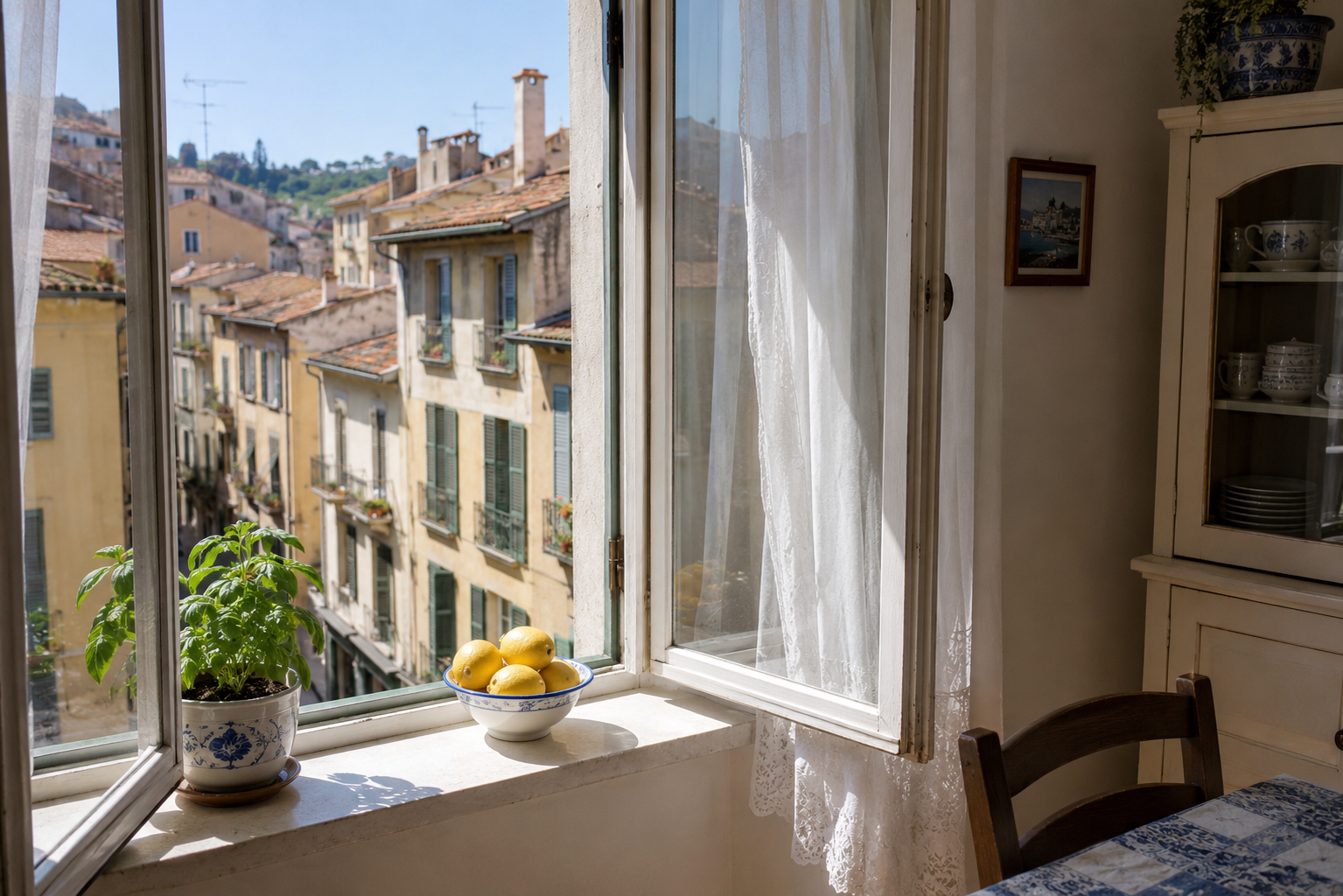
There is also a simple mechanical reason screens are rarer in Europe, which is that European windows are built differently and do not take a screen easily. The classic American window is a double-hung sash that slides up and down, leaving a flat outer opening onto which a screen fits neatly and permanently, on the outside, out of the way.
European windows tend to open inward, swinging into the room on a hinge or tilting in from the top in the clever tilt-and-turn design common across the continent. A window that opens inward cannot take a fixed interior screen, because the opening sash would collide with it, so screening such a window requires an exterior or roller-mounted screen, which is a more complicated and more expensive proposition than the American clip-in mesh.
Aesthetics reinforce the practical obstacle. Europeans often regard screens as unattractive, a grey haze over a clean window that spoils the view and dims the light, and in older or historic buildings the objection is stronger still, since a mesh screen looks out of place on a centuries-old facade. Between a window design that resists screens and a taste that dislikes them, the screen faced two headwinds that kept it from ever becoming standard.
None of this is insurmountable, and screens for inward-opening windows certainly exist. But the friction was always higher in Europe than in America, and higher friction, applied to a problem that was already smaller, was enough to keep the screen from spreading the way it did across the Atlantic.
The House Built to Breathe
The missing screen makes more sense once you see it as one piece of a much larger difference in how European and American homes handle summer. The American home is built to be sealed and cooled, with central air conditioning humming away and the windows shut tight against the heat, the whole house held at a steady temperature behind screens and insulation. The traditional European home does almost the opposite.
Across most of Europe, central air conditioning is far from standard, especially in older housing, and homes stay cool instead through their design and their daily handling. Thick masonry or stone walls hold the night’s coolness deep into the day, small windows and high ceilings limit the heat that gets in, and the shutters do the rest, closed against the sun through the afternoon and opened to the cool of the evening. The house is kept comfortable by working it rather than by running a machine.
That handling extends to the air itself. Germans even have a word for it, Stoßlüften, or shock-airing, the practice of throwing the windows wide for a few concentrated minutes to flush the stale air out and the fresh air in, then closing them again. It is the opposite of the American habit of leaving screened windows cracked all day, and it is one more reason a permanent screen never seemed necessary, since the windows are only ever meant to be open in short, controlled bursts.
In a home run on this logic, the screen simply does not fit the plan. You are not trying to hold a window open against the world for hours on end, you are opening and closing it deliberately, in step with the temperature and the light and the insects. The whole rhythm of the European summer home is built around that active handling of the boundary, and the screenless window is only the most visible sign of it.
How Europeans Keep the Bugs Out

So how do Europeans manage without the screens Americans consider essential? The plain first answer is that in much of Europe, they simply tolerate a few insects, accepting the odd fly indoors as a minor fact of summer rather than a crisis to be engineered away. A lower insect load makes that tolerance far easier than it would be in a Louisiana August.
Where mosquitoes are a real problem, as they increasingly are around the Mediterranean, the tool of choice is the plug-in repellent, the little electric vaporizer that sits in a wall socket and quietly diffuses insecticide through the room all night. These plug-ins are a fixture of southern European bedrooms in summer, doing the job the screen does but chemically rather than physically, and most households keep a few running through the hot months.
The shutters play their part again here, closed at dusk exactly when the mosquitoes come out, sealing the bedroom before the biting begins. Ceiling fans help too, since mosquitoes struggle to fly in moving air, and many people simply time their open windows to the cool, insect-free parts of the day. Northern Europeans, meanwhile, lean on a habit of brief, vigorous airing, flinging the windows wide for a few minutes to change the air rather than leaving them open for hours, which limits the chance for anything to fly in.
Taken together, these habits add up to a real and workable defense, just a different one from the American mesh. It relies on closing up, timing and a plug-in socket rather than on a permanent screen, and for the climate most of Europe has historically had, it has been more than enough.
The Screens Are Coming
The picture is changing, though, faster than tradition tends to allow. Europe’s summers are growing hotter and longer, and with them the season and the range of the insects. Most strikingly, the tiger mosquito, an aggressive daytime biter that spreads readily and can carry disease, has established itself across large parts of southern Europe over the past two decades, arriving in places that never had a serious mosquito problem before.
As the insects have advanced, the screen has begun its long-delayed spread. In Spain, Italy, and the south of France, retrofitted mosquiteras, roller screens and fixed frames and simple magnetic mesh panels, are now sold everywhere and installed in growing numbers, especially in newer buildings and homes near water. What was once an oddity is becoming, in the buggier parts of the continent, an increasingly sensible upgrade.
The tiger mosquito, known to scientists as Aedes albopictus, is the clearest driver of the change. Unlike the native mosquitoes that come out mainly at dusk, it bites aggressively through the day, breeds in the smallest puddle of standing water, and has spread up through Spain, Italy, and southern France with startling speed since arriving in Europe. Its daytime biting defeats the old defense of closing the shutters at nightfall, which is precisely why households that never bothered with screens are now fitting them, since the shutter alone no longer keeps this particular pest out.
The change is uneven, as such things always are. Northern Europe, still relatively insect-light, feels little pressure to adopt screens, while the Mediterranean, facing more mosquitoes and hotter nights than ever, is warming to them quickly. A visitor today will still find plenty of screenless windows, but the trend line points toward more screens over time, not fewer, as the climate that made them unnecessary slowly disappears.
So the American who arrives baffled by the missing screens has, in a sense, arrived at a moment of transition. The old European way, built on shutters and tolerance and a gentler bug season, is meeting a new reality that looks a little more American, and the humble window screen is quietly making its way across a continent that managed without it for a very long time.
The Real Answer to the Fly Question

When an American finally asks a European how they keep the flies out without screens, the honest answer is a small lesson in cultural difference. They keep them out by closing the shutters, by plugging in a vaporizer, by opening windows only when the air is cool, and, more than an American finds comfortable, by simply not minding a fly or two. It is a different relationship with the outdoors, less sealed and engineered, more a matter of managing the boundary by hand, window by window, as the day and the weather change.
That difference is really what the missing screen is about. American homes are built to hold the outside firmly at bay, climate-controlled and screened and closed against the elements, while European homes, especially older ones, are built to be opened and closed in rhythm with the day, working with the weather rather than sealing it out. Neither is wrong, and each suits the place and the history it grew from.
So the next time you open a European window onto the open air and feel that flicker of alarm, know that you are looking at a whole different way of living with summer. The screen is not missing so much as never needed, replaced by a shutter, a plug, and a certain relaxed tolerance that the rest of us, insect by insect, might even learn from, one open window at a time.

About the Author: Ruben, co-founder of Gamintraveler.com since 2014, is a seasoned traveler from Spain who has explored over 100 countries since 2009. Known for his extensive travel adventures across South America, Europe, the US, Australia, New Zealand, Asia, and Africa, Ruben combines his passion for adventurous yet sustainable living with his love for cycling, highlighted by his remarkable 5-month bicycle journey from Spain to Norway. He currently resides in Spain, where he continues sharing his travel experiences with his partner, Rachel, and their son, Han.