

We’re planning a trip to Japan right now — and I thought I’d take you along for the part first-timers find most confusing: booking the transport.
Here’s what makes this the moment to write it down. Omio has been our most trusted booking site for years — we’ve leaned on it hard across Europe, from Madrid to Barcelona to Milan down to Sicily, and we’ve used it on past trips through Asia too — and as of 2026, it finally covers Japan. So the tool we already reach for on instinct now works in the one country where a first-timer needs it most. Japan is exactly the kind of place a platform like this earns its keep, because the transport network is world-class and genuinely confusing when you’re new to it.
What follows is simply how we’re doing it: the real routes I’ve been searching, the actual prices that came up, and the honest trade-offs I’d want a friend to give me before booking anything. If you’re planning your first trip to Japan and the words “Shinkansen,” “JR Pass,” and “reserved seat” make your eyes glaze over a little — follow along. Let’s make it simple.
A quick note on prices: every figure below comes from real searches I ran on Omio while planning our trip. Fares are in euros because that’s how I search, with rough US dollar conversions in parentheses (at the time of writing, €1 was about $1.14). Exchange rates move, so treat the dollar figures as a ballpark, not gospel.
First, how getting around Japan actually works
Here’s the thing nobody tells first-timers: Japan doesn’t have one transport system, it has several overlapping ones, and they don’t all talk to each other.
The star of the show is the Shinkansen — the bullet train. These are the sleek high-speed trains you’ve seen in photos, and they’re the fastest, most comfortable way to cover long distances between major cities. On the busiest lines you’ll see three tiers: Nozomi (the fastest, fewest stops), Hikari (a little slower, a few more stops), and Kodama (the local one that stops everywhere). Same tracks, same trains more or less — the difference is how many times they pull over.
Underneath the Shinkansen sits a dense web of regional and local trains, long-distance highway buses (cheap, slow, great for a budget), domestic flights (worth it for the long hops to the far north or south), and even ferries out to the islands. Most of these are run by different companies. Japan Railways alone is split into regional operators like JR Central and JR East.
For a local, this is second nature. For a visitor who doesn’t read Japanese and is trying to book from a hotel room in Ohio, it’s a maze. That’s the whole reason a platform that pulls every option into one search is so useful here — more so than almost anywhere else we’ve traveled.
Why Omio is the tool I reach for

I want to be straight with you here, because this piece is honest first and a recommendation second: I’m not going to pretend Omio is magic or that it’s the only way to book Japan. You can buy tickets at station machines, and there are official Japanese apps. But having tried the alternatives, here’s why Omio is where I actually book.
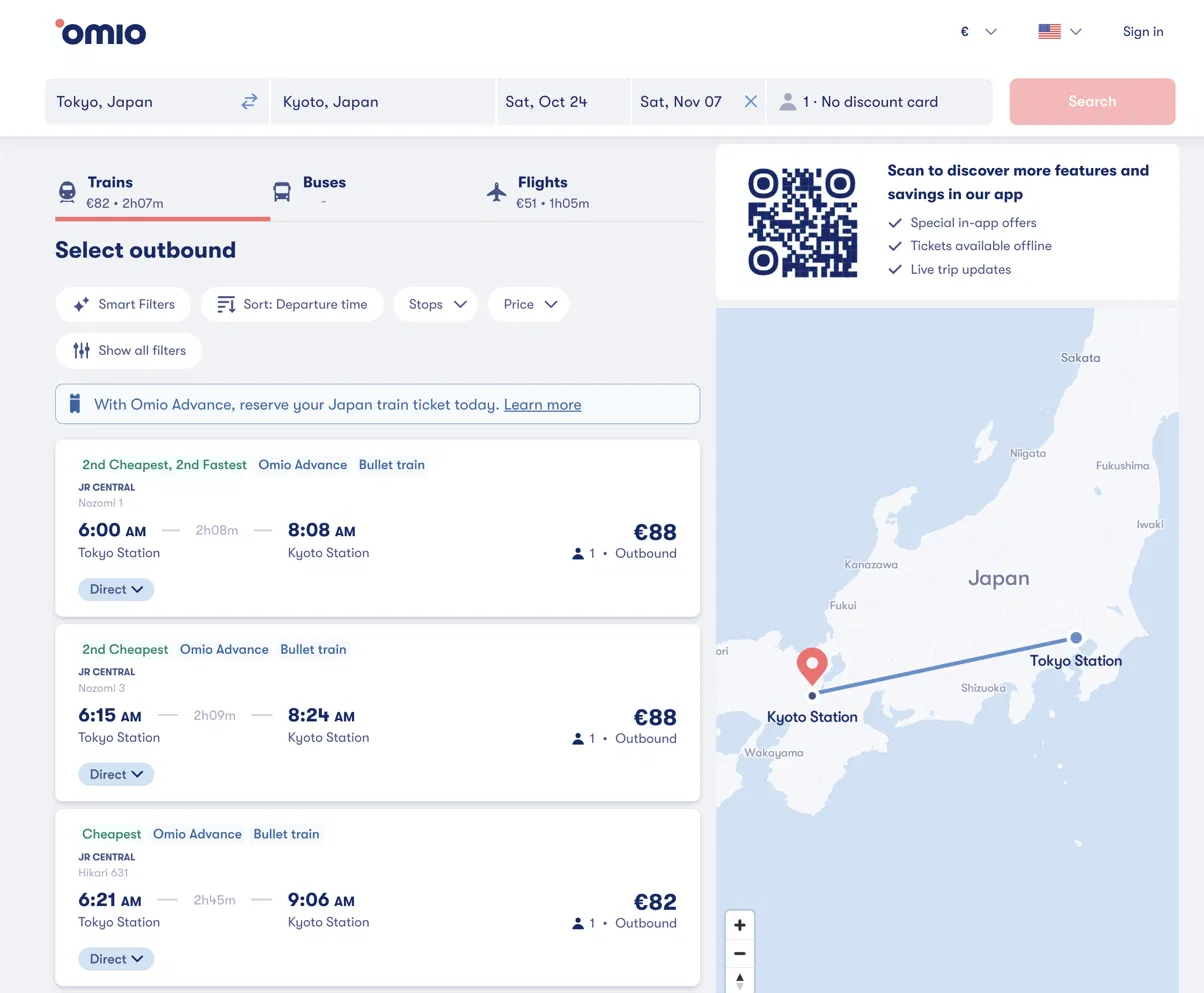
It puts everything in one place. One search for “Tokyo to Kyoto” gives me trains, buses, and flights side by side, with prices and journey times, so I can compare real options in about ten seconds instead of opening six tabs.
The price you see is the price you pay. Japanese rail tickets are technically split into a base fare plus a separate express fee, which is exactly the kind of small print that trips travelers up. Omio just shows the total up front, seat reservation included. No mental math, no surprise charges at the gate.
It works in your language and your currency. Omio supports dozens of languages and currencies, so you’re booking in English and paying in dollars if you want, not squinting at a Japanese-only booking screen and hoping your card goes through. That last part matters — a lot of travelers hit walls when foreign cards get rejected by local booking sites, and this sidesteps it.
The tickets live on your phone. Once you book, your tickets sit in the Omio app, available offline, which is exactly what you want when you’re standing in a crowded station with patchy signal.
None of that is flashy. It’s just less friction at every step, and after years of using it, less friction is the whole game.
The route every first-timer books: Tokyo to Kyoto

If you’re doing Japan for the first time, you’re almost certainly going Tokyo → Kyoto at some point. It’s the backbone of the classic first-timer route, and it’s the first thing I searched. So let’s use it as our worked example.
Here’s what came up when I searched it on Omio:
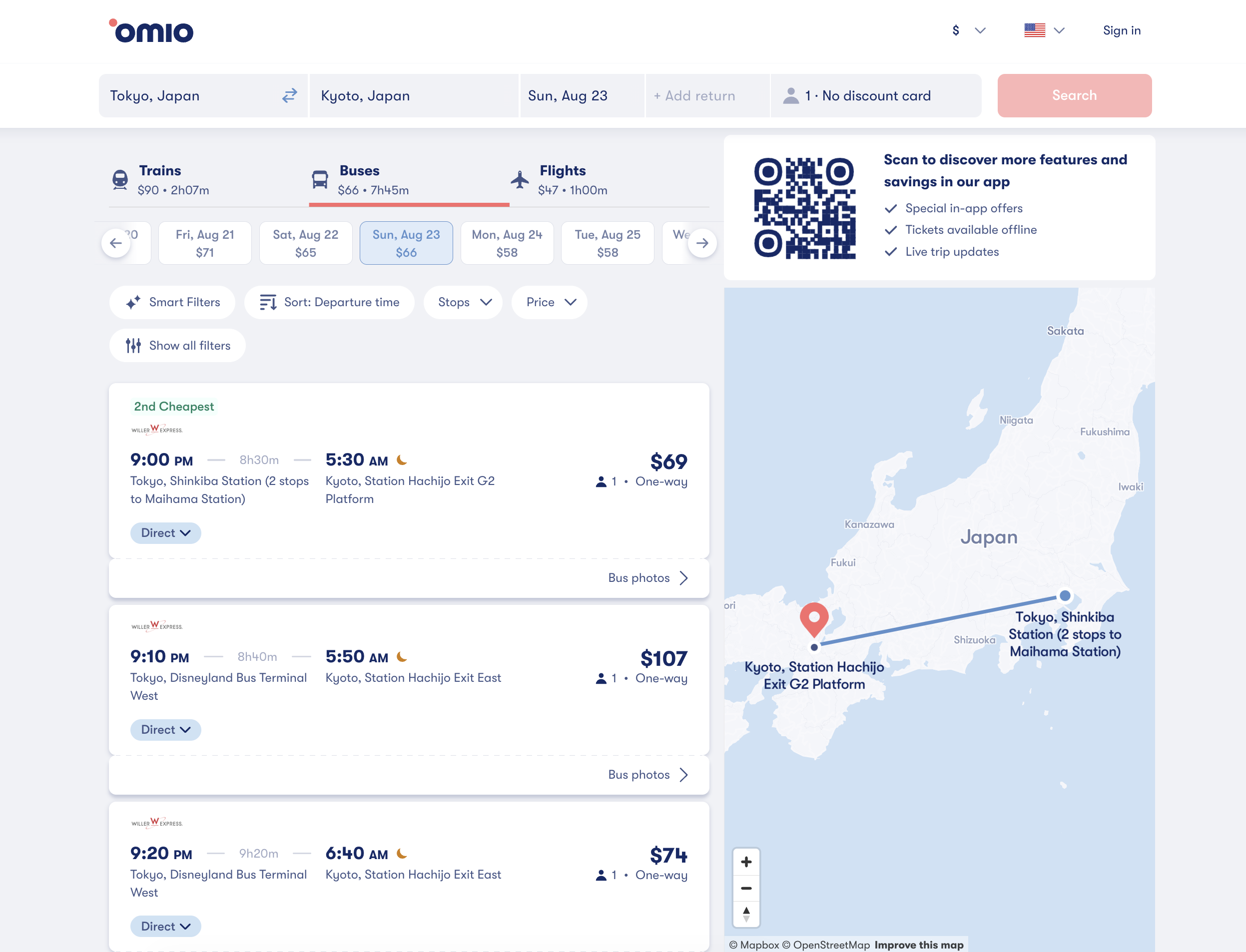
- Train: from €82 (about $93), around 2 hours 7 minutes
- Bus: from €63 (about $72), just under 8 hours
- Flight: from €69 (about $78), 1 hour in the air
Look at that for a second, because it tells you almost everything about traveling in Japan. The bus is the cheapest, but it eats your entire day. The flight looks fast on paper — one hour! — but we’ll get to why that number lies in a minute. And the train sits right in the middle on price while landing you in the center of Kyoto in a little over two hours.
Drilling into the trains, you get a clean choice. The Nozomi services run about €88 (roughly $100) and get you there in around 2h08. The slower Hikari and Kodama trains come in a touch cheaper at €82 (about $93), but they take longer — the Hikari around 2h34, the Kodama a full 3h37 because it stops at every station.
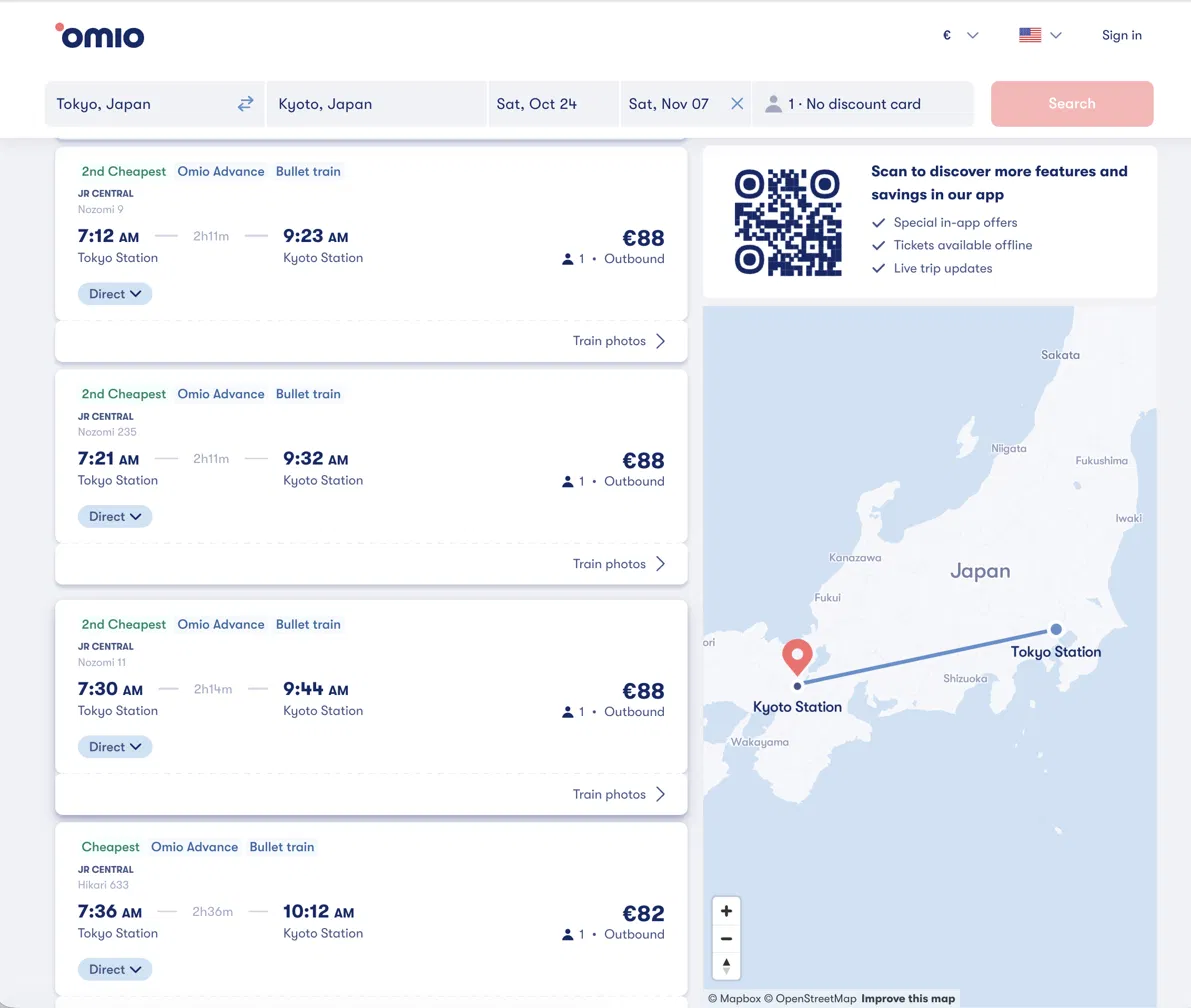
My honest take: for Tokyo–Kyoto, pay the extra six euros for the Nozomi. The time you save is worth more than the coffee money you’d keep, and on your first trip you want the smooth, fast introduction to what Japanese rail can do. Save the penny-pinching for routes where the gap is bigger.
→ Search your own Tokyo to Kyoto dates on Omio
Trains vs flights: the honest answer
Let’s go back to that flight that looked so tempting — one hour, and sometimes cheaper than the train.
Here’s why the one-hour number is misleading, and it’s the single most useful thing I can tell a first-timer. That hour is wheels-up to wheels-down only. It doesn’t count getting out to the airport (Tokyo’s airports are well outside the city), arriving early for domestic check-in and security, waiting to board, or the trip from the arrival airport into Kyoto on the other end. Stack all of that up and your “one hour” flight is realistically a four-to-five-hour ordeal, door to door.
The Shinkansen, by contrast, leaves from Tokyo Station — right in the middle of the city — and drops you at Kyoto Station, also right in the middle. You show up ten minutes before departure, walk on, and you’re moving. There’s no security line. Two hours on the train genuinely beats “one hour” in the air for this kind of distance.
So my rule of thumb: for the classic city-to-city routes in central Japan, take the train. Flights start to make sense only when the distances get big — think Tokyo up to Sapporo in the far north, or down to the southern islands, where the rail journey stretches into most of a day. Omio shows you both, so you can make the call route by route, but for your core first-timer itinerary, the train wins almost every time.
Omio Advance: booking ahead, and what it really does
This is the feature I was most curious about, and it’s worth explaining carefully because it’s easy to misunderstand.
Omio Advance lets you reserve your Japan train tickets well before you travel — up to twelve months out. When I ran my Tokyo–Kyoto search for dates a few months ahead, nearly every result came tagged with “Omio Advance,” and there was a banner offering to reserve the ticket today.
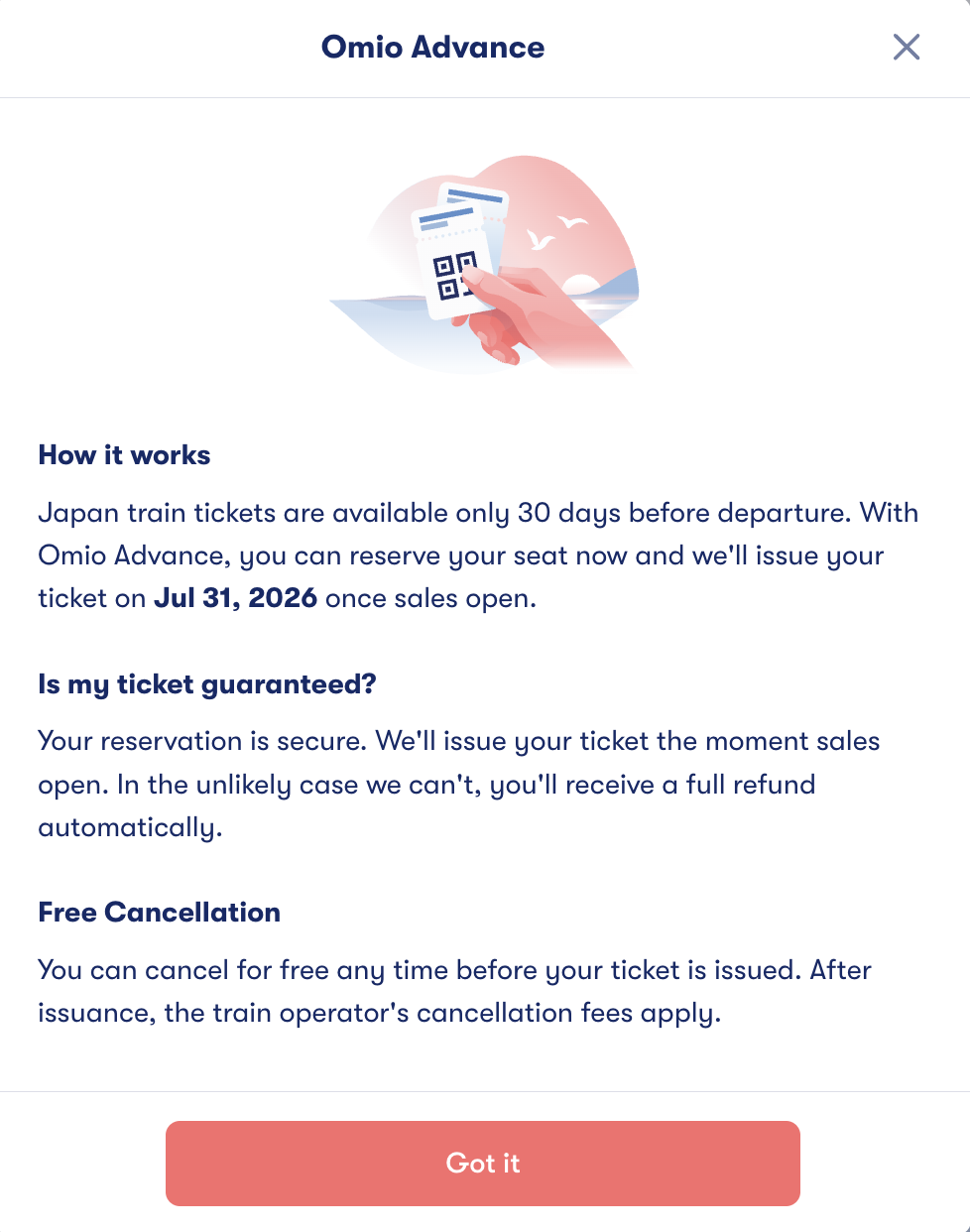
Now here’s the honest part, and it’s important. Booking ahead on the Shinkansen does not get you a cheaper fare. I checked the same route for this week and for three months out, and the prices were identical — €82 and €88, exactly the same. Unlike airlines, Japanese rail doesn’t do that dynamic pricing thing where the fare creeps up as the date fills in. The fare is the fare.
So if booking early doesn’t save money, what’s it for? Peace of mind and a guaranteed seat. In Japan’s busy travel windows — the autumn leaf season in late October, cherry blossom season in spring, national holidays — popular trains really do sell out of reserved seats. There are even stretches, like the busy summer period, where certain Nozomi services between Tokyo and the south go reserved-seat-only with no standing room sold. On those dates, “I’ll just buy it at the station” is how you end up standing for two hours or missing your train entirely.
That’s the real value of booking ahead: not a discount, but the certainty that your seat is locked in for the day you actually want to travel. For a first trip where you’ve got hotels booked and a schedule to keep, I’d take that certainty every time.
Should you get the Japan Rail Pass?
Every first-timer asks this, and the honest answer is: it depends, and probably less often than you’d think.
The Japan Rail Pass gives you unlimited travel on most JR trains for a fixed number of days — 7, 14, or 21 — and you can book it directly through Omio. When it first launched it was a no-brainer deal. After a big price increase a couple of years back, the math got tighter, and now it only pays off if you’re covering serious distances.
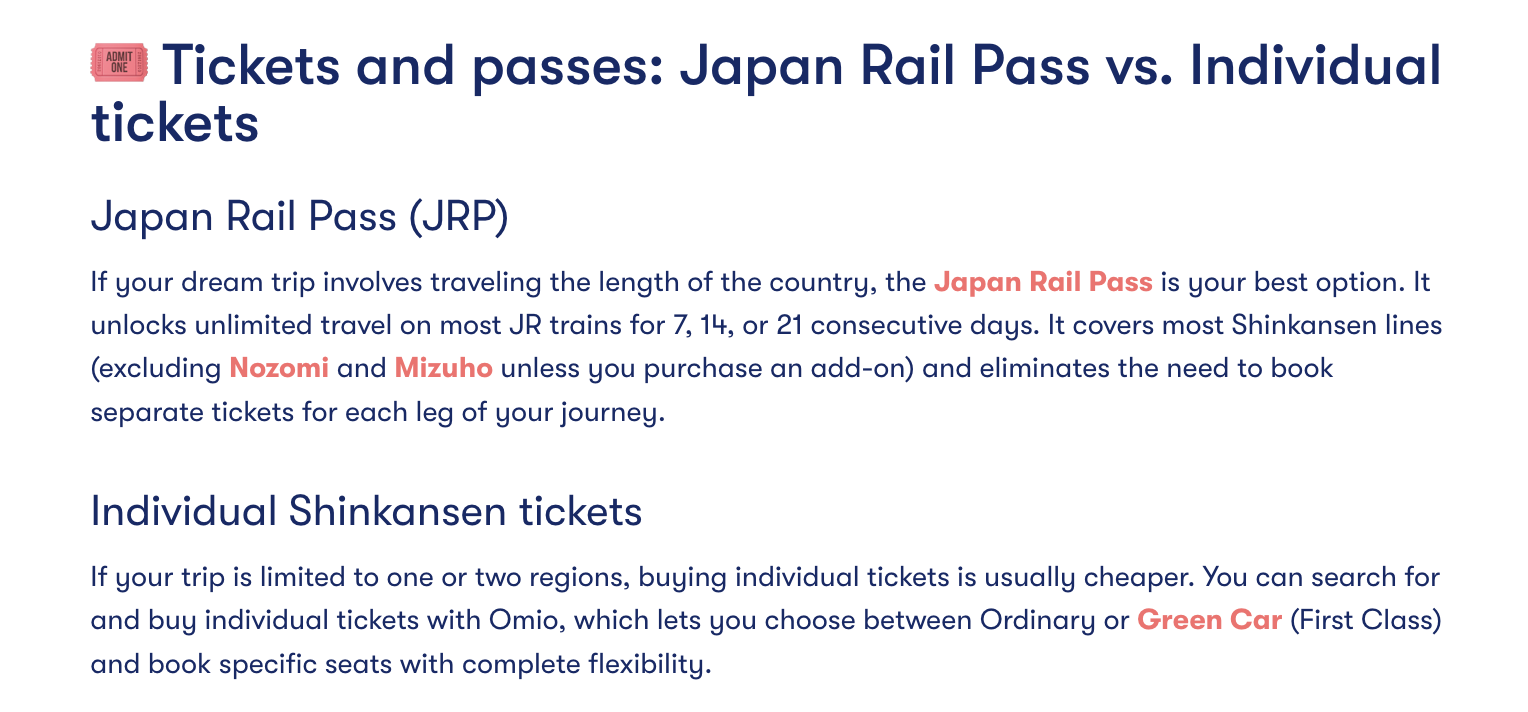
Here’s the simple way to decide, and it’s the approach I’m using for our own trip. Add up the individual fares for the trips you actually plan to take, then compare that number to the cost of the pass. If your itinerary is the classic loop — say Tokyo → Kyoto → Osaka → Hiroshima and back — you’re doing enough long Shinkansen legs that a 7-day pass often comes out ahead. But if you’re basing yourself in Tokyo with just one or two day trips, buying individual tickets is almost always cheaper.
Don’t buy the pass because a blog told you to (yes, I see the irony). Price out your specific route first. Omio makes this easy because you can search each leg, jot down the fares, and total them up in a few minutes — then you’ll know instead of guessing.
→ Compare Japan Rail Pass options on Omio
Beyond the bullet train: buses, ferries, and the rest of Asia
The Shinkansen gets all the attention, but a big part of why I trust Omio in Japan is that it handles the unglamorous stuff too.
Long-distance buses are your budget lever. That Tokyo–Kyoto bus at €63 is slow, but if you’re a backpacker watching every euro and don’t mind an overnight ride, it’s there in the same search. Ferries matter more than first-timers expect, because Japan is thousands of islands — the short hop over to Miyajima near Hiroshima, for example, is a ferry, and it’s the kind of leg that’s a pain to book separately but easy to slot in when it’s in the same app.
And if your Japan trip is turning into a wider Asia adventure, it’s worth knowing Omio’s recent expansion didn’t stop at Japan — it also added coverage across Southeast Asia, including Indonesia, Malaysia, Thailand, Singapore, and Vietnam. We haven’t planned that leg yet, but it’s good to know the same tool travels with us if the trip grows. (One honest caveat for anyone island-hopping the wider region: coverage isn’t everywhere yet — the Philippines, for instance, still isn’t in there — so always run the search before you count on it.)
A few things I always tell first-timers
After years of booking travel this way, here’s the short list of advice I’d give a friend heading to Japan for the first time:
- Book your peak-season trains ahead. Not for the price — for the seat. Autumn and spring fill up fast.
- Reserve seats when you can. Reserved beats non-reserved for the sake of a few euros, especially with luggage.
- Keep your tickets on your phone. Mobile tickets in the app mean nothing to lose and nothing to print.
- Pay in your own currency so a rejected foreign card doesn’t derail you at a booking screen.
- Total your fares before buying a rail pass. Two minutes of math saves you real money either way.
- Take the train over the plane for central-Japan city hops. Door to door, it’s not close.
Final thoughts
Japan is one of the most rewarding places we’ve ever planned a trip to, and also one of the most intimidating to book — which is a strange combination until you’ve sat there staring at a wall of unfamiliar train names. The good news is that the hard part isn’t the travel itself; Japanese trains are punctual, spotless, and a genuine joy to ride. The hard part is just booking it, and that’s the part a good tool quietly solves.
We’ve trusted Omio across years and continents, and now that it covers Japan, it’s how we’re planning this trip too — one search, every option, honest prices, tickets on the phone. If you’re staring down your first Japan itinerary feeling a little overwhelmed, start with a single route. Search Tokyo to Kyoto, look at your options side by side, and you’ll feel the whole thing get smaller and more manageable. That’s how we’re doing it, one leg at a time — and it’s going to be a great trip.
→ Start planning your Japan routes on Omio

About the Author: Ruben, co-founder of Gamintraveler.com since 2014, is a seasoned traveler from Spain who has explored over 100 countries since 2009. Known for his extensive travel adventures across South America, Europe, the US, Australia, New Zealand, Asia, and Africa, Ruben combines his passion for adventurous yet sustainable living with his love for cycling, highlighted by his remarkable 5-month bicycle journey from Spain to Norway. He currently resides in Spain, where he continues sharing his travel experiences with his partner, Rachel, and their son, Han.