
There is one Ryanair charge that stings more than almost any other, and it is entirely self-inflicted. Turn up at the airport without having checked in online, and the airline will charge €55, roughly $60, per person just to check you in at the desk. A family of four can lose €220, about $240, before they have even reached security, for the crime of not tapping a few buttons the night before.
The fee is not a mystery or a trick buried in the fine print. It is plainly listed, it is designed to be painful, and it is completely avoidable. Understanding exactly what triggers it, and the handful of quirks that surround it, turns a potential €55 disaster into a non-event that takes five minutes on a phone.
What the €55 Fee Actually Is
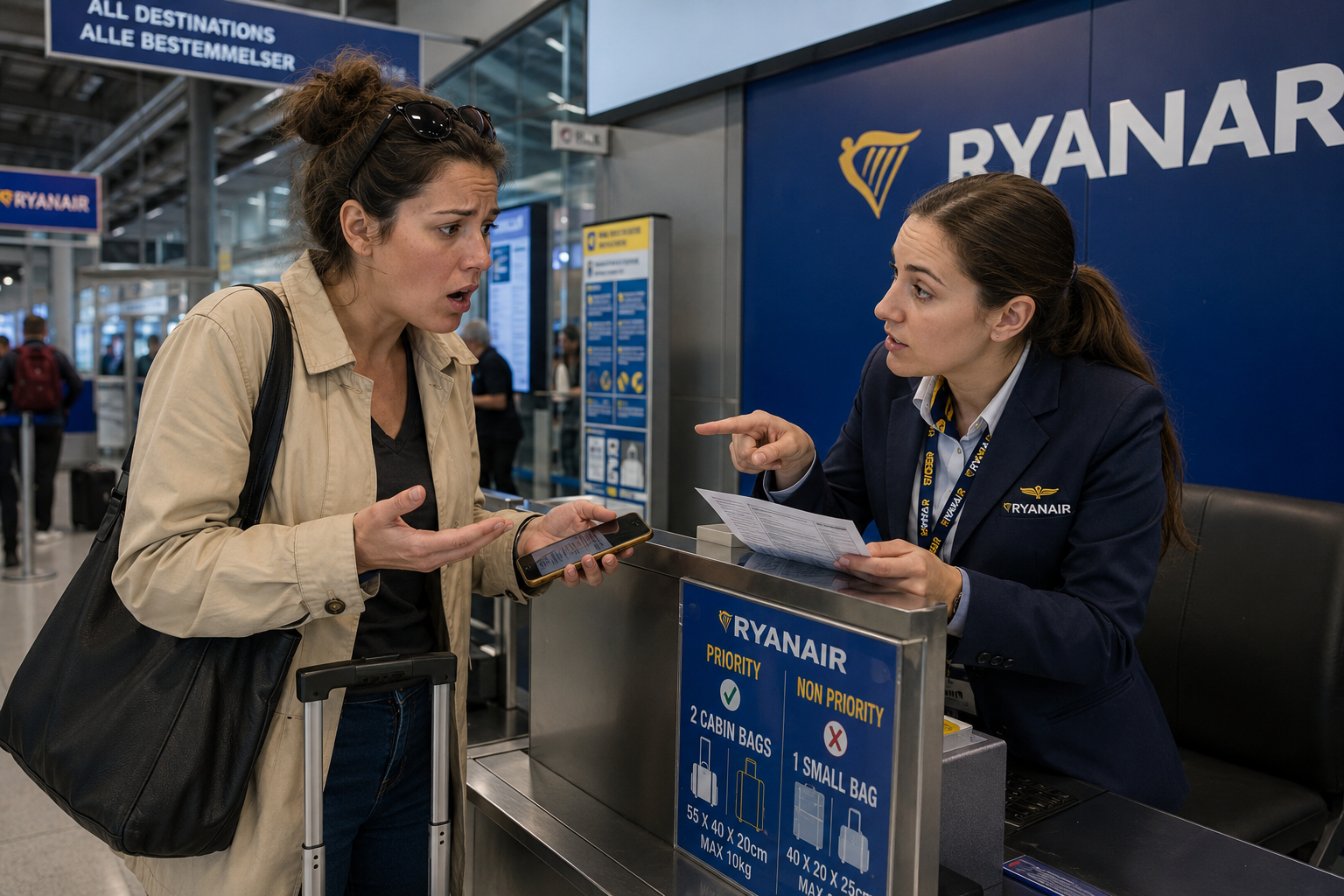
The charge is Ryanair’s airport check-in fee, and it applies to anyone who has not completed online check-in before arriving at the airport. It is not a fee for a bag, a seat, or a service you receive. It is a penalty for making the airline check you in the old-fashioned way, at a staffed desk.
Ryanair is refreshingly open about the logic. More than 99% of its passengers already check in online before they travel, and the airline wants that figure as close to 100% as possible so it can run its airports with minimal desk staff. The €55 is deliberately punitive, set high enough that almost nobody chooses to pay it. In the airline’s own framing, it is less a revenue line than a deterrent, closer to a parking fine than a genuine charge for work done.
That design is worth keeping in mind, because it explains why there is no gentle version of the fee and no sympathetic exception at the counter. The whole point is to make skipping online check-in hurt. For the passenger, the fix is equally simple: check in online, on the app or the website, before you leave for the airport, and the €55 never enters your life. Everything else in this piece is about the edge cases where people still get caught.
The Ultra-Cheap Fare and the Fees That Guard It
To understand the €55, it helps to understand the business it belongs to. Ryanair sells the headline fare as low as it possibly can, then earns its margin on the extras, and the check-in fee is one of the guard rails protecting that model.
The airline’s whole system is built to move enormous numbers of people at rock-bottom base prices, which only works if costs are stripped to the bone everywhere else. Desk staff, printed materials, and slow manual processes are exactly the costs it wants gone, so the fees around them are set high enough to push every possible passenger onto the self-service app. Seen this way, the €55 is not really about check-in at all. It is about keeping the airport operation lean enough to sustain the cheap seat that got you on the plane in the first place.
None of that makes the fee pleasant, but it does make it predictable. Ryanair charges are almost always avoidable if you play by the airline’s rules: travel light, check in online, bring only the cabin bag your fare includes, and print nothing. The passengers who complain loudest about being nickel-and-dimed tend to be the ones who treated a Ryanair booking like a full-service airline ticket. Treated as what it is, a bare fare with strict conditions, the same booking stays genuinely cheap and the fees remain someone else’s problem.
The Spain Exception Nobody Mentions
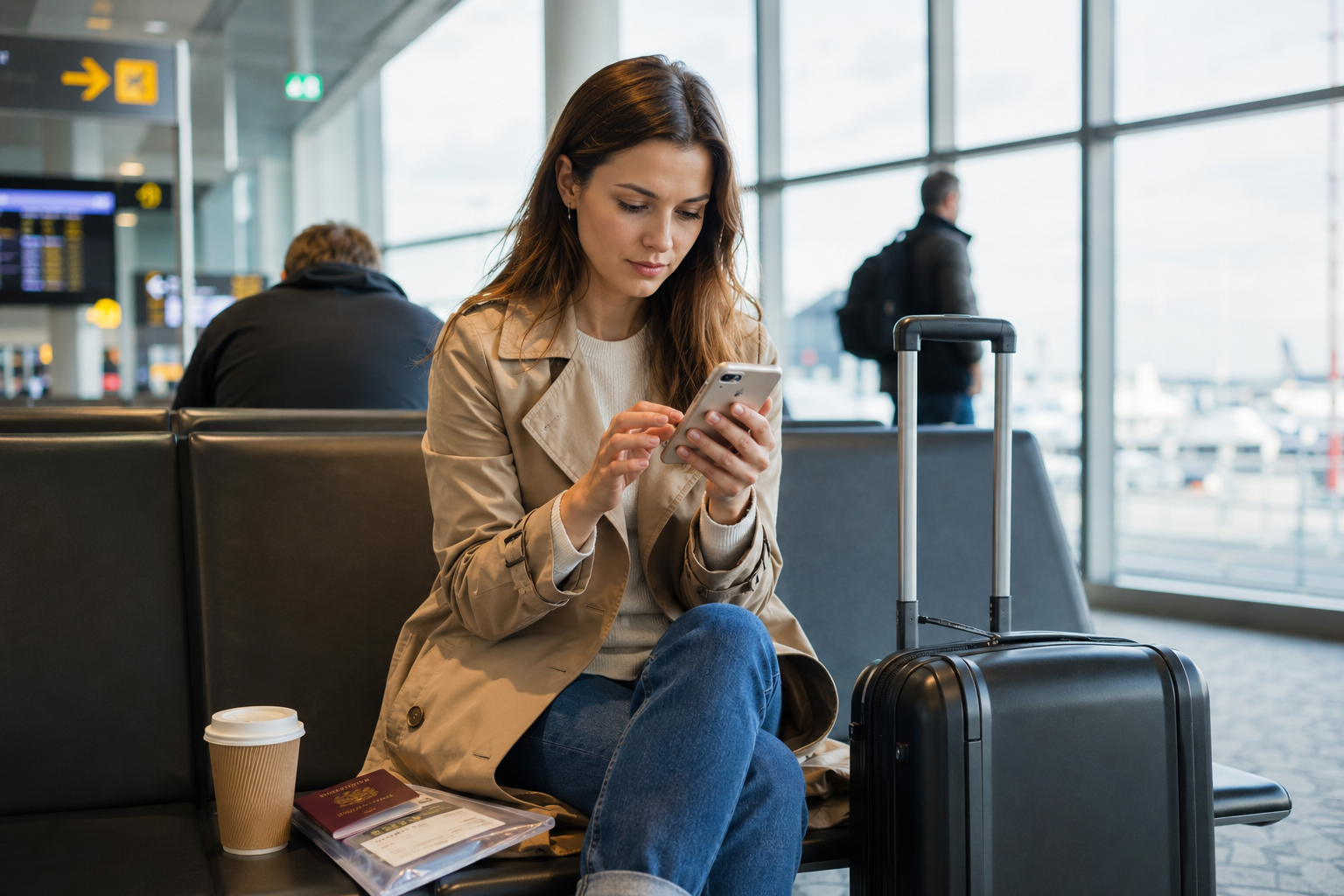
Here is a detail that matters enormously for anyone flying out of Spain and that most articles about the fee leave out entirely. The €55 figure is the general rate. For flights departing from Spain, the airport check-in fee is €30, not €55.
That is roughly $32 rather than $60, a meaningful difference, though still a charge worth avoiding. Ryanair’s own table of fees lists the Spanish rate separately, at €30 per passenger, most likely because Spanish consumer rules have historically taken a harder line on airline surcharges than some other markets. Whatever the reason, an expat or traveler flying from Madrid, Barcelona, Alicante, or Málaga who forgets to check in faces a smaller hit than the headline number suggests.
It is not a rate to rely on, of course. €30 is still real money to hand over for nothing, and the same flight on the return leg from another country could carry the full €55. The safe habit does not change: check in online wherever you are flying from. But it is useful to know the true number for your departure airport, both so you are not overcharged and so you are not talked into a panic at the desk over a fee that is lower than you feared.
For frequent flyers based in Spain, this is worth learning once and remembering. A quick look at Ryanair’s fee table for your specific route removes any doubt, and it stops a desk agent’s quoted figure from triggering a needless scramble for a card. The rule to follow stays the same everywhere, but the number that lands on the receipt is not identical across borders.
The €20 Boarding Pass Trap Is Different
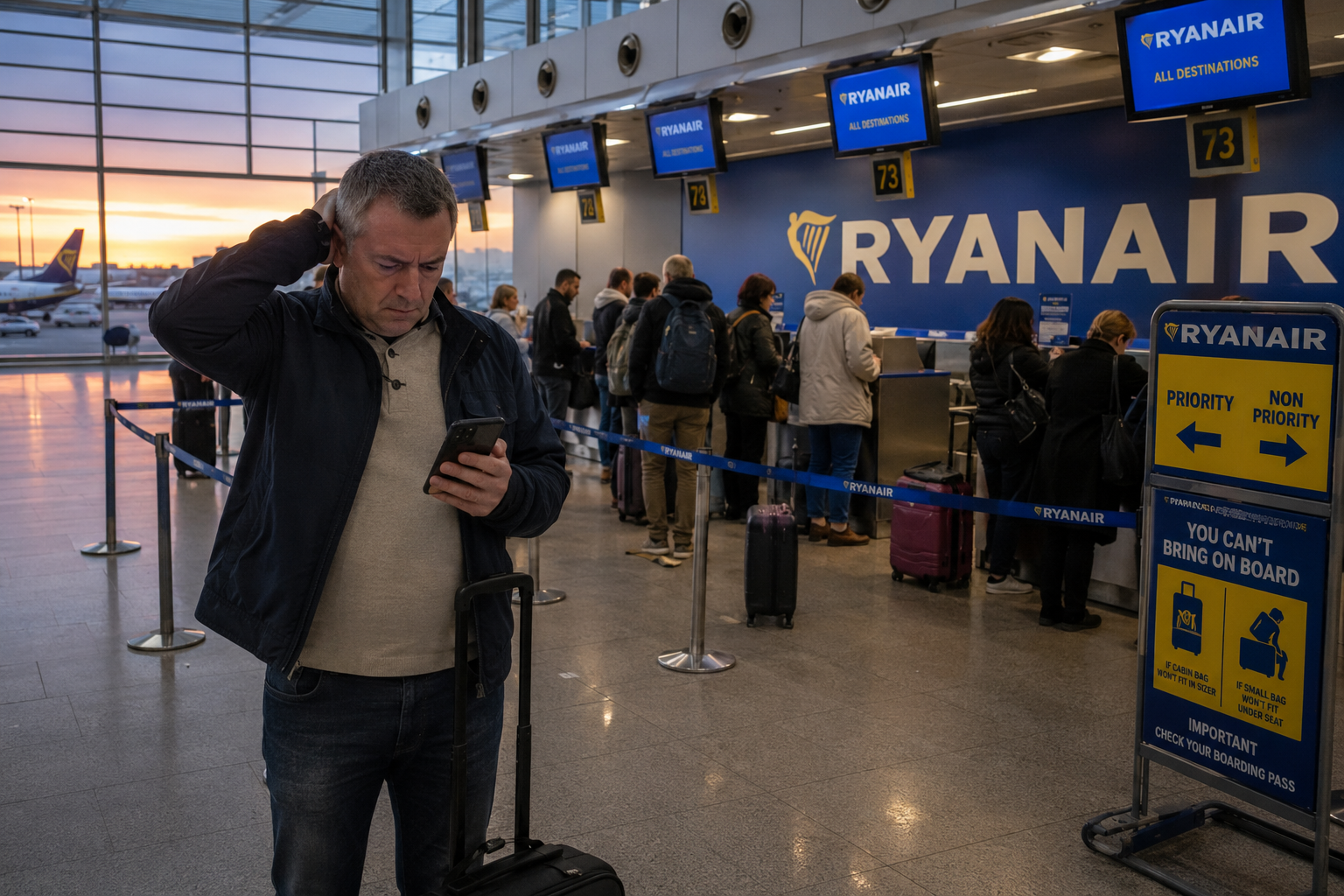
A second, smaller fee causes a lot of confusion because people mix it up with the €55 one. This is the boarding pass reissue fee, and it is €20, about $22, per passenger. It applies in a different situation entirely.
The €55 is for not checking in at all. The €20, by contrast, is for passengers who did check in online but then cannot present a valid boarding pass at the airport. In the past that meant someone who checked in but did not print the pass, or printed the wrong one. It is a real trap: there are documented cases of travelers, often older ones less comfortable with the app, who checked in correctly but brought the wrong leg’s boarding pass to the airport and were charged to have the right one reissued.
Knowing the two fees are separate helps you dodge both. If you have checked in online but lost access to your boarding pass, the answer is almost never to pay €20 at the desk. Open the myRyanair app, enter your booking, and your digital boarding pass is there to be re-downloaded for free. The fee exists to catch people who do not realise the app will simply give them the pass again, and a moment of calm at the airport saves the charge.
The Check-In Window That Catches People
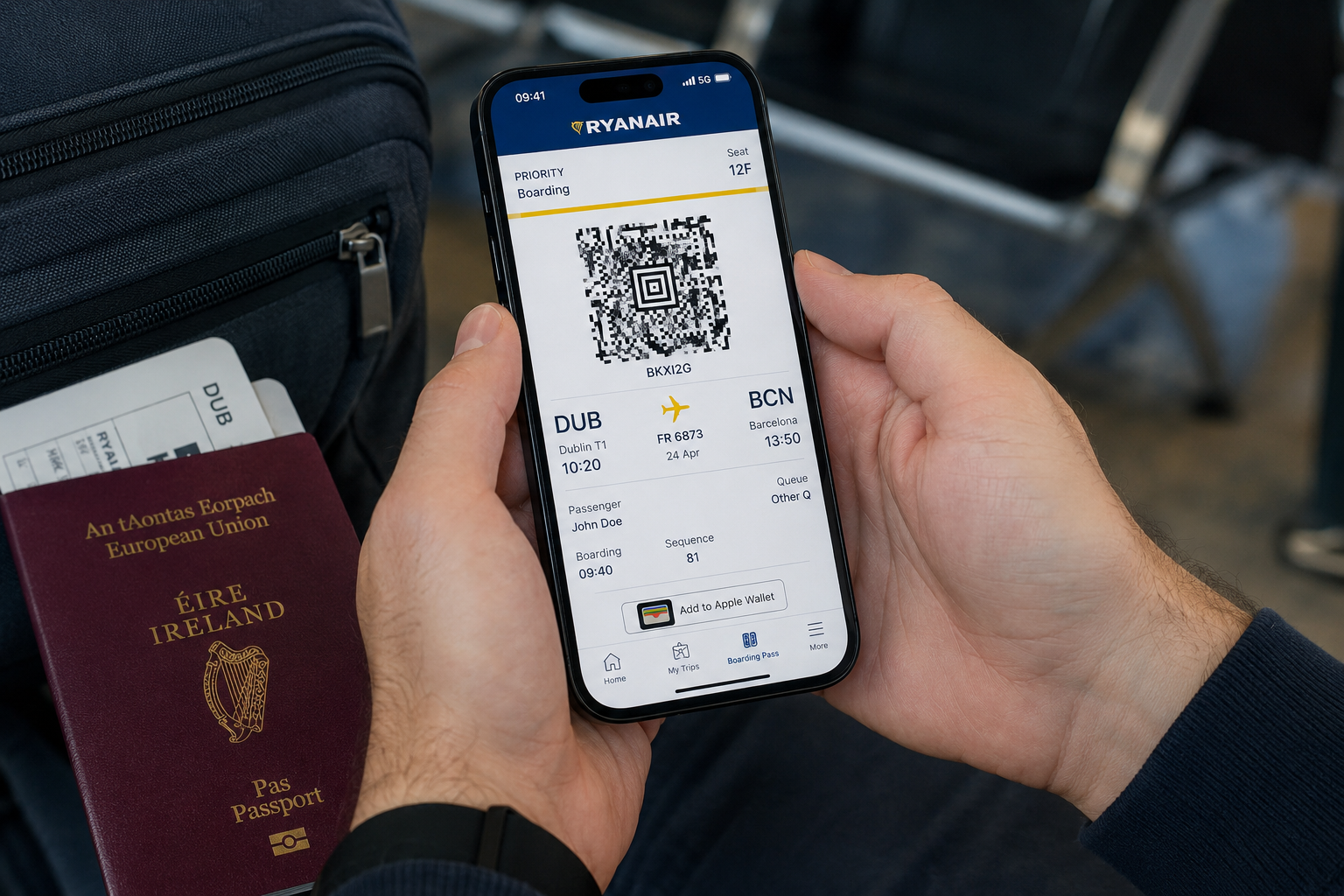
Timing is where even organised travelers come unstuck, because Ryanair’s check-in window has firm edges. Online check-in opens well in advance, up to 60 days before departure if you have paid for an allocated seat, and from 24 hours before if you are taking the free random seat. Crucially, it closes two hours before the scheduled departure time.
Miss that two-hour cut-off and you can no longer check in online at all. Your only option becomes the airport desk and its fee. The desks themselves stay open until 40 minutes before departure, so you can still make the flight, but you will pay to be checked in once the online window has shut.
There is one escape hatch worth knowing. If you arrive at the airport more than two hours before your flight and are told about the fee, the online window is technically still open, so you can step away from the desk, check in on your phone for free, and walk back with a valid boarding pass. The moment you slip inside that two-hour boundary, that door closes and the fee is unavoidable. The practical lesson is to check in the day before, or the moment the window opens, and never let the timing decide for you.
Groups and families should take particular care, because everyone on a booking usually has to be checked in together, and a single unchecked passenger can drag the whole party to the desk. It is also easy to lose track of the window on the return leg of a trip, once the outbound has gone smoothly and complacency has set in. A phone reminder set for the day before each flight is a dull little habit that reliably saves the fee.
Everything Went Digital in 2025
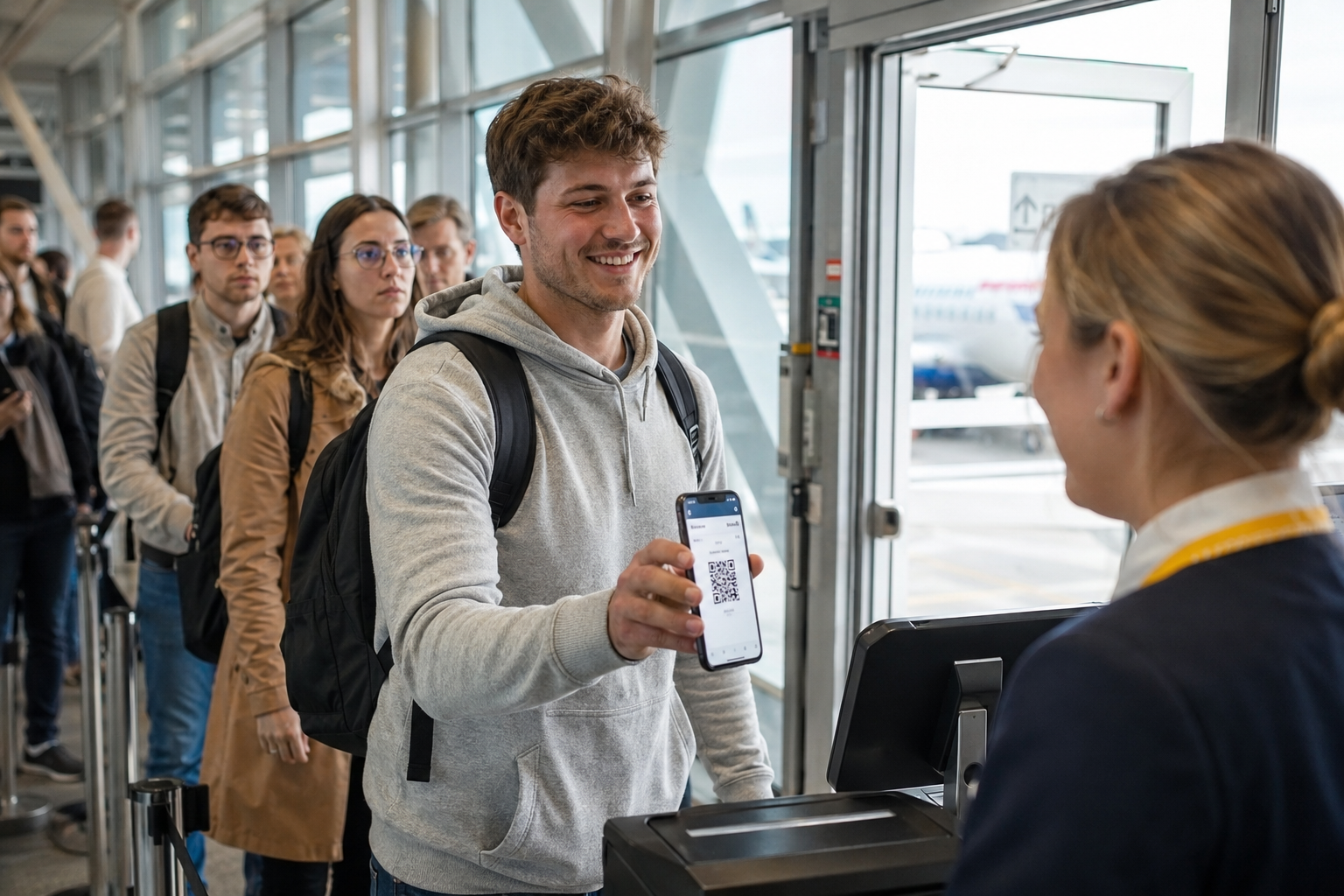
The whole system shifted in late 2025, and it caught out travelers who still think in terms of paper. From November 2025, Ryanair moved to fully digital boarding passes, phasing out the printed pass almost entirely in favour of the one in the myRyanair app.
In practice this means your boarding pass now lives on your phone. You check in through the app, and the pass sits in your account and in the app’s wallet, ready to be scanned at security and the gate. For most people this is genuinely easier, since there is nothing to print and nothing to leave on the kitchen table. But it does assume a charged phone, a working app, and an account you can log into, which is a new dependency for travelers used to a piece of paper.
The airline has built in some grace for the transition. For flights from late 2025 onward, a passenger who completed online check-in but cannot show a valid digital pass at the airport can generally get an alternative reissued rather than being stranded. Even so, the smart move is to open the app before leaving home, confirm the boarding pass loads, and take a screenshot as a backup in case the network drops in a crowded terminal. A dead battery is now a genuine travel risk in a way it never used to be.
The change also quietly ended a small ritual. For years, part of the Ryanair experience was the frantic hunt for a printer in a hotel lobby or an internet cafe before a flight. That is gone now, replaced by a quick check that the app has loaded, which is easier for most travelers and harder for the few who never made peace with the smartphone. For them, flying with someone who has the app, or asking the hotel for help before setting off, is worth far more than any printout ever was.
A Court Just Called It Unfair
The €55 fee is not going unchallenged. In a notable ruling, Austria’s Supreme Court found that Ryanair’s airport check-in fee, along with several other charges, was unfair and not transparent to passengers.
The court did not stop at check-in. It also took aim at the boarding pass fee, an infant fee, an oversized hand baggage fee, and a rebooking fee for missed flights, deeming the whole cluster improper. The consumer organisation behind the case argued that passengers who paid these fees in the past should be entitled to refunds, a claim Ryanair rejects, and the matter is far from settled legally.
For a traveler today, the practical situation is unchanged: the €55 fee, or €30 from Spain, is still being charged at the desk right now, whatever a court in Vienna has said. Rulings like this can take years to translate into refunds or changed policy, and airlines routinely appeal. The case is worth knowing about because it may eventually reshape these charges, but nobody should turn up unchecked-in on the assumption that the fee has been abolished. It has not.
The Travelers Who Still Get Caught
Even with all this understood, certain groups run into the fee more than others, and it is worth seeing whether you are one of them. Non-EU and non-EEA passengers face an extra hurdle: they must have their visa or passport documents verified, and Ryanair now pushes this through the app during online check-in. If that verification is not completed before the online window closes, the passenger is sent to the airport desk and charged the check-in fee like anyone else. The verification itself can take a few attempts when a document scan fails, which is a common way into the fee for those who leave it to the final hour. Doing it days ahead, with time to retry a rejected scan, keeps that group clear of the desk.
Passengers who booked through a third-party website, an online travel agent rather than Ryanair directly, are a special case in the opposite direction. Because they often cannot complete check-in online, Ryanair offers them airport check-in free of charge, so they should not be paying the €55 at all. Anyone in that situation who is quoted the fee should point this out at the desk.
The other classic victims are the ones the systems were never quite built for. Older travelers less at home with a smartphone app, families juggling several bookings and boarding passes at once, and anyone who assumed a printed pass from a previous trip would still do. These are exactly the people the digital shift and the two-hour window trip up, and exactly the people for whom a calm five minutes on the app the night before pays off most.
Five Minutes That Saves the Fee
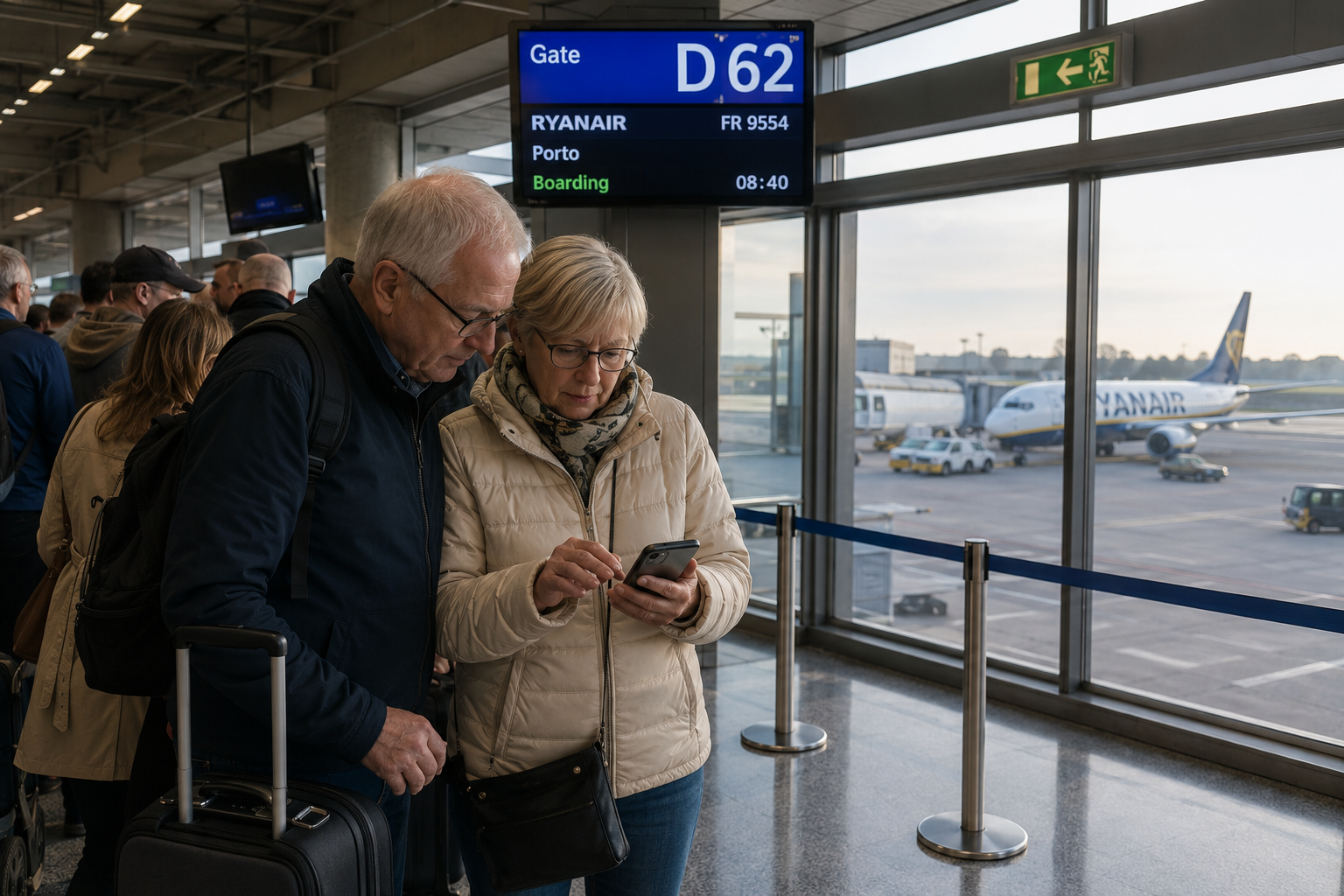
Strip away the detail and the whole thing reduces to one habit. The moment your flights are booked, or at the very latest the day before you travel, open the myRyanair app and check in. It takes a few minutes and it closes off almost every version of the fee at once.
While you are in the app, do the small things that prevent the edge cases. Confirm your boarding pass has loaded and is showing the correct flight, not last week’s or the return leg. If you are a non-EU or non-EEA passenger, complete the document verification then and there rather than leaving it for the airport. Take a screenshot of the pass as a backup, and make sure your phone will be charged when you travel.
Do that, and the numbers in this article become trivia. The €55, the €30 in Spain, the €20 reissue, all of them exist to catch the unprepared, and five minutes on your phone moves you firmly out of that group. The single most expensive thing you can do with a Ryanair booking is nothing at all, and it is the one thing easiest to avoid.

About the Author: Ruben, co-founder of Gamintraveler.com since 2014, is a seasoned traveler from Spain who has explored over 100 countries since 2009. Known for his extensive travel adventures across South America, Europe, the US, Australia, New Zealand, Asia, and Africa, Ruben combines his passion for adventurous yet sustainable living with his love for cycling, highlighted by his remarkable 5-month bicycle journey from Spain to Norway. He currently resides in Spain, where he continues sharing his travel experiences with his partner, Rachel, and their son, Han.