You have finished a wonderful dinner in Rome, the plates are long cleared, and now you are ready to pay and go. So you wait for the check. And you wait. The waiter drifts past, unhurried, attending to other tables, and the bill simply never appears, until you begin to feel invisible, wondering if you have somehow been forgotten. You have not.
In most of Europe, the check does not come until you ask for it, and the way Europeans ask is not by flagging the waiter down and announcing it, but with a small, silent gesture that summons the bill in seconds. It is one of the most useful travel signals there is, understood almost everywhere on the continent, and yet tourists almost never learn it, which is exactly why they end up sitting and stewing at the end of every meal.
What follows is why the check never comes on its own, the wordless signal that fetches it, why a gesture beats a shout, and the one situation where you skip it entirely and just go pay. It is a tiny piece of know-how that removes one of the most common small frustrations of European travel.
The Check That Never Comes
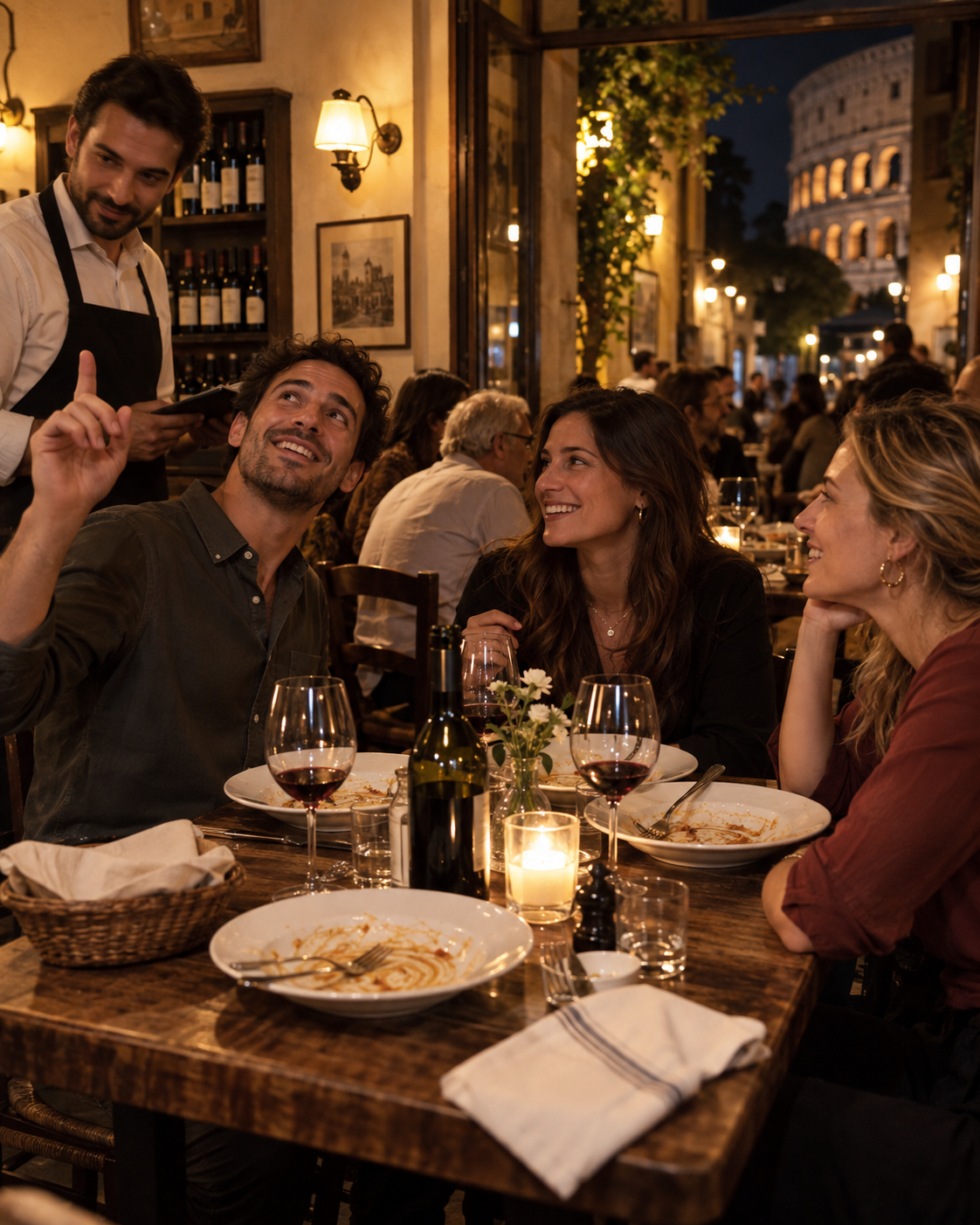
The first thing to understand is that the endless wait is not bad service, it is good manners, at least by European standards. In American restaurants, the check tends to land the moment your plates are cleared, part of a system built around turning tables quickly, and diners are conditioned to expect it. The faster a table turns over, the more customers a night, so the American waiter is quietly incentivized to keep things moving, and the early check is part of that. In Europe the logic is the opposite, because bringing you the bill unbidden would imply the restaurant wants you gone, which is considered rude, so the waiter deliberately leaves it off until you signal that you are ready. Your table is yours for as long as you want it, and the uncleared silence is a courtesy, not neglect. The Europeans call it giving you room to enjoy the sobremesa, the lingering over the table after the food is gone, and the waiter who leaves your bill unbrought is protecting exactly that, not forgetting you.
This single cultural difference is behind an enormous amount of tourist frustration, because visitors sit waiting for a check that, by local custom, will never arrive until they act. They interpret the delay through American eyes, as being ignored or forgotten, and either fume quietly or grow anxious about how to get someone’s attention. Some end up flagging the waiter down with an apologetic urgency that feels awkward to everyone, when a calm gesture would have done the job with none of the fuss.
The truth is simply that the ball is in your court, and the meal will not end until you decide to end it, which is a lovely thing once you understand it and a maddening one until you do. Framed correctly, the wait is not the restaurant failing you but the restaurant handing you control of your own evening. The whole problem dissolves the moment you learn how to ask. What feels like poor service turns out to be a small piece of etiquette you simply had not been taught, and once you have it, the endless wait never happens to you again.
The Silent Signal
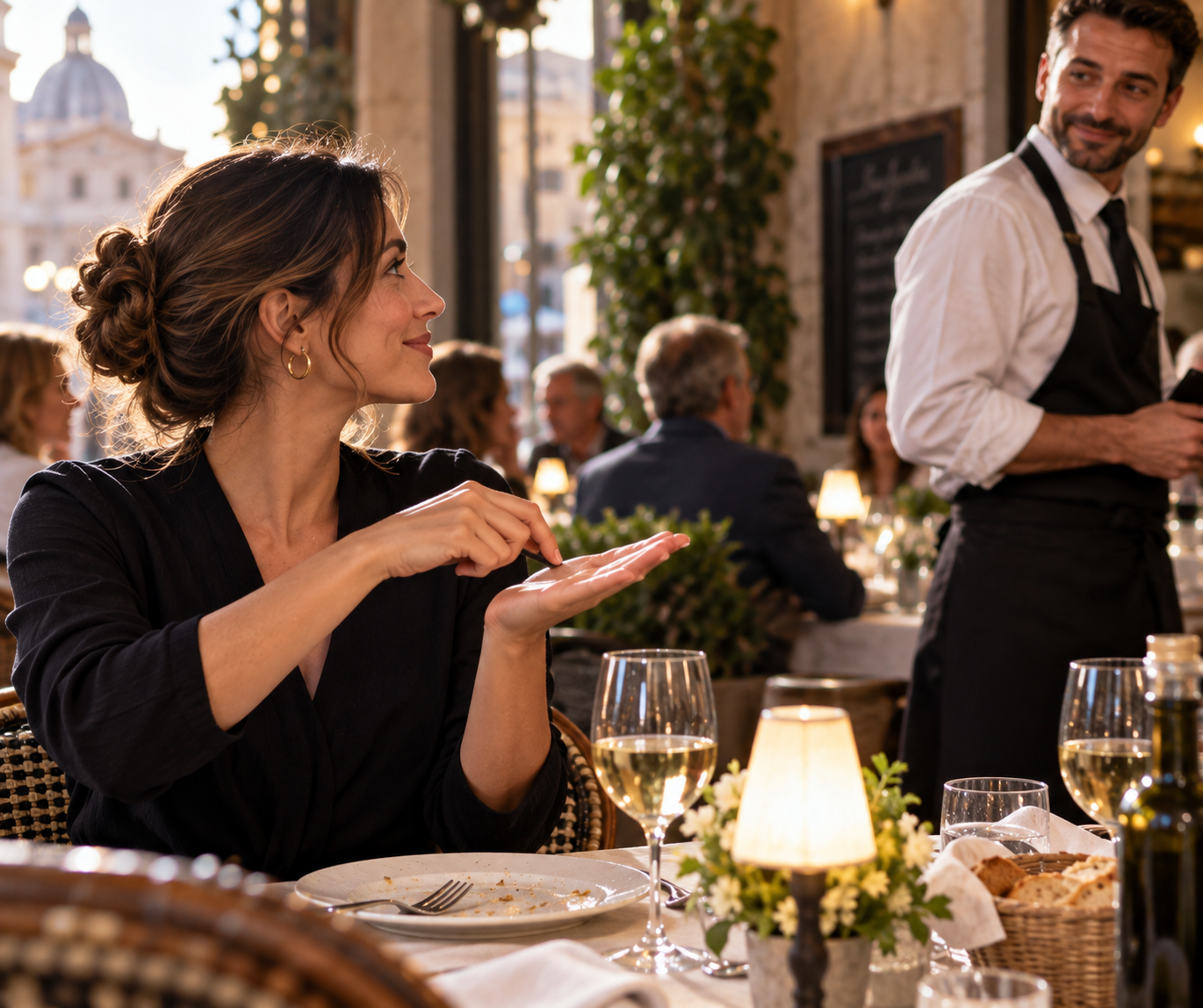
Here is the signal itself, the one Europeans use and tourists rarely know. You catch the waiter’s eye across the room, and then, holding up one hand with the palm open, you make a little writing motion on it with your other hand, as though you were scribbling on a notepad or signing your name in the air. That small mime, the air-signature, is universally understood to mean the check, please, and the waiter will nod and bring it over. No words, no shouting, no waving of arms, just a quiet gesture that carries the message clean across a crowded room.
The beauty of it is its efficiency and its discretion. Because European waiters do not hover at your table the way American servers often do, and may not come within speaking distance for long stretches once your food has arrived, you frequently cannot simply ask out loud, and this is precisely the problem the gesture solves. Catch the eye, make the writing motion, and you have communicated exactly what you need without breaking the calm of the room or your own conversation. It works in Spain, Italy, France, and across most of the continent, a near-universal piece of dining sign language that instantly marks you as someone who knows how things are done rather than a baffled visitor. There is even a small pleasure in it, the quiet satisfaction of communicating across a busy room with a single gesture and watching it work exactly as intended.
Why a Gesture Beats a Shout
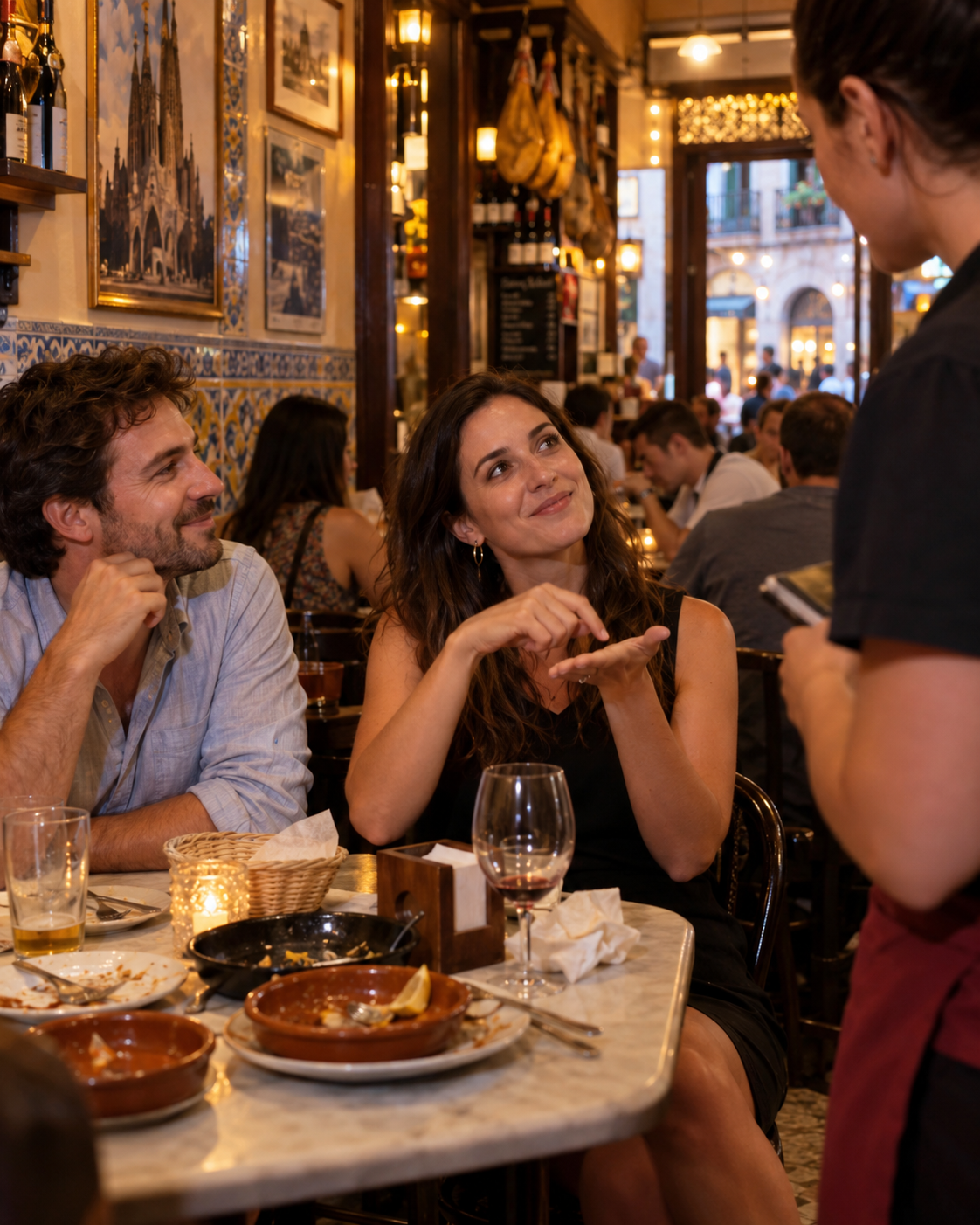
You might wonder why not just call out or wave the waiter over, and the answer reveals something about the etiquette at work. Summoning a waiter by shouting, snapping your fingers, or waving your arms is considered genuinely rude across Europe, the mark of an impatient or entitled diner, and it disrupts the calm the whole meal is built around. The writing gesture, by contrast, is quiet and dignified, a signal rather than a summons, and it respects the unhurried atmosphere even as it moves things along. It says you are ready without saying you are in a hurry. That distinction matters in a culture that prizes the unhurried meal, since to seem impatient is itself a small breach of the spirit of the table, and the gesture lets you move things along without committing it.
It is also simply practical in a way shouting is not. In a busy restaurant where the waiter is halfway across the room, a discreet raised hand and a writing motion travel silently over the heads of other diners and catch the eye without disturbing anyone, where calling out would turn heads and break the mood at every table between you and the server. The gesture is the polite solution to a real logistical problem, how to communicate with someone you cannot easily reach without making a scene, and it is why generations of Europeans have settled on it. It is quietly ingenious, a bit of shared body language that solves at a stroke what words and waving handle so clumsily. Learn it, and you get the efficiency you want with none of the rudeness you would rather avoid. It is the difference between a diner who seems to understand the room and one who seems to be fighting it, and waiters notice which one you are.
Where It Works, and the One Exception
The writing gesture is remarkably portable, understood not just across Europe but in much of the world’s more formal dining, so once you have it you can use it almost anywhere a waiter brings a bill to the table. In sit-down restaurants in Spain, Italy, France, Portugal, and beyond, it is the reliable, polite way to summon the check, and it will rarely fail you. The specifics of dining vary from country to country, but this one signal cuts across all of them, which is part of what makes it so worth carrying in your pocket. It is one of those small pieces of fluency that travels as well as a passport. Once it is in your repertoire you stop even thinking about it, reaching for the gesture as naturally as a local, in a Roman trattoria or a Parisian brasserie or a tapas bar in Seville alike.
There is one important exception to know, and it is common in the most casual places. In many informal spots, particularly Italian trattorias, French cafes and bouchons, and bars everywhere, the custom is not to be brought a check at the table at all but to simply get up when you are ready and pay at the counter or register on your way out.
In these places, waiting for a bill, gesture or no gesture, will leave you waiting a long time, because none is coming to the table by design. The rule of thumb is that the fancier the restaurant, the more likely the check comes to you, and the more casual the spot, the more likely you pay at the bar. When in doubt, a glance at what other diners are doing, or a look for a register by the door, will tell you which world you are in. If the locals are drifting up to a counter to settle up, follow them; if they are seated and signalling, do the same, since the surest guide in any unfamiliar place is simply to watch how the regulars handle the end of their meal.
The Deeper Etiquette
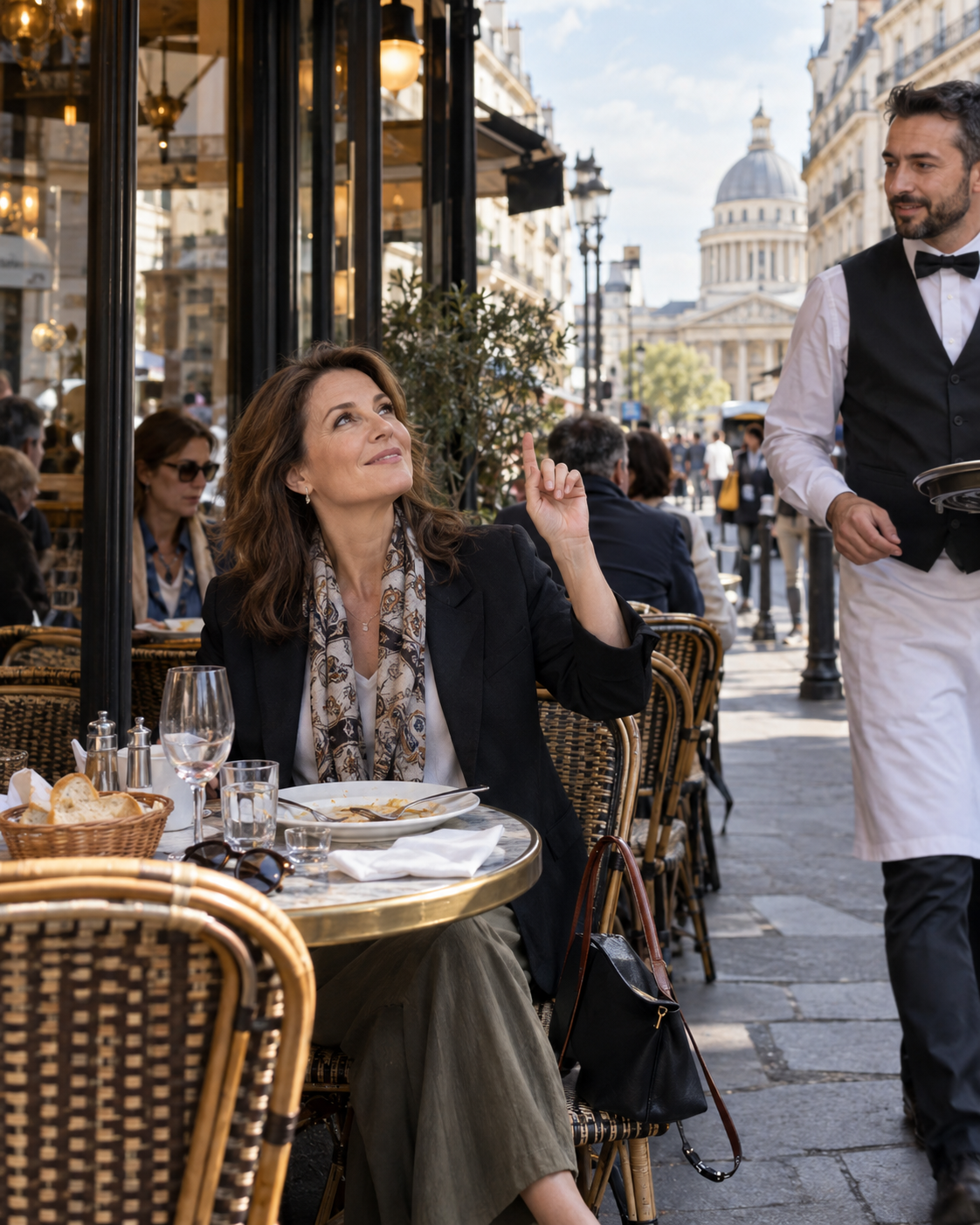
Underneath the gesture lies the same philosophy that shapes so much of European dining, the conviction that a meal is not a transaction to be processed but an experience to be lingered over. The whole ritual, the uncleared plates left in peace, the check that waits for your signal, the unhurried pace, is designed around the idea that you should never feel rushed, that the table is yours to enjoy for as long as you like. The silent signal is the mechanism that makes this work, the way you, and not the restaurant, get to decide when the evening ends.
Seen this way, learning the gesture is not just a convenience but a small act of cultural fluency, a way of stepping into the European rhythm rather than fighting it. The tourist who does not know it experiences the end of every meal as a frustrating limbo, while the traveler who does glides out whenever they please, having quietly told the waiter with a flick of the wrist that they are ready. That small difference, repeated at every lunch and dinner of a trip, adds up to a noticeably smoother, less irritating experience of eating your way across a continent. It is a tiny thing, a motion that takes a second to make, but it transforms the close of every European meal from a source of low-grade irritation into a moment of easy, wordless understanding between you and the staff.
What Not to Do While You Wait
Just as useful as knowing the right signal is knowing the wrong ones, because tourists tend to reach for exactly the moves that mark them out and, in some cases, quietly offend. The worst is snapping your fingers at a waiter, a gesture that in much of Europe is considered genuinely insulting, the way you might summon a dog rather than address a person. Almost as bad is a loud, arm-waving hail across the room, or calling out repeatedly, both of which read as impatient and entitled and break the calm the restaurant is trying to preserve.
Then there is the opposite mistake, doing nothing at all and simply sitting in mounting frustration, waiting for a check that local custom guarantees will never come unbidden. This is the trap most well-mannered tourists fall into, too polite to make a scene and unaware that a small signal is not only acceptable but expected. Stacking your plates to hint that you are done, or catching the waiter’s eye and then staring meaningfully, tends not to work either, since neither clearly communicates that you want to pay. The whole point of the writing gesture is that it threads this needle perfectly, neither rude nor invisible, and once you have it you can retire all these awkward improvisations for good. It is precise where the alternatives are clumsy, saying exactly one thing, the check please, clearly and without offense.
How to Do It
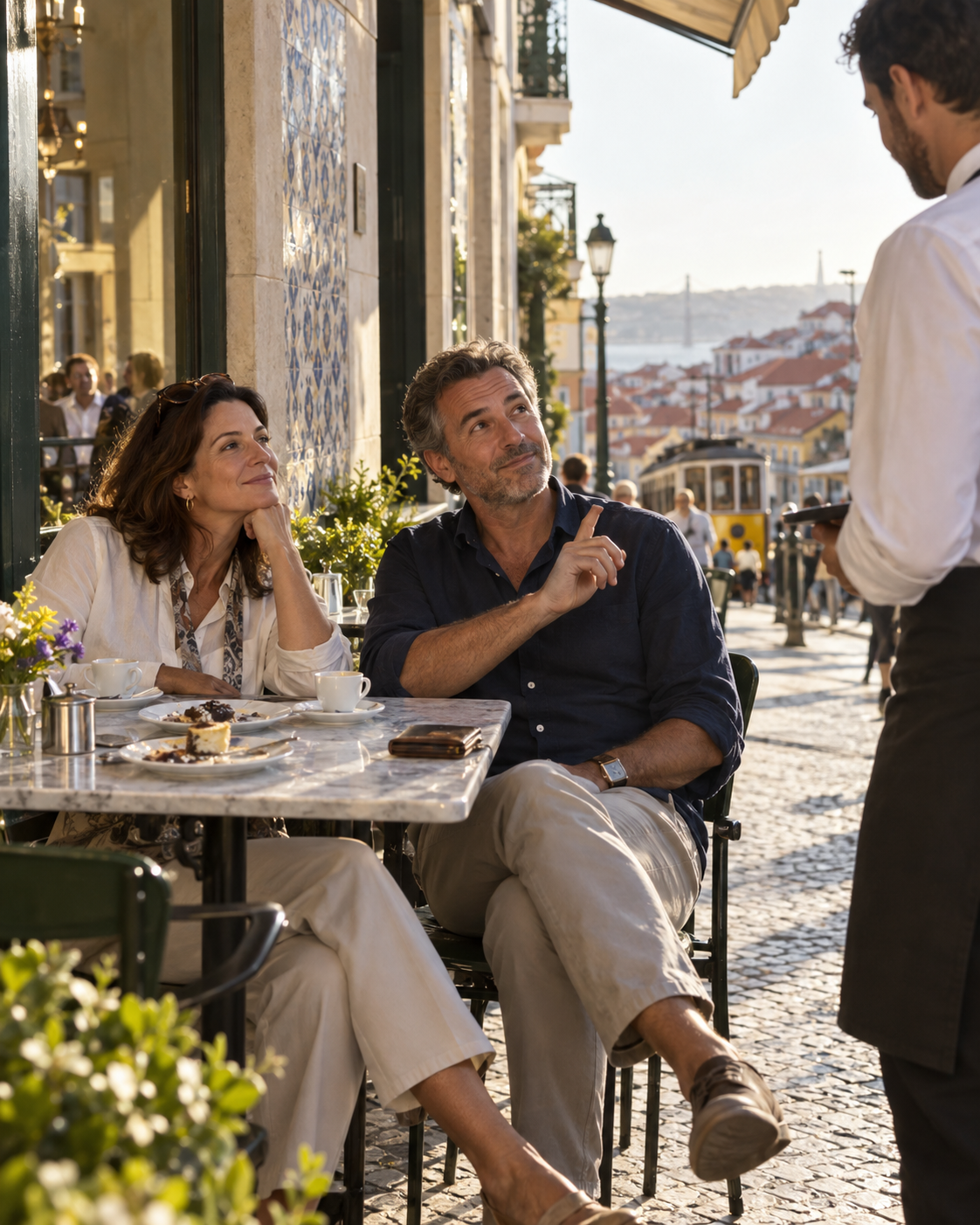
In practice it could not be simpler, and it comes down to a short sequence you can use tonight. When you are ready to pay, look up and catch the waiter’s eye, which in a European restaurant may take a moment of patience since they are deliberately not hovering. Once you have their attention, raise one hand and make the writing or signing motion in the air, and hold it just long enough to be seen. There is no need to be theatrical about it; a small, clear motion at a height the waiter can see across the room is all it takes, and overdoing it only undercuts the quiet discretion that makes the gesture work. The waiter will acknowledge you, usually with a nod, and bring the bill, though even then it may not arrive at breakneck speed, since nothing about the European meal is meant to be rushed. Build in a few minutes of patience even after you have signalled, and you will spare yourself the second wave of frustration that catches out travelers who expect the bill the instant they ask.
A few small refinements make it smoother still. If the waiter happens to be right beside you, there is no need for the mime at all, just quietly ask for the bill by its local name, l’addition in France, la cuenta in Spain, il conto in Italy, and it will come. Keep the gesture small and calm rather than a big theatrical wave, since the whole point is discretion. And if you are in a casual bar or trattoria, skip all of it and simply go pay at the counter. Master this one small signal and you will never again sit stranded at the end of a European meal, waiting helplessly for a check that was always yours to summon. It is among the easiest pieces of travel fluency to learn and among the most immediately useful, paying off the very first evening you put it to work.

About the Author: Ruben, co-founder of Gamintraveler.com since 2014, is a seasoned traveler from Spain who has explored over 100 countries since 2009. Known for his extensive travel adventures across South America, Europe, the US, Australia, New Zealand, Asia, and Africa, Ruben combines his passion for adventurous yet sustainable living with his love for cycling, highlighted by his remarkable 5-month bicycle journey from Spain to Norway. He currently resides in Spain, where he continues sharing his travel experiences with his partner, Rachel, and their son, Han.