Picture the scene. You are at a restaurant in Paris or Rome, you have finished a lovely meal, and you sit back to enjoy the last of your wine, waiting for the waiter to clear your plate. And you wait. And wait. The plate sits there, congealing, while the waiter passes by again and again without touching it, and you begin to wonder whether the service has forgotten you.
What you may not realize is that you have been sending a silent message this whole time, through the position of your knife and fork, and the message you have been sending is please do not clear my plate, I am still eating. In much of Europe, your cutlery talks to the waiter, and most Americans, without knowing it, are speaking the wrong language every single time. It is one of those invisible cultural gaps that causes a small, baffling friction abroad, the kind you feel without ever understanding, until someone finally explains what your fork has been saying on your behalf.
What follows is the silent signal your cutlery sends, the finished position that means come and clear, the pause position that means leave it, and the small mistakes Americans make that quietly confuse European waiters.
Your Cutlery Is Talking to the Waiter
In European dining, the position of your knife and fork on the plate is a genuine, understood language, a way of silently telling the waiter exactly where you are in your meal without having to interrupt your conversation to say so. This is not fussy affectation but a practical, rather elegant system, developed over generations of formal dining, that lets the diner and the server communicate wordlessly. It grew up in an era when it was thought rude to summon or instruct the staff mid-meal, so a silent language did the work that speaking would have done less gracefully. The waiter glances at your plate, reads the position of your utensils, and knows instantly whether to clear it, leave it, or bring the next course, all without a single word passing between you. It is a quietly ingenious solution to a small daily problem, how to coordinate diner and server without either one having to break the spell of the meal.
The whole thing rests on a simple idea, that your knife and fork are like the hands of a clock, and where you leave them says something specific. Two positions matter above all, one that means you are finished and the plate can go, and one that means you are merely pausing and the plate should stay. Get these two right and you will glide through a European meal in perfect silent understanding with the staff, the plate cleared the moment you want it gone and left untouched for as long as you want it there. Get them wrong, or fail to use them at all, and you will either be left with a plate that never gets cleared or, worse, have a plate whisked away while you were still working on it. Both are small indignities, and both are entirely avoidable once you know the code, which is why a minute spent learning it saves a lot of low-grade confusion later. The signals are easy, and knowing them changes how you dine.
The Finished Position

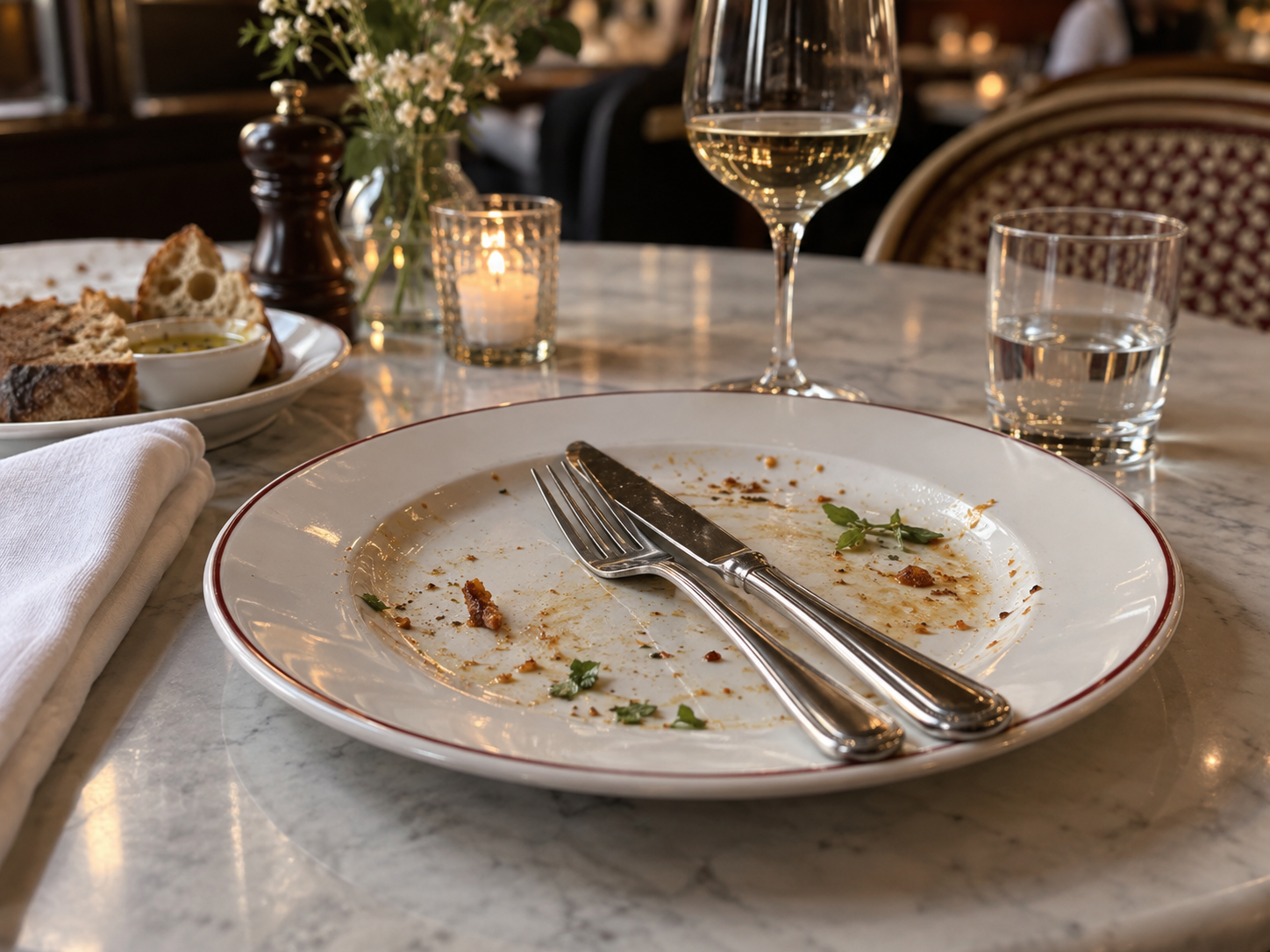
Here is the one that matters most, the signal that tells the waiter you are done and the plate may be cleared. When you have finished eating, you place your knife and fork together, side by side and parallel, resting them diagonally across the plate, as though they were the single hand of a clock pointing to somewhere around four o’clock. The handles rest at the edge of the plate, the knife blade turned inward toward the fork, and the two utensils lie neatly together rather than splayed apart. Some people picture it as the two hands of a clock brought together to point the same way, which is a useful image, since the neatness is half the signal. That tidy, parallel placement is the universal European sign for I am finished, please take my plate. Think of the two utensils lying down together to rest, side by side, the meal over, and you will remember it easily, since the image matches the meaning.
There is one small but telling detail that separates the European version from the American one, and it is the direction the fork tines face. In the strict European or continental style, the fork is laid down with its tines facing down, whereas Americans habitually leave the fork tines up. It is a tiny difference and no European waiter will think less of you for tines up, but it is the little tell that marks a diner as American rather than continental.
The essential thing, the part that actually communicates finished, is simply that the knife and fork lie together and parallel across the plate, tines up or down. Nail that, and the tine direction is a refinement you can add or ignore as you please. Do that, and any European waiter will read you loud and clear. The tidiness matters too, since utensils flung down at odd angles read as carelessness rather than a clear signal, whereas the neat parallel placement looks deliberate and says finished in a way no one can misread.
The Pause Position

Just as important, and more often gotten wrong, is the signal for I am not finished, please leave my plate, because this is where Americans most often send exactly the wrong message. When you are pausing mid-meal, to talk, to sip your wine, to rest for a moment, you do not leave your utensils together, since together means done and you are not done. Instead you cross them, laying the knife and fork across each other on the plate, often in a loose X or an inverted V shape with the tips meeting and the handles apart. Crossed cutlery is the European signal for still eating, do not clear.
This is the crucial thing for Americans to understand, because in much of the United States the convention is muddier, and many Americans cross their cutlery to mean the opposite, that they are done. An American who finishes a meal and crosses the knife and fork to signal finished has, in European terms, just told the waiter to leave the plate alone, which is precisely why the plate never comes. The diner grows steadily more impatient, the waiter steadily more careful to respect what looks like a clear do-not-disturb, and the two are locked in a silent misunderstanding neither one knows is happening.
Meanwhile an American who is merely pausing but leaves the utensils lying parallel may find the plate cleared out from under them mid-meal. The crossed-means-pause, parallel-means-finished system is consistent across Europe, and it is the opposite of what many Americans instinctively do. This single reversal is probably the most useful thing in this whole piece, because it explains both classic frustrations at once, the plate that will not go away and the plate that vanishes too soon, and fixing it fixes both.
The Mistakes Americans Make

Beyond mixing up the two main signals, there are a few other habits that mark an American at a European table and can muddle the message to the waiter. The most common is simply not using the signals at all, leaving the knife and fork wherever they happen to land when you stop eating, which gives the waiter no clear information and leaves them guessing. To a European server it is a little like being asked a question and getting only a shrug in reply, since the plate is supposed to answer and instead says nothing. In a culture where the cutlery is supposed to speak, silence, or rather a mumble, leaves the staff unsure whether to approach. A good waiter faced with ambiguous cutlery will usually err on the side of not clearing, so as not to snatch away a plate someone is still enjoying, which means the uncertain signal almost always defaults to the plate staying put.
Then there are the small faux pas of placement. Resting your cutlery half on the plate and half on the table, with the handles on the tablecloth, is considered poor form throughout Europe, where the rule is that used utensils belong on the plate, never touching the table. Propping a knife against the plate like an oar, dropping cutlery into a bowl or cup, or stacking your plates to help the waiter, a kindly American instinct, are all small missteps in the European context. None of them is a catastrophe, and no one will scold you, but together they mark the diner who has not learned the quiet grammar of the European table, and any one of them can leave a waiter uncertain about whether you are truly finished. The stacking instinct is a particularly American kindness, born of helpfulness, but in Europe it slightly disrupts the waiter’s own practiced routine and, more to the point, tells them nothing clear about whether you are done.
Why the System Exists
It is worth understanding why Europeans bother with all this, because the reason is genuinely charming and makes the whole thing easier to remember. The cutlery signals exist to allow the meal to proceed without the waiter ever having to interrupt the diners, which reflects a deep European belief that a meal is about conversation and company, and that the service should be as unobtrusive as possible. Rather than a waiter breaking into your discussion to ask whether you have finished, the plate itself answers the question, so the flow of the evening is never broken. A good European dinner can run for hours precisely because it is never interrupted by these small transactional questions, and the cutlery code is one of the quiet mechanisms that makes that possible.
This is the same instinct that makes European service feel more relaxed and less hovering than the American kind, where a waiter may check in repeatedly and clear plates the moment a fork goes down. In the European model, the diner sets the pace and the cutlery does the talking, which gives a meal its unhurried, conversational rhythm, the sense that the table is yours for as long as you want it. Once you see the signals in that light, as a piece of quiet consideration rather than stuffy formality, they stop feeling like a test to pass and start feeling like a small, civilized courtesy worth adopting. Far from being snobbish, the system is really a kindness, a way of making everyone’s evening run a little more smoothly, the diner’s and the waiter’s alike.
It Works Far Beyond Europe

Here is a bonus that makes learning the signals doubly worthwhile: they are not only useful in Europe but understood in good restaurants almost everywhere, because this cutlery language originated in European fine dining and spread with it around the world. Any well-trained waiter, in a serious restaurant in New York, Tokyo, or Sydney, will very likely recognize the finished and pause positions, since they are the standard grammar of professional service internationally. Learn them for a trip to France, and you carry them home to use in any decent restaurant for the rest of your life. It is a rare piece of travel knowledge that keeps paying dividends long after you have unpacked, useful at every proper dinner you attend from now on.
This is part of what makes the signals worth the tiny effort of memorizing. They are not an obscure local custom you will use once and forget, but a genuinely portable piece of dining fluency, the sort of quiet competence that serves you at a business dinner, a wedding, or a special-occasion restaurant just as well as on a European holiday. In an age when so much about dining has grown casual, knowing how to silently and correctly tell a waiter you are finished is a small, durable mark of someone who moves through the world with a little polish. It costs nothing to learn and pays off at every good table you ever sit at, which is about the best return any small piece of knowledge can offer.
How to Get It Right

Putting this into practice is genuinely simple, and it comes down to remembering just two positions for the rest of your travels. When you are taking a break, cross your knife and fork on the plate, and the waiter will leave you in peace. When you are finished and ready for the plate to go, lay them together, parallel, diagonally across the plate, tines down if you want to do it the full continental way, and the plate will be cleared without a word. That is the entire system, two positions, one meaning still eating and one meaning done.
Master those two, keep your cutlery on the plate rather than the table, and resist the urge to stack or tidy, and you will dine through Europe in effortless silent partnership with the staff, never again left with an uncleared plate or startled by one vanishing too soon. It is genuinely satisfying, the first time you do it deliberately and watch the waiter respond exactly as you intended, like discovering a small secret handshake that has been in use all around you for years. It is a tiny piece of etiquette, but it is one of those small keys that makes travel smoother and makes you feel less like a tourist and more like someone who knows how things are done. The next time your plate sits stubbornly uncleared in a Paris bistro, you will know exactly why, and exactly how to fix it, with a small, confident adjustment of your knife and fork that quietly tells the waiter everything they need to know.

About the Author: Ruben, co-founder of Gamintraveler.com since 2014, is a seasoned traveler from Spain who has explored over 100 countries since 2009. Known for his extensive travel adventures across South America, Europe, the US, Australia, New Zealand, Asia, and Africa, Ruben combines his passion for adventurous yet sustainable living with his love for cycling, highlighted by his remarkable 5-month bicycle journey from Spain to Norway. He currently resides in Spain, where he continues sharing his travel experiences with his partner, Rachel, and their son, Han.