
Wander through a French Christmas market on a cold December evening and the smell will find you before the stall does. Warm red wine, orange, and spice, rising in clouds of steam from great kettles, drawing you in with the promise of something to cup in your cold hands.
This is vin chaud, which means simply hot wine, and it is France’s beloved winter warmer. At a glance it looks just like the German Gluhwein you may have met at a market across the border, and the two are indeed close cousins.
But a French cup has its own character. Vin chaud tends to be lighter, a little less sweet, and more forward with citrus and spice, letting the wine itself show through rather than burying it. Here is what vin chaud actually is, its long history, how it really compares to Gluhwein, what gives it the French touch, and how to make a potful at home. It is one of the easiest and most rewarding things you can make to bring a French Christmas market into your own kitchen.
France’s Mulled Wine
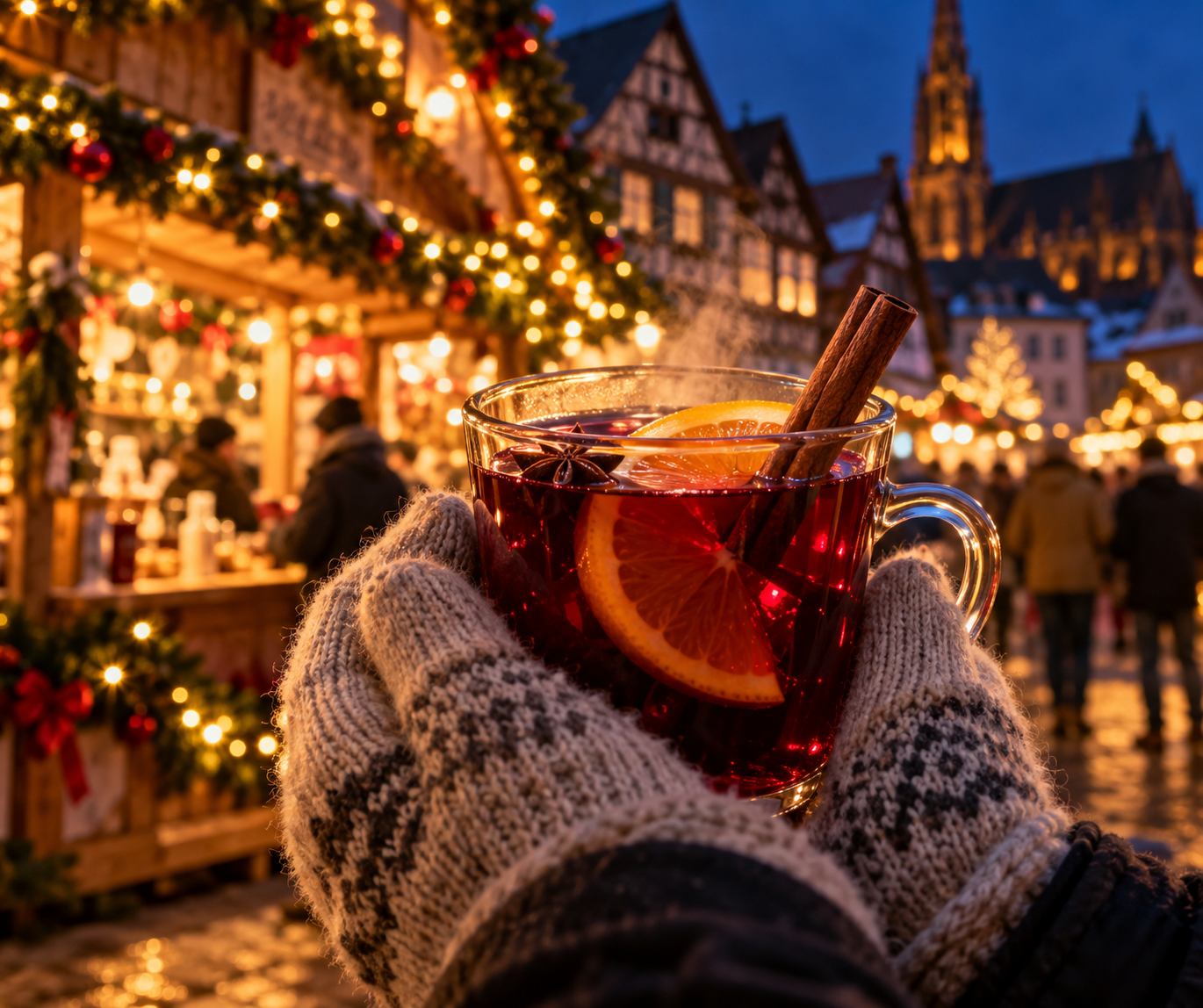
Vin chaud is, at heart, red wine gently warmed with sugar, citrus, and warm spices. The spicing leans on cinnamon, star anise, cloves, and often cardamom and fresh ginger, while slices of orange and sometimes lemon bring a bright citrus note that runs right through the drink.
It is sweetened, but usually with a lighter hand than its German cousin, often with brown sugar or honey. The whole thing is heated gently, never boiled, so the spices infuse and the wine stays warm and aromatic without losing its kick.
The result is a drink that is both comforting and a little elegant, warming you from the inside on a freezing night while still tasting, unmistakably, of wine.
It is one of the great simple pleasures of a French winter. For many people it is also pure nostalgia in a cup, the taste that brings back a particular market, a particular cold evening, a particular set of fairy lights, all in a single warm mouthful.
An Ancient Winter Ritual
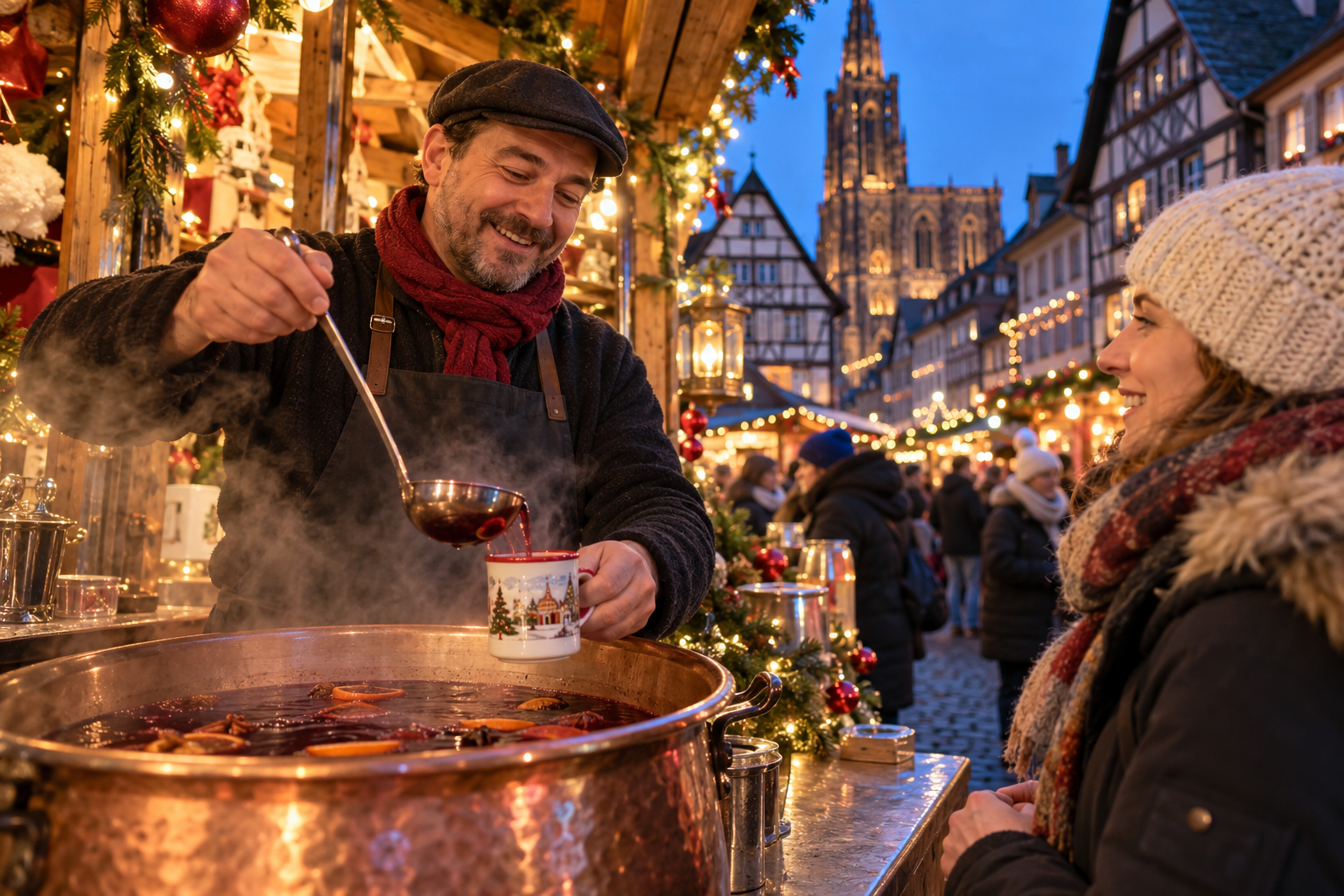
Mulled wine is far older than the Christmas markets that now sell it, and vin chaud carries that long history in every cup. The practice of heating and spicing wine reaches back to the ancient Romans, who warmed their wine and added spices and honey against the cold of winter.
For centuries there was a practical side to it too. Spices were expensive and exotic, carried along the great trade routes, and adding them to wine was partly a way to make a rough or souring batch more pleasant to drink. A heated, spiced, sweetened wine was also long thought to be good for you, warming and restorative, even an aid to digestion.
By the time the European Christmas markets took their modern shape, mulled wine had become the drink of the season, less a medicine than a pleasure. Vin chaud sits at the end of that very long line, an ancient ritual of comfort against the dark and cold, now wrapped up in fairy lights and poured by the cupful at the market.
Cousins, Not Twins

It is worth being honest about the Gluhwein question, because vin chaud and Gluhwein are not really different drinks so much as regional versions of the same idea. Both are mulled wine, that ancient European tradition of warming and spicing wine against the cold, and both go back, in spirit, all the way to Roman times.
The differences are mostly ones of degree and style. German Gluhwein, whose name means glowing wine, tends to be sweeter, and is often given a shot of rum or liqueur to fortify it. French vin chaud more often leans lighter and more citrus-forward, served straight, with the wine kept more present and the sweetness dialed back.
The line blurs at the border, too. In Alsace, the French region closest to Germany and heavily shaped by it, vin chaud is made in a style very close to Gluhwein, heavily spiced and sweet. So when a French person insists that vin chaud is not Gluhwein, they are expressing a real difference of style and a certain national pride, rather than describing a completely different drink.
The two are cousins, and lovely ones. Which you prefer tends to come down to whether you like your mulled wine sweeter and fortified, in the German way, or lighter and more wine-forward, in the French one. There is no wrong answer, and a cold December is long enough to try both.
The French Touch
A few things tend to give a good vin chaud its particularly French character. Star anise is often more prominent than in a German cup, lending its distinctive sweet, licorice-like warmth. The citrus is generous, with both orange and lemon common, and some recipes add a split vanilla pod for roundness.
The wine matters too. The French reach for a dry, fruity French red, something like a Cotes du Rhone or a Pinot Noir, nothing expensive, but a proper wine that can hold its own against the spices rather than disappearing into sugar. And crucially, vin chaud is most often served just as it is, without the extra shot of spirit that a German Gluhwein might get, which keeps it lighter and lets the spiced wine speak for itself.
None of this is rigid. Every French family and every market has its own recipe, with its own balance of spices and sweetness. But the overall effect, when it is done well, is a mulled wine that feels a little more restrained and wine-forward than its sweeter German relative.
A Cup at the Market
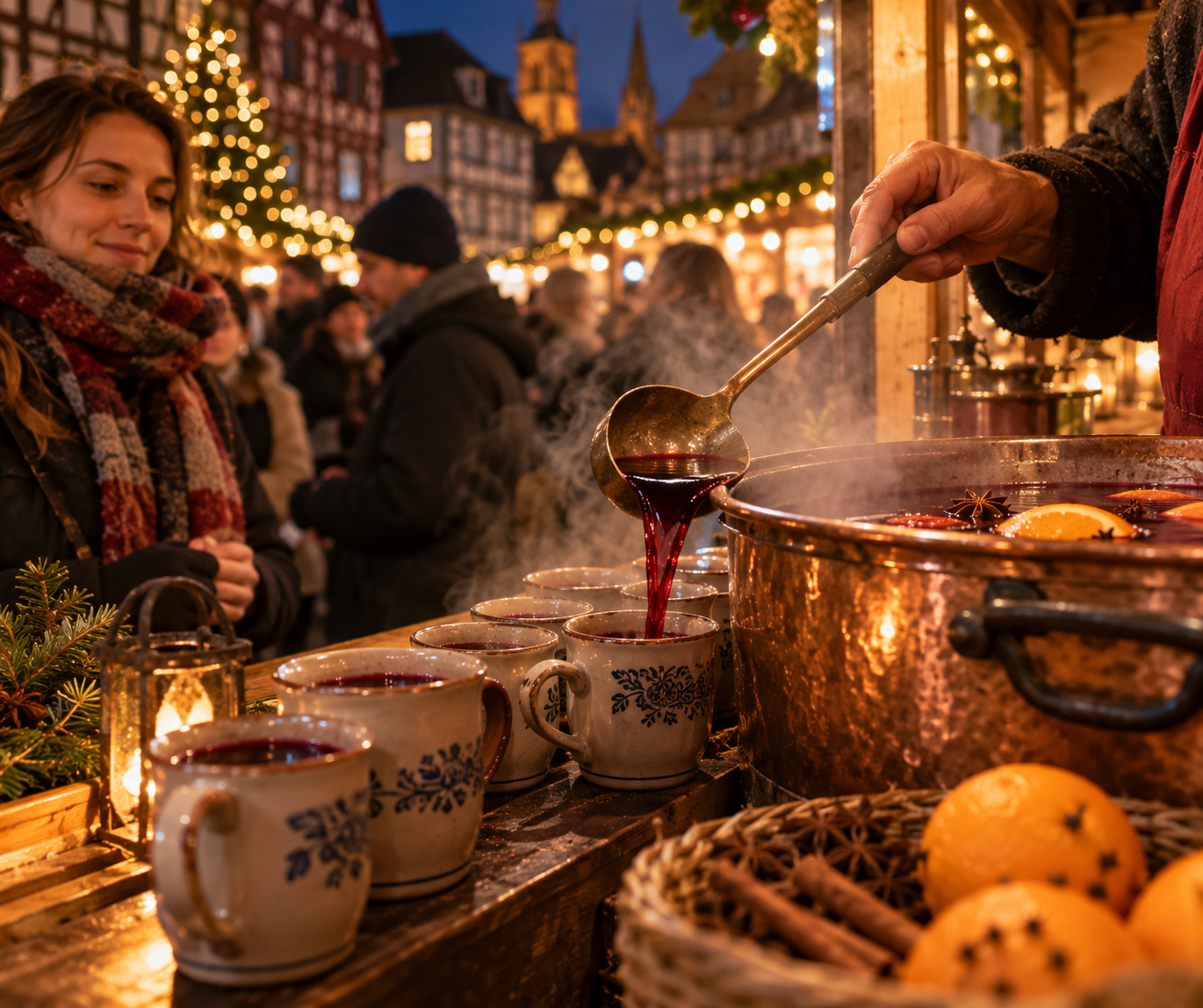
To drink vin chaud the proper way is to drink it outdoors, in the cold, at a Christmas market. It is poured by the liter from huge steaming pots, ladled into cups and handed over to be wrapped in gloved hands, the heat of it as welcome as the taste.
France’s great home of the Christmas market, and of vin chaud, is Alsace, where the markets of cities like Strasbourg and Colmar are among the most famous and beautiful in all of Europe. Wandering those fairy-lit wooden stalls with a cup of vin chaud warming your hands is one of the quintessential experiences of a European December.
The cup itself is part of the ritual. Like the German markets, French ones often serve the wine in a souvenir mug with a deposit, so you can keep the cup as a memento or return it for your coins, sipping as you drift from stall to stall.
Vin chaud also takes its place in the wider family of European mulled wines, alongside the German Gluhwein and the Nordic glogg, each country warming its winter with its own spiced cup. They are all variations on the same ancient, comforting theme, and a French vin chaud is the lighter, more citrus-bright member of the family.
A Drink Made for the Market
Vin chaud is really inseparable from the place you drink it, and that place is the Christmas market. All over France through December, the markets fill the squares with wooden chalets, strings of lights, and the smell of roasting chestnuts, and somewhere among them a great pot of vin chaud is always steaming away.
It is the drink that makes the cold bearable and the evening magical. You buy a cup, wrap your gloved hands around it, and wander the stalls, warmed from the inside as you browse the crafts and the food, the heat of the cup as much the point as the taste. A French Christmas market without a vin chaud in hand is barely a Christmas market at all.
The heartland of all this is Alsace, in France’s northeast, where the German influence runs deep and the Christmas markets are among the oldest and most beautiful in Europe. The markets of Strasbourg and Colmar draw visitors from around the world, and vin chaud flows at every turn, poured by the liter into the cold December air. If you want to taste vin chaud at its most magical, that is where to go.
But you do not need a trip to France to enjoy it, which is the lovely thing about making it at home. A pot of vin chaud on the stove fills a house with the smell of orange and spice, and a cup of it turns an ordinary cold evening into something festive. It is one of the simplest ways to bring a little of the European Christmas market into your own kitchen, no plane ticket required.
Part of the joy of making it is that there are no strict rules. Every French household has its own balance of spice and sweetness, its own preferred wine, its own little additions, and you are encouraged to find yours.
Start with the classic framework, taste as you go, and adjust until the cup tastes like your idea of a cold December evening. That freedom to make it your own is exactly how the French treat it. There is no single authoritative recipe to live up to, only a warm, spiced, citrusy cup of red wine and the good company to share it with, which is really all vin chaud ever asked to be.
Make It: Vin Chaud
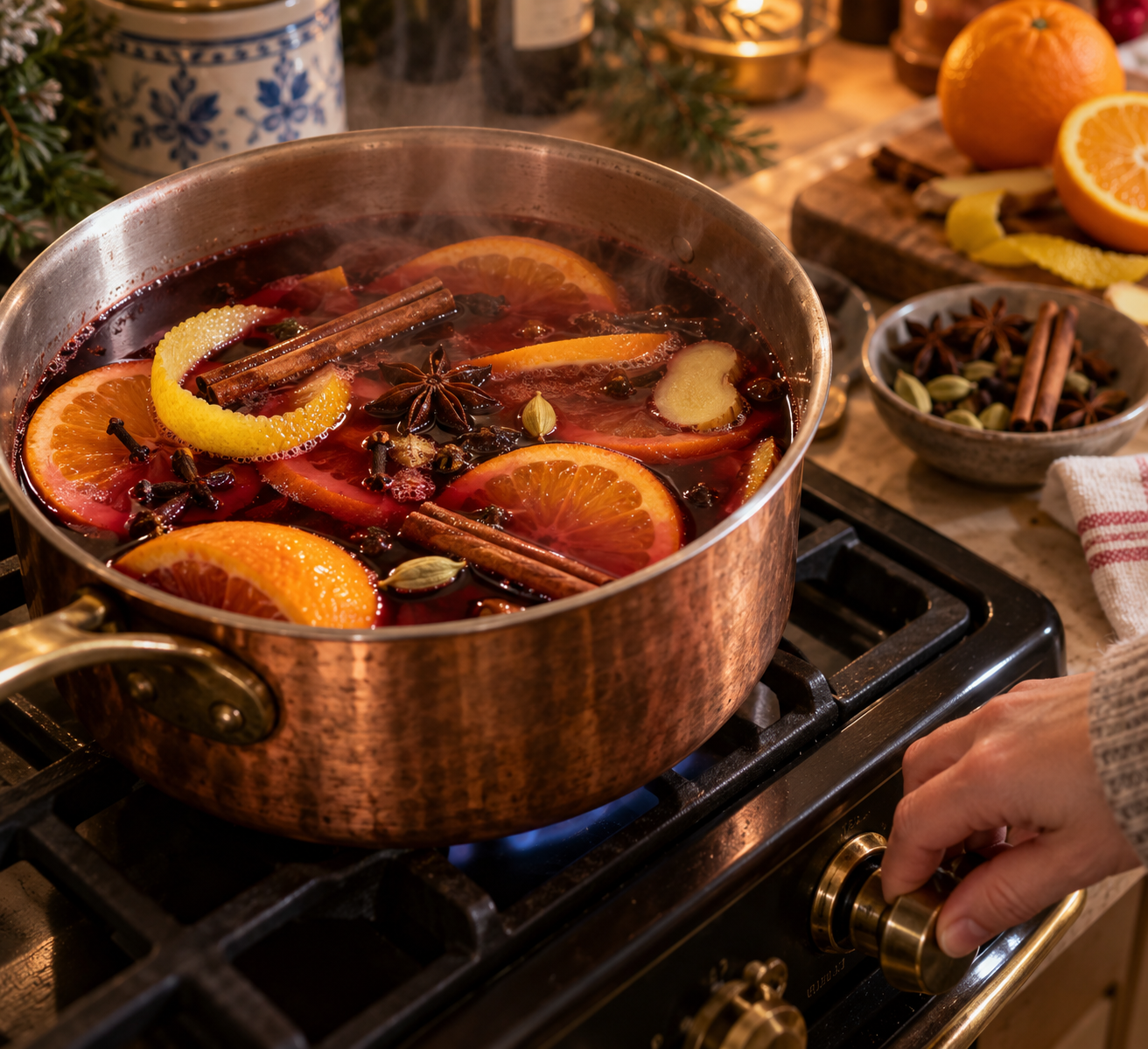
Here is a classic, lighter French version, making about six small cups. Use a decent but inexpensive dry red, and remember the golden rule of all mulled wine: never let it boil.
Ingredients
- 1 bottle (750ml) dry, fruity red wine
- 1 orange, sliced
- peel of 1 lemon, in strips
- 3 tablespoons brown sugar or honey, to taste
- 2 cinnamon sticks
- 2 star anise
- 4 whole cloves
- 3 cardamom pods, lightly crushed
- a few thin slices of fresh ginger
Instructions
- Pour the wine into a saucepan and add the sugar or honey.
- Warm gently over low heat, stirring, until the sugar has fully dissolved. Do not let it boil at any point.
- Add the orange slices, lemon peel, cinnamon sticks, star anise, cloves, cardamom, and ginger.
- Keep the mixture over low heat, barely steaming and never bubbling, for at least 20 to 30 minutes so the spices and citrus infuse the wine.
- Taste and adjust the sweetness if you like, then strain out the spices and citrus.
- Ladle the hot vin chaud into cups and serve at once, each with a fresh slice of orange. Drink it somewhere cold, if you can.

About the Author: Ruben, co-founder of Gamintraveler.com since 2014, is a seasoned traveler from Spain who has explored over 100 countries since 2009. Known for his extensive travel adventures across South America, Europe, the US, Australia, New Zealand, Asia, and Africa, Ruben combines his passion for adventurous yet sustainable living with his love for cycling, highlighted by his remarkable 5-month bicycle journey from Spain to Norway. He currently resides in Spain, where he continues sharing his travel experiences with his partner, Rachel, and their son, Han.