
Few images say Santorini like the donkey ride. The whitewashed town perched on the cliff, the blue domes, and the line of donkeys and mules carrying tourists up the steep, zigzagging steps from the old port far below. For generations it has been one of the island’s signature experiences, and for many cruise passengers it is high on the list of things to do.
But there is a rule now that catches a lot of visitors completely off guard. If you weigh too much, you are not allowed to ride.
Greece has set a legal limit on how much weight these animals can be made to carry, and the practical effect is that heavier tourists are turned away from the donkeys and told to walk the steps or take the cable car instead.
For the passengers it surprises, it can be an awkward, even upsetting moment. But the rule is not really about the tourists at all; it is about the donkeys, and the uncomfortable truth of what was being done to them.
Here is what the rule actually is, the climb that caused it, why the animals needed protecting, how to think about it kindly, and the better way up the cliff. It turns out to be less about weight than about the welfare of some very tired animals.
The Rule About the Donkeys
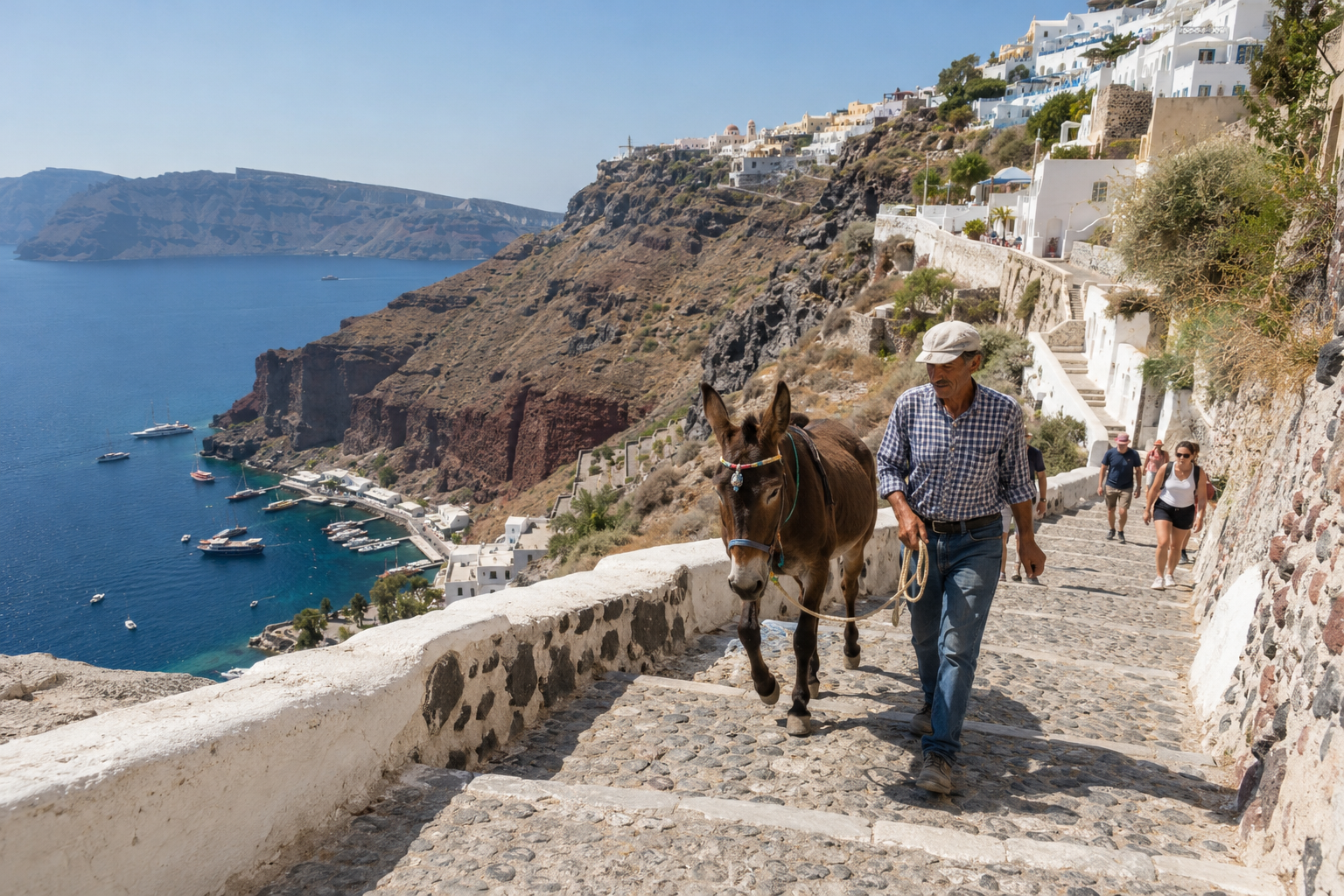
The rule comes from Greek animal-welfare law, which was updated some years ago to protect working donkeys, mules, and horses from being overloaded. The core of it is a simple weight limit: these animals should not be made to carry a load heavier than a hundred kilograms, roughly two hundred and twenty pounds, or more than one-fifth of the animal’s own body weight.
On paper, it is a rule about loads and animals, and it never mentions tourists at all. But everyone understood immediately what it meant in practice, especially on Santorini. If a donkey cannot carry more than a hundred kilograms, then a rider who weighs more than that, once you account for the saddle and gear, simply cannot be allowed on the animal’s back.
So without ever naming them, the law effectively bars heavier tourists from the famous donkey ride. The weight limit is the operative fact, and the rest follows. It is enforced, in principle, by the people running the rides and by the authorities, and it has periodically made headlines, sometimes framed as a brand-new ban even though it has been on the books for several years now.
That recurring confusion is worth clearing up. Every so often, fresh photos of overloaded or injured donkeys surface online, and the story circulates again as though a weight limit had just been introduced. In fact the rule has been Greek law for years; what keeps resurfacing is the gap between the rule on paper and what still sometimes happens on the ground.
The Climb That Caused It
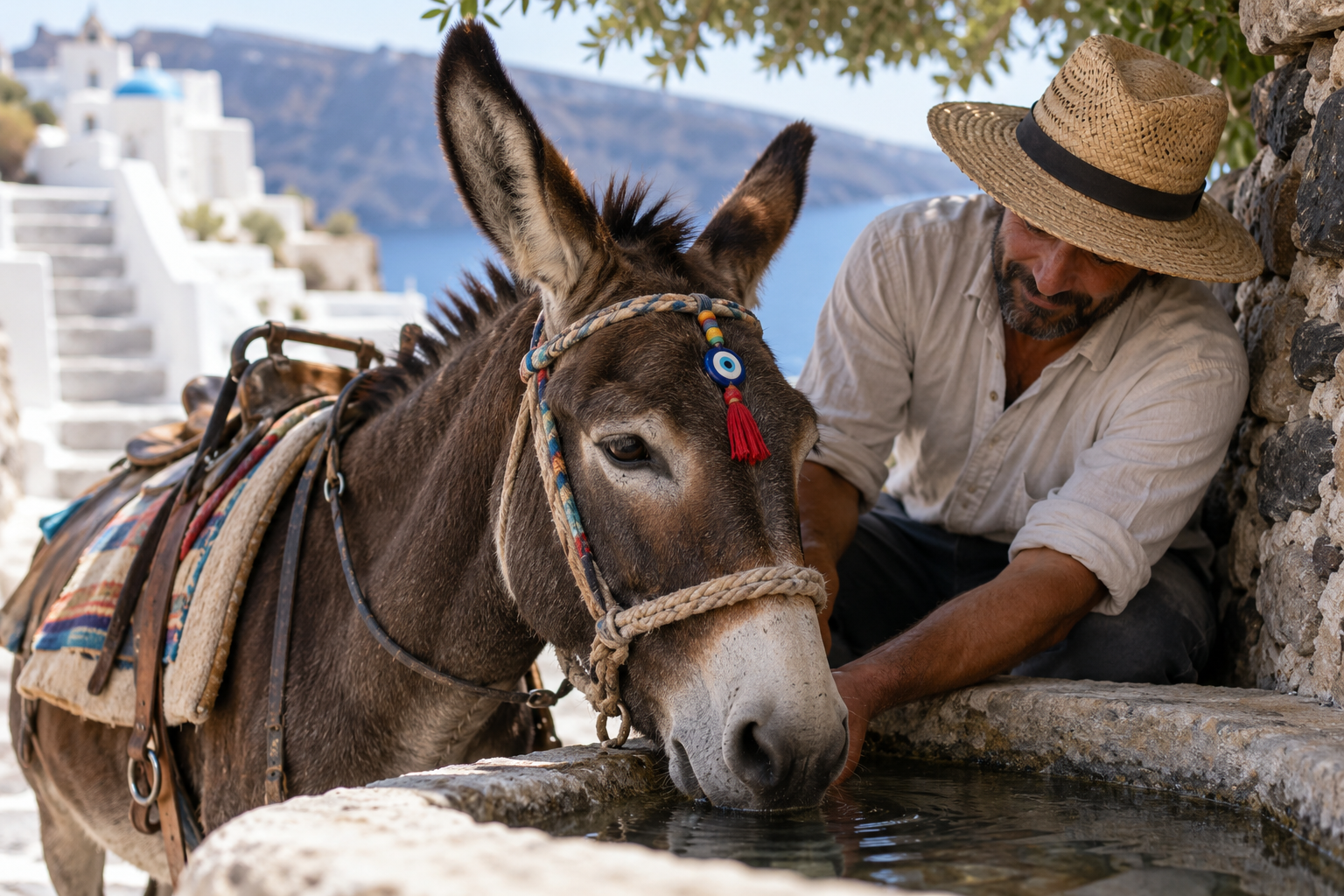
To understand why this became such an issue, you have to picture the climb itself, because it is genuinely brutal. The old port of Santorini sits at the base of the caldera cliff, and the main town is perched at the top, hundreds of feet above. Connecting them is a long, steep staircase of several hundred stone steps, switchbacking up the cliff face in the fierce Mediterranean sun.
For centuries, the donkeys and mules of the island were the way up and down this cliff, carrying people and goods on their backs along the only route there was. The donkey ride is not a modern gimmick invented for tourists; it grew out of the island’s real history, when these sure-footed animals were essential transport on terrain too steep for anything else.
The trouble is that what the donkeys do now bears little resemblance to that older, gentler arrangement. Instead of the occasional islander or a modest load, the animals face a relentless daily procession of tourists, often in the brutal heat, making the same exhausting climb over and over, trip after trip, all day long through the high season. A climb that was always hard became, under the pressure of mass tourism, something close to an ordeal.
The numbers are the heart of it. When several cruise ships are in port at once, thousands of visitors can pour onto the island in a single morning, and a significant share of them head straight for the donkey ride as the quintessential Santorini photo. The animals, a finite and tiring resource, are pushed to meet a demand that balloons far beyond anything their older role ever involved.
Why the Donkeys Needed Protecting
The reason the law was needed is not pleasant, but it is important. Under the strain of carrying heavy riders up that punishing staircase, day after day, the donkeys of Santorini were being seriously hurt, and animal-welfare groups had documented the damage in distressing detail.
The injuries were real and specific. The animals suffered spinal problems and back injuries from loads too heavy for their frames.
There were open sores and wounds from ill-fitting saddles rubbing on the long climbs, and exhaustion and dehydration from working in the fierce heat with too little rest, water, or shade. It was not a case of a few overworked animals but a documented, systemic problem. A body of evidence built up showing that the donkeys were paying a genuine physical price for the rides.
Part of the problem was simple arithmetic. Cruise tourists, often coming from countries where people are on average considerably larger than the islanders the donkeys were historically used to, were in many cases far heavier than the animals could safely bear, especially repeated many times a day. The weight limit was a direct response to that: a line drawn to stop the animals from being loaded beyond what their bodies could take. Behind the awkwardness of telling a tourist they cannot ride lies a straightforward goal, which is sparing the donkey a spinal injury.
It is also worth saying that the donkeys cannot refuse. A horse might balk or an elevator might simply stop, but a working donkey will keep carrying what it is loaded with until it is hurt, because that is what it has been trained and driven to do. The weight limit exists precisely because the animal has no way to say that a load is too much; the law has to say it on the donkey’s behalf.
The Rule That Shocked Cruise Passengers
For the passengers on the receiving end, the rule can land as a genuine shock, and it is worth being honest and kind about that. Being told, often in front of a crowd, that you are too heavy to ride an animal is an uncomfortable thing, and it is easy to see why it can feel embarrassing or even humiliating.
But it is worth holding onto what the rule is actually about, because the framing matters enormously. This is not a judgment of anyone’s body or a comment on how a person looks. It is a measurement about the load on an animal’s spine, the same kind of weight limit you would find on an elevator or a small boat or a zip line, applied here to a living creature that cannot speak up for itself.
Seen that way, there is no shame in it, for anyone. A weight limit on a donkey is simply a fact about donkeys, not about people, and being over it says nothing about the rider except that a different way up the cliff is the right choice today. The kindest and most dignified response, for the tourist and the animal alike, is to shrug it off and take one of the easy alternatives, of which there is a very good one.
And honestly, most people who have ridden the donkeys do not remember it as the highlight they expected. The ride is lurching, a little nerve-wracking on the narrow cliff path, and shadowed for many by the visible tiredness of the animals. Plenty of former riders come away wishing, in hindsight, that they had simply taken the cable car and spared both themselves and the donkey the experience.
Walk, or Take the Cable Car
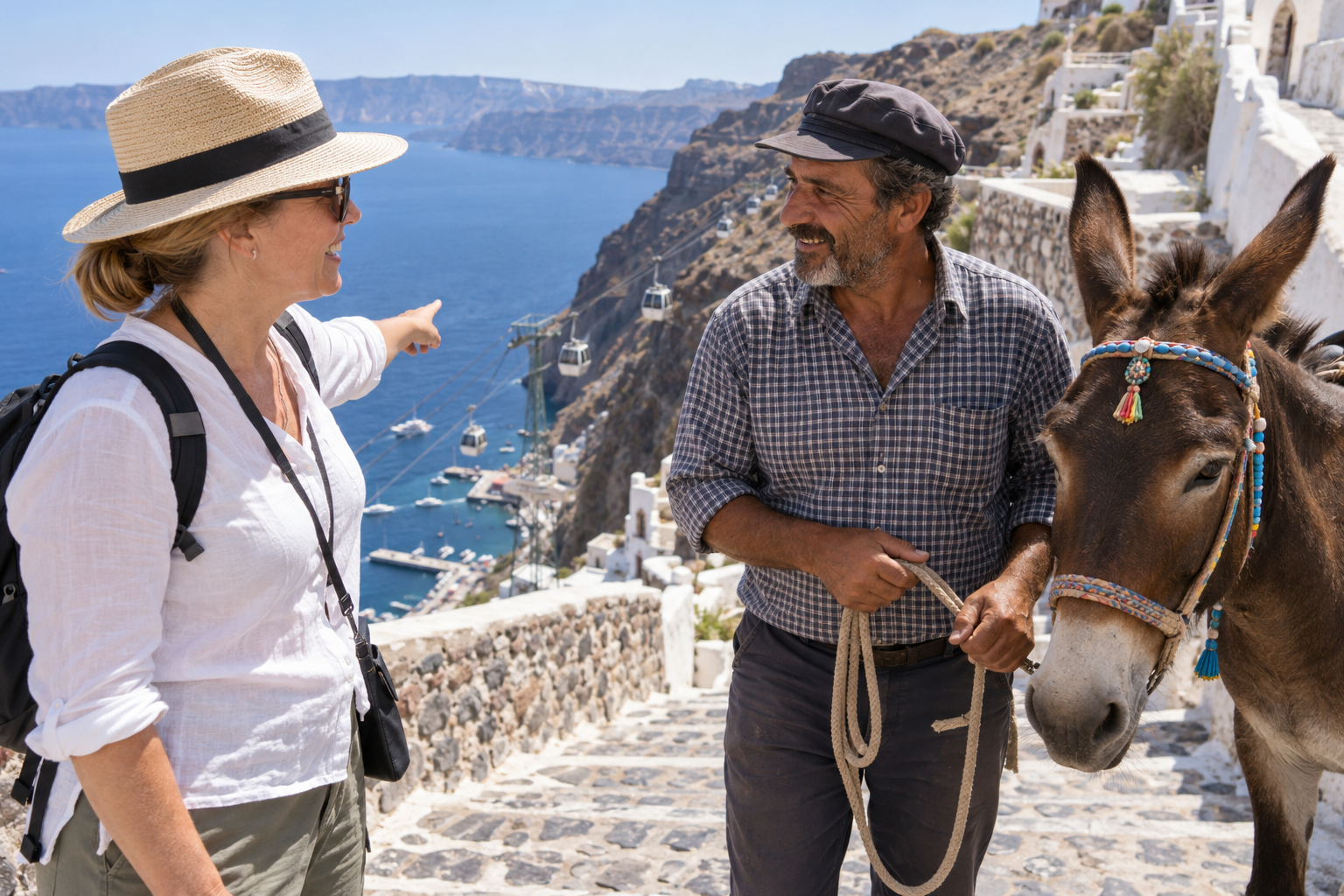
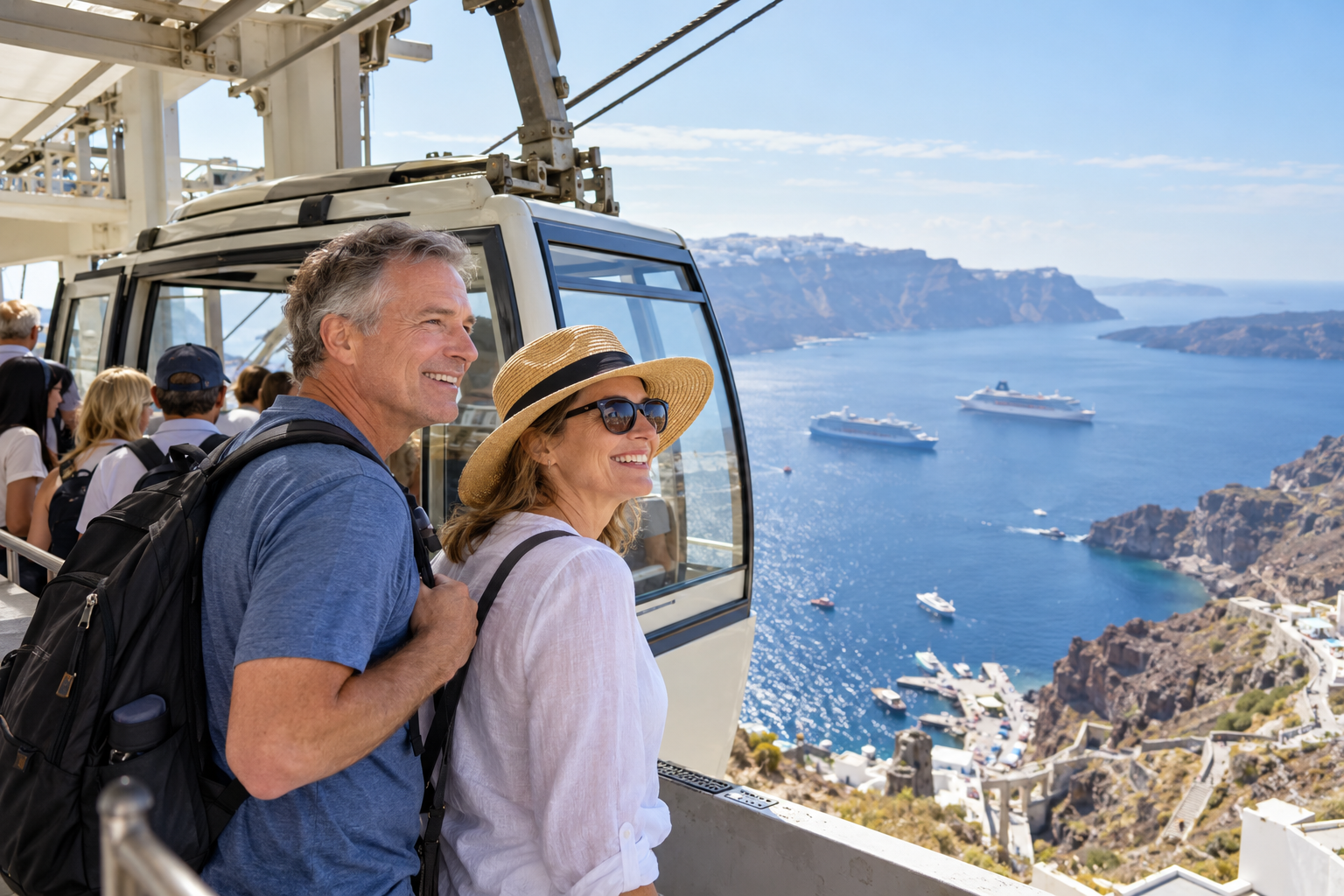
The genuinely good news is that nobody actually needs to ride a donkey up that cliff, because there is a fast, cheap, and humane alternative sitting right there. A cable car runs up and down the caldera, whisking passengers between the old port and the town in a few effortless minutes for a small fare.
The cable car is, by almost any measure, the better option anyway. It is quick, it offers spectacular views over the caldera as you rise, it spares you the heat and the steep climb, and, crucially, it does not involve a tired animal at all. For most visitors, taking the cable car is simply the sensible way up, donkey rule or no donkey rule.
There is one practical catch worth knowing: when the big cruise ships are in, the cable car can develop long queues, since thousands of people are trying to use the same small system at once. This is, ironically, part of what historically pushed impatient tourists toward the donkeys in the first place. The fix is simple patience, or timing your trip up or down for a quieter moment, rather than reaching for the animals as a shortcut.
The other alternative is to walk, and plenty of people do. The staircase is free and open to anyone, and walking it is a real Santorini experience in its own right.
It does come with caveats, though: it is steep, it is hot, it takes real effort, and you share the steps with the donkeys and, inevitably, with what the donkeys leave behind. Many people find walking down more pleasant than up, letting gravity do the work and saving the climb for the cable car. Going down on foot and up by cable car is, for a lot of visitors, the ideal combination, giving you the experience of the staircase without the punishing uphill slog in the sun. Either way, between the cable car and your own two feet, there is never any real need to put your weight on a donkey’s back.
An Uncomfortable Truth About Tourism
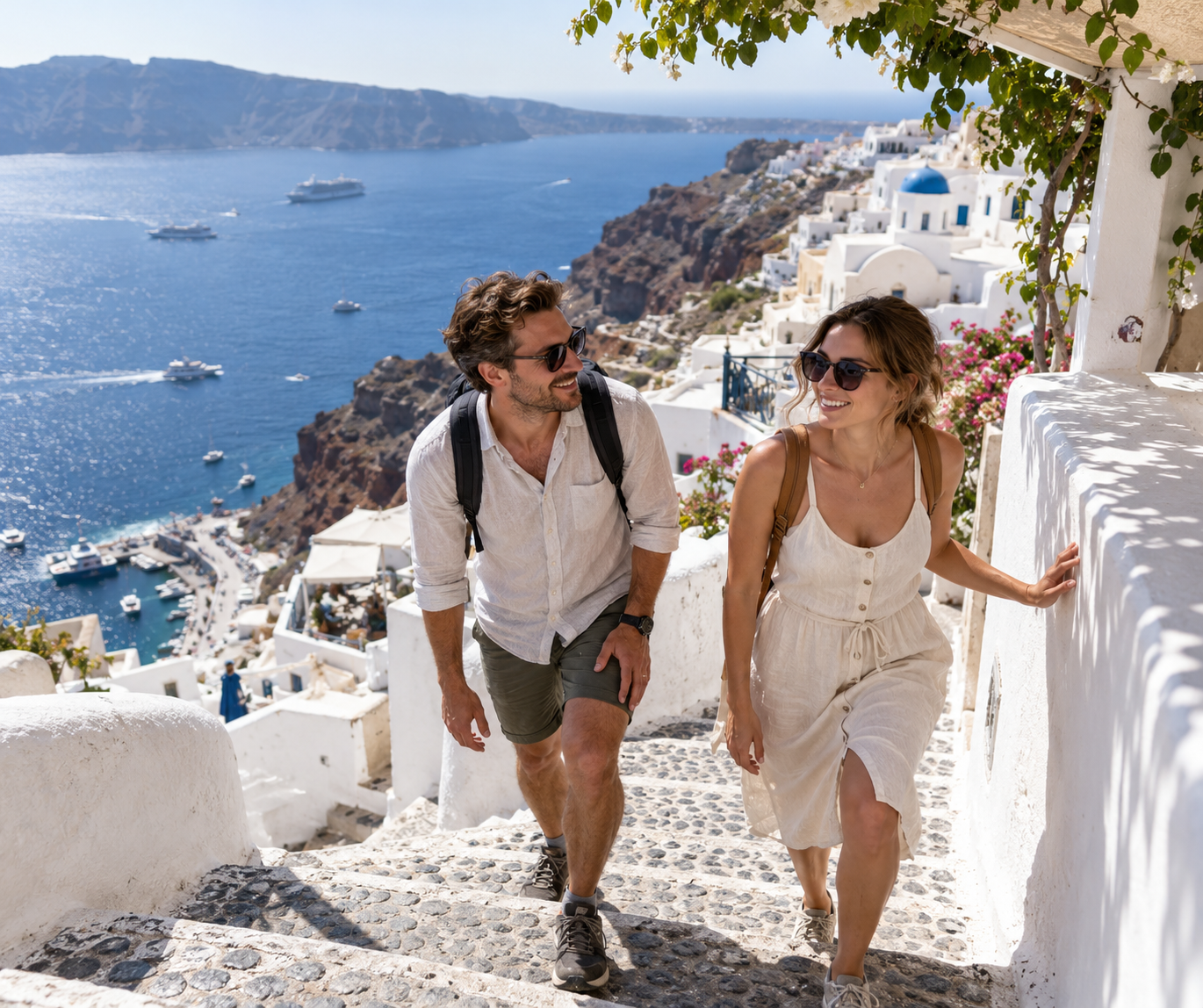
Step back, and the Santorini donkey rule is a small, vivid example of a much larger and more uncomfortable question about travel, which is how we treat the living things caught up in it. For a long time, the donkeys were simply a prop in other people’s holiday photos, their suffering invisible to the smiling tourists on their backs.
Santorini is not unique in this. All over the world, animals are folded into the tourist experience as rides, photo opportunities, and attractions, often with little thought for the toll it takes on them, from elephants in Asia to horses pulling carriages in city heat. The island’s tired donkeys are simply one of the more visible and better-documented cases, which is part of why they have drawn so much attention.
The weight limit is a modest correction, and many animal-welfare advocates argue it does not go nearly far enough. They point out that even a rider under the limit still represents a hard climb many times a day for an animal in the heat, and a growing number of voices call for the tourist rides to be phased out altogether, leaving the donkeys to rest and the cable car to do the carrying. The weight rule, in this view, is a first step rather than a solution.
Wherever you land on that larger debate, the individual choice in front of a visitor is simple and kind. You do not have to ride the donkey.
The cable car is faster, cheaper, and more comfortable, and choosing it costs you nothing and spares an animal a difficult trip. The rule that shocks some cruise passengers is, in the end, pointing everyone toward the same gentle conclusion: let the donkeys rest, and take the car up.

About the Author: Ruben, co-founder of Gamintraveler.com since 2014, is a seasoned traveler from Spain who has explored over 100 countries since 2009. Known for his extensive travel adventures across South America, Europe, the US, Australia, New Zealand, Asia, and Africa, Ruben combines his passion for adventurous yet sustainable living with his love for cycling, highlighted by his remarkable 5-month bicycle journey from Spain to Norway. He currently resides in Spain, where he continues sharing his travel experiences with his partner, Rachel, and their son, Han.