
You have been invited to stay with a European family. Perhaps it is your partner’s relatives, a friend’s parents, or a family you met and clicked with on a previous trip. It is a warm and generous gesture, a real sign of welcome, and you are delighted. And you are also, if you are honest, a little unsure of the rules.
Because there are rules, unwritten ones, and they are not quite the same as the American ones. Staying as a houseguest in a European home comes with a set of small expectations that nobody will ever state out loud but that your hosts will quietly notice, and an American used to different norms can stumble over them without ever knowing it.
None of this is complicated or scary, and European families are generally warm and forgiving with foreign guests. But knowing the unspoken rules, about towels and water and breakfast and, crucially, about when to leave, is the difference between being a guest who gets invited back and one who does not. Here is what to know, from the gift you bring to the towel you are handed to the moment you ought to pack your bag, with the honest caveat that customs vary a great deal from one country to the next. Master the spirit of it and you will be a guest any European family is glad to have.
The Unwritten Rules
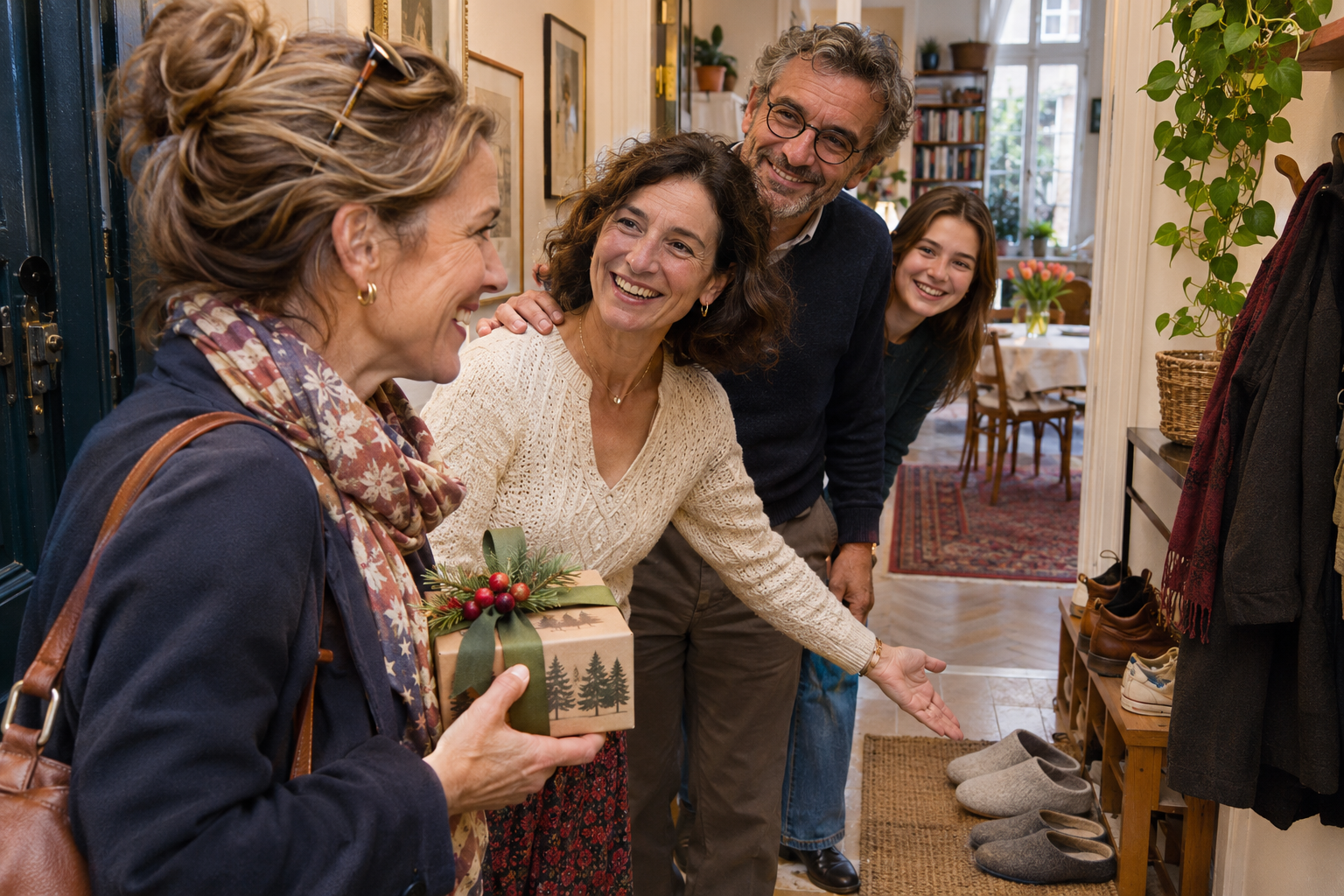
The first thing to understand is that these expectations exist at all, because that is the part Americans most often miss. Being an overnight guest in a European home is governed by a web of small, mostly silent customs, and your hosts will register, consciously or not, whether you seem to understand them.
This is not about being judged harshly or walking on eggshells. It is simply that hospitality in much of Europe is a more formal and more reciprocal affair than the casual American version, with its own etiquette of gifts, help, and restraint, and a good guest is one who senses and respects that etiquette rather than treating a host’s home like a hotel. The rules are rarely stated because, to the hosts, they are obvious, absorbed in childhood and assumed in everyone.
The patterns that follow are broad tendencies, and they genuinely do differ across the continent; what is expected in a German household may differ from a Spanish or a Greek or an Italian one. So treat all of this not as a rigid code but as a set of sensitivities to carry with you, and above all, watch your hosts and follow their lead. The single best rule, underneath all the specific ones, is simply to pay attention and take your cues from the family, because they will show you how their home works if you are watching.
Americans, coming from a famously casual and informal hospitality culture, sometimes assume that warmth means there are no rules, that a host who is relaxed and friendly expects nothing in particular. That is the trap. The warmth is real, but it coexists with expectations, and mistaking the one for the absence of the other is how well-meaning guests go wrong.
Bring a Gift, the Right Kind
The one rule almost everyone agrees on is that you do not arrive empty-handed. Showing up at a European family’s door with nothing in your hands is a genuine misstep, and bringing a thoughtful gift is close to mandatory, a basic token of respect for the hospitality you are about to receive.
The question is what to bring, and here the details matter more than Americans expect. Good options generally include quality chocolates, flowers, a nice bottle of wine where appropriate, or, best of all, something distinctive from your own country or region, which is both thoughtful and a lovely conversation piece. But the particulars carry meaning that varies by place: in some countries the number or color of flowers matters, certain blooms being associated with funerals or romance; in others, bringing wine to a meal can subtly suggest the host’s own choices are not good enough, so a dessert or chocolates are safer. The impulse to bring wine, in particular, can backfire in some cultures, where it reads less as a gift and more as a comment on the host’s table.
The safe approach is to put a little thought into it rather than grabbing the nearest bottle. A small, considered gift that shows you made an effort, and ideally that reflects where you come from, is almost always welcome, and the gesture itself matters as much as the object. When in doubt, flowers chosen with a quick check of local custom, or a quality treat from home, will rarely steer you wrong. What you must not do is arrive with nothing, because that single omission can color a whole visit.
If you genuinely cannot organize a gift before you arrive, perhaps because you have come straight from travel, the graceful recovery is to acknowledge it and make good quickly, offering to take the family out for a meal, buying something nice the next day, or otherwise finding a way to reciprocate. The point is never the object itself but the acknowledgment that you have received something and wish to give something back.
Towels, Shoes, and Water

Once you are inside, a set of small household customs comes into play, and several of them surprise Americans used to a more abundant style of living. The first is the towel. In many European homes you will be given one towel for your entire stay, not a fresh one each day, and you are expected to reuse it, hanging it up to dry between uses rather than expecting a daily replacement.
This connects to a broader European consciousness about water and resources that runs deeper than in much of America. Water and energy are treated as things not to be wasted, so the marathon twenty-minute shower that passes without comment in an American home can raise eyebrows in a European one, where quick, efficient showers are the norm. Tap water may or may not be offered for drinking depending on the country, and you should take your cue from the household rather than assuming. The general spirit is one of modest, careful use of the home’s resources, and a guest who is mindful of it, who keeps showers reasonable and lights off and water running only as needed, is quietly appreciated.
Shoes are another common one. In a great many European households, shoes come off at the door, and you may be offered a pair of guest slippers to wear inside. Padding through someone’s home in your outdoor shoes, tracking in the street, can be a real breach in these homes, so the simplest move on arrival is to glance at what your hosts and their family do at the entrance and copy it exactly. These small domestic customs are easy to honor once you know to look for them, and getting them right signals, better than any words, that you respect how the household lives.
Breakfast Is Not What You Expect

Mealtimes bring their own gentle surprises, and breakfast is often the first. The large, hot, varied American breakfast, with eggs and meat and several options, is not the European norm, and a guest hoping for one may be quietly disappointed.
In much of Europe, breakfast is a lighter, simpler affair: bread or pastries with butter and jam, some cheese or cold meat, perhaps yogurt and fruit, and coffee or tea. It is not a cooked spread made to order but a modest spread put out for everyone, and the gracious thing is to eat happily what is offered rather than to request special additions or wish aloud for something more substantial. The rest of the day’s meals may run on an unfamiliar schedule too, particularly in the south, where lunch is the large midday meal and dinner comes late, sometimes very late by American standards.
The key attitude throughout is to fit yourself to the family’s rhythm rather than expecting the family to accommodate yours. You eat what is served, at the times it is served, with gratitude and without fuss, and you do not treat the kitchen as a place to help yourself freely or impose your own dietary preferences and schedules. A guest who slots gracefully into the household’s existing patterns of eating is a pleasure to host; one who needs the whole rhythm rearranged around them is a strain, however unintentionally. If you have genuine dietary needs, mention them once, simply and early, and then be easy about it rather than making every meal a negotiation.
Help, But Read the Room
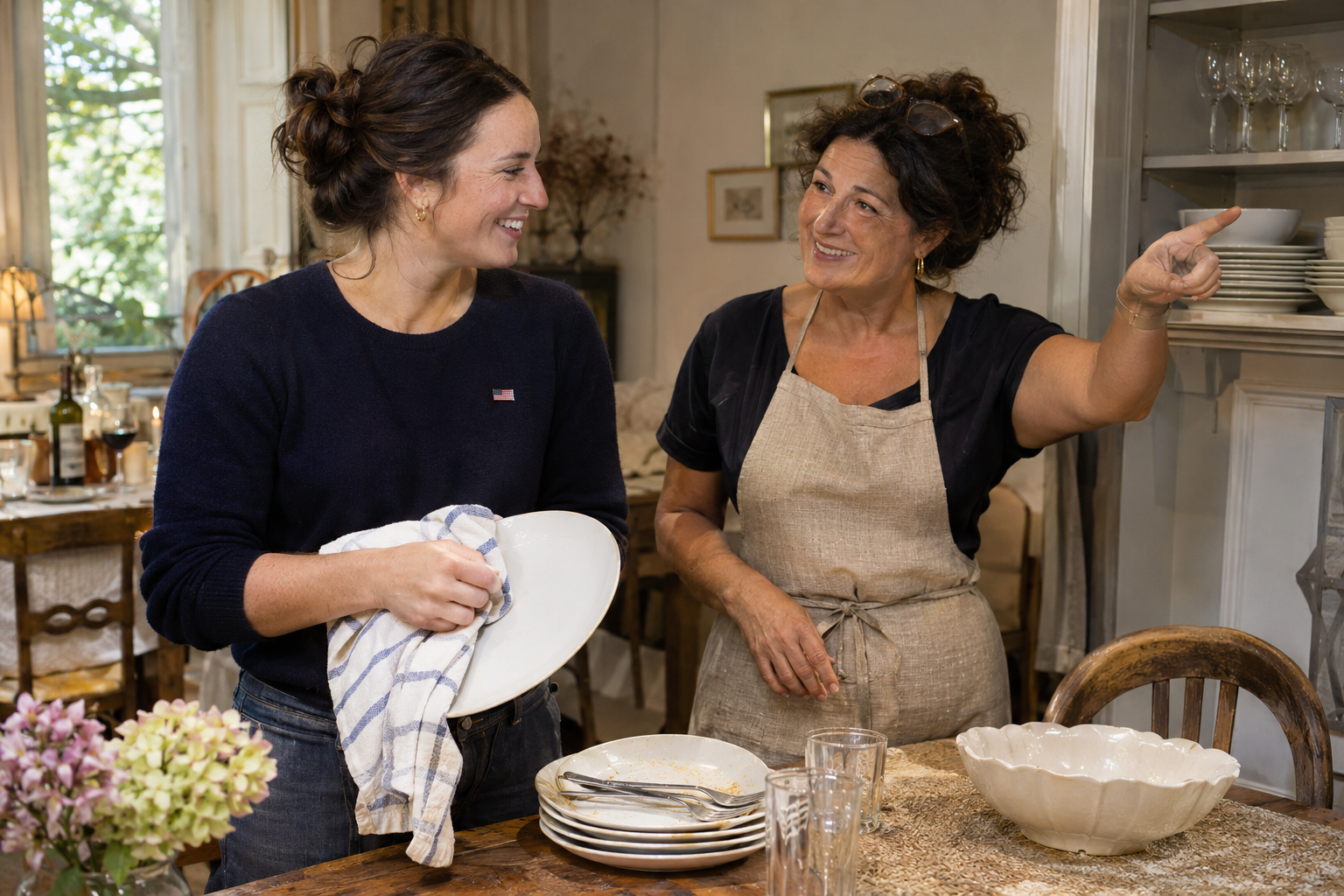
A good guest offers to help, and in a European home this matters, but it comes with a subtlety: you must offer without barging in. The instinct to pitch in is correct, but how you pitch in requires reading the room.
The reliable moves are the clearly helpful, low-risk ones. Offer to help clear the table and wash or dry the dishes, make your own bed and keep your room tidy, and generally make yourself useful in the obvious communal ways.
These offers are almost always welcome, and even when politely declined, the offering itself registers as good manners. It is the asking, as much as the doing, that counts. What you want to avoid is the overstep: taking over the host’s kitchen, rearranging their systems, or insisting on helping in ways that actually disrupt how they like to run their home.
Different families and different cultures want different levels of this, which is where the reading comes in. Some hosts will happily put you to work and treat your help as a sign you are comfortable; others will firmly shoo you out of the kitchen and be slightly affronted by too much insistence, preferring to host you properly. The skill is to offer sincerely, accept the answer you are given gracefully, and watch for the household’s actual preferences rather than imposing your own idea of helpfulness. Offer, and then follow their lead, is the whole of it.
When It Is Time to Leave
Now for the most important and most delicate rule of all, the one that does the most damage when it is broken: knowing when to go. There is an old saying, common across many cultures, that fish and guests both begin to smell after three days, and the wisdom in it is real.
The cardinal sin of houseguesting is overstaying your welcome, lingering past the point where your presence has shifted from a pleasure to a quiet burden. Hospitality, however warm, has natural limits, and a visit has a natural arc, building to a peak and then gently winding down.
The good guest senses that arc and moves to leave while they are still wanted, rather than staying until the hosts are privately counting the days until the house is theirs again. Reading that turn, and acting on it before anyone has to hint, is perhaps the single most valuable guesting skill there is. It is far better to leave a little early, with everyone wishing you could stay longer, than to leave a little late, with everyone relieved you are finally going. The guest remembered fondly is almost always the one who left a day too soon, not a day too late.
In practice, this means being clear and modest about the length of your stay from the start, and being alert to the signs as it unfolds. Unless you have been genuinely, specifically pressed to stay longer, treat the original plan as the plan, offer to leave rather than waiting to be nudged, and err on the side of brevity. And when you do go, go well: strip the bed if that is the custom, leave the room as you found it, thank your hosts warmly and specifically, and follow up afterward with a message of thanks, perhaps a small gift or card, closing the loop of the hospitality you were shown. The exit, done gracefully, is remembered as warmly as the welcome.
Being a Guest Worth Inviting Back

Underneath every one of these specific rules runs a single thread, and once you grasp it the particulars take care of themselves. The thread is consideration: a genuine respect for your hosts’ home, their resources, their rhythms, and their generosity, and a refusal to take any of it for granted.
That is really all the unwritten rules amount to. Bring a gift because the hospitality deserves acknowledgment, and mind the towels and the water because the home’s resources are not yours to waste.
Fit into the family’s meals and routines because you are a guest in their life, not the other way round. Offer to help because you are not a customer. And leave at the right time because you value the relationship more than the free bed. Each small custom is just a particular expression of the same basic decency.
Get these things right, and the reward is considerable, because European hospitality, once you have shown yourself worthy of it, is deep and warm and often lifelong.
A family that has taken you in and found you a thoughtful, easy, considerate guest will open their door to you again and again, and a stay in a real home, with a real family, is one of the richest experiences travel offers. The small effort of being a good guest is repaid many times over, in welcomes that keep coming. Watch, consider, help, and know when to go, and you will not just be hosted; you will be hoped for.

About the Author: Ruben, co-founder of Gamintraveler.com since 2014, is a seasoned traveler from Spain who has explored over 100 countries since 2009. Known for his extensive travel adventures across South America, Europe, the US, Australia, New Zealand, Asia, and Africa, Ruben combines his passion for adventurous yet sustainable living with his love for cycling, highlighted by his remarkable 5-month bicycle journey from Spain to Norway. He currently resides in Spain, where he continues sharing his travel experiences with his partner, Rachel, and their son, Han.