
An American arrives in a European city in August, excited, and finds half of it closed. The little restaurant they were looking forward to has a handwritten sign in the window: closed for holidays, back in September. The bakery is shuttered, the family-run shop is dark, and the streets feel strangely empty, as if everyone has quietly slipped away. It is disorienting, and it feels almost like the city has been abandoned.
It has not. What the visitor has run into is one of the deepest differences between European and American life, written right into the law: Europeans get weeks of paid vacation guaranteed, and, just as importantly, they actually take all of it.
To an American, raised in a culture where vacation is a hard-won perk often left unused, this is genuinely startling. Here is how the European vacation rule works, why it is so much more generous than the American version, and why it empties out entire cities every August.
Five Weeks, Guaranteed by Law
The foundation of it all is a legal right, not a company benefit. Across the European Union, a directive guarantees every single worker a minimum of four weeks of paid annual leave every year, as a floor that no employer can go below.
And most countries go well above that floor. In France, Austria, Sweden, and Denmark, the statutory minimum is five weeks, twenty-five working days of paid holiday a year, written into national law.
Spain mandates thirty calendar days, which works out to around twenty-two working days, and in Germany, Italy, and the Netherlands, where the legal minimum sits at four weeks, the great majority of workers get five or even six through their collective agreements. Five weeks off is not an exotic privilege in Europe; for a huge share of workers, it is simply the standard. It is the baseline from which an ordinary working life is planned, the amount of rest a person simply expects to have.
This is the first thing an American has to absorb, because it is so far from the US reality. There, paid vacation is not a legal right at all; the United States mandates no paid vacation whatsoever at the federal level, leaving it entirely to employers, with the result that many workers get two weeks if they are lucky, and some get none. In Europe, by contrast, four to five weeks of paid holiday is a guaranteed entitlement of every job, as fundamental as the minimum wage. The gap is not a matter of degree; it is a matter of kind.
And They Actually Take It

Here is the part that matters just as much as the number, and that Americans often miss: Europeans do not just have the vacation, they take it, all of it, every year. The law does not merely grant the leave; it insists that it be used.
Under European rules, paid annual leave generally cannot be bought out, cashed in, or quietly skipped. You are not allowed to trade your holiday for extra money except when you leave a job, and the European courts have ruled firmly that workers cannot be made to forfeit their leave or pressured into not taking it. The whole legal architecture is designed to ensure that the time off actually happens, that it is rest rather than a number on a payslip.
The cultural expectation reinforces the law completely. In most of Europe, taking your full holiday is not seen as slacking or as a sign of insufficient dedication; it is simply what everyone does, expected and unremarkable.
Nobody earns points for skipping their vacation, and nobody is admired for it. This is the quiet opposite of a familiar American pattern, in which workers leave vacation days unused year after year, out of guilt, fear, or a workplace culture that subtly punishes taking time off. In Europe, the time off is not just offered; it is genuinely taken, which is the whole point of having it.
The American Contrast

It is worth dwelling on the American side of this comparison, because the contrast is what makes the European norm so striking to US visitors, and because it reveals two very different sets of values. The United States stands almost alone among wealthy nations in guaranteeing its workers no paid vacation at all.
The consequences flow from there. Where Europeans start from a legal floor of four or five weeks, many Americans are working with two weeks or less, and a meaningful share of the workforce, often those in lower-paid jobs, receives no paid time off whatsoever.
And even the Americans who do have vacation days frequently fail to use them, leaving days unspent at the end of the year because the workplace culture treats taking time off as faintly suspect, a sign that you are not committed or not essential.
This has produced a genuine cultural difference in how the two societies think about work and rest. American culture has tended to prize constant productivity and availability, to wear busyness as a badge and to regard long breaks with a touch of unease. European culture, broadly, has made a different bargain, treating substantial, protected rest as a normal and necessary part of a working life rather than a luxury or a weakness. Neither is simply right, but they are profoundly different, and the empty August street is one of the places where that difference becomes visible to the naked eye.
Add the Public Holidays
The four or five weeks of annual leave is not even the whole of it, because on top of that sit the public holidays, and most European countries have a generous stack of them. These are days off over and above your personal vacation allowance.
The numbers add up quickly. Most European countries observe somewhere between ten and fifteen public holidays a year, and in many places these are genuinely days when the country stops. Add those to the statutory vacation, and the real total of paid days off climbs to somewhere around thirty-six days a year in countries like France and Spain, and comparable figures across much of the continent. That is well over a month and a half of paid time away from work, every year, as a matter of ordinary entitlement.
For an American accustomed to counting vacation in single-digit days, this total is almost difficult to believe. It is not that Europeans are lazy; by many measures they are highly productive during the hours they do work. It is that their societies have decided, collectively and legally, that a working life should contain a great deal more rest than the American model allows. The public holidays are the visible, calendar-wide expression of that choice, moments when the whole country exhales together.
Why August Empties Out

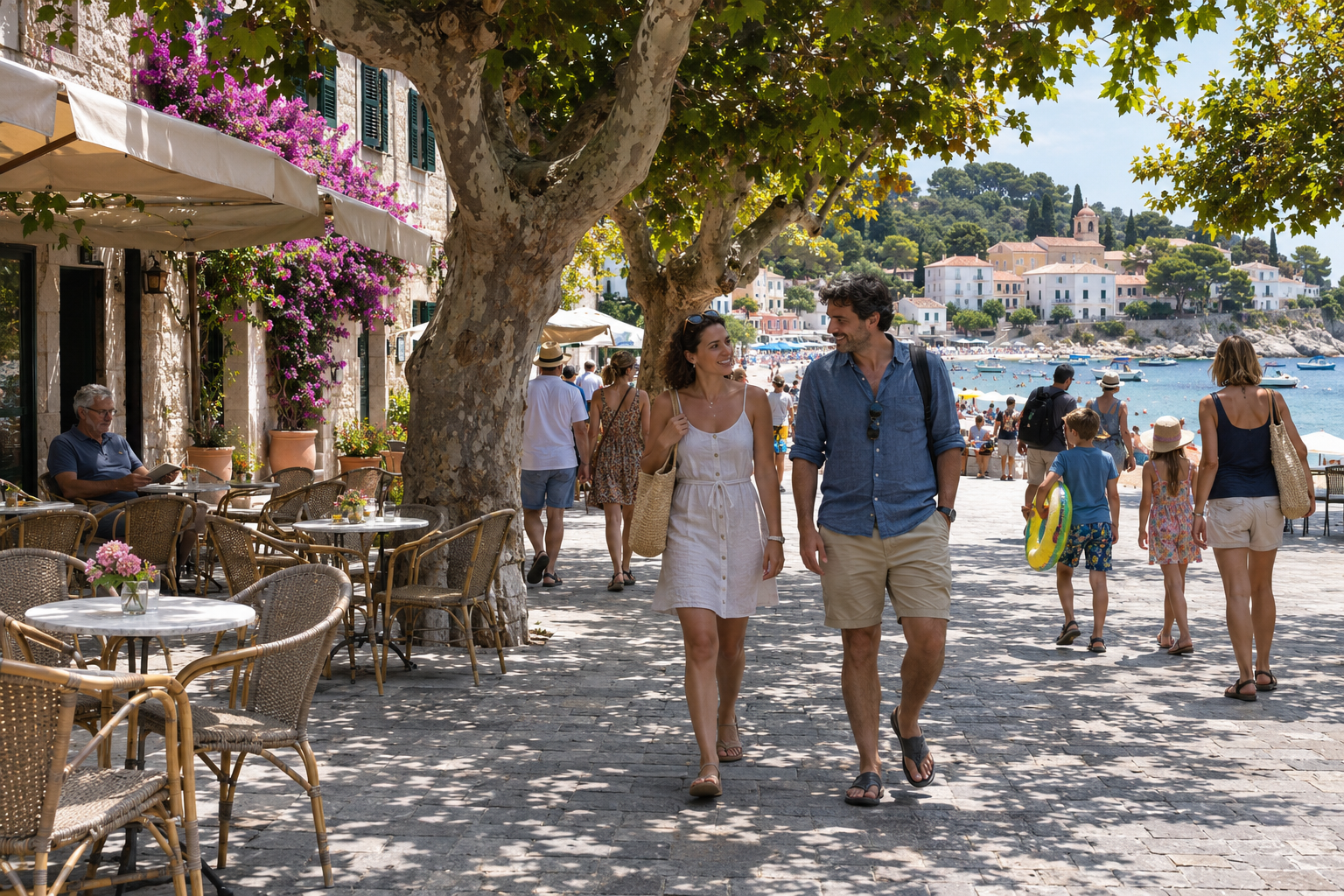
All of this comes to a head in August, which is why that month feels so strange to a visitor. In much of Europe, and especially in the south, August is the holiday month, the time when a huge share of the population takes its long summer break all at once.
The effect is a kind of national slowdown. Across Spain, Italy, and France in particular, families decamp to the coast, the mountains, or the village for weeks at a stretch, and the cities they leave behind grow quiet and sleepy.
Small businesses, independent shops, workshops, and even some restaurants simply close for two, three, or four weeks, hanging up those signs announcing their return in September, because the owners, too, are on holiday. In Italy, the holiday reaches a symbolic peak around Ferragosto in mid-August, when the country all but shuts down. It is not that a few people are away; it is that a large part of the whole society is on vacation simultaneously.
For a newcomer, this takes real adjustment, because it means that August is simply not a month for getting things done. Trying to sort out anything official, reach a tradesperson, or rely on your usual shops being open can be an exercise in frustration, met again and again by closed doors and out-of-office replies. But once you understand what is happening, the empty August city stops feeling eerie and starts feeling like what it is: the sound of an entire society taking the rest it has guaranteed itself.
What It Does to the Rhythm of Life
There is something worth appreciating in this shared, simultaneous pause, beyond the inconvenience it causes the unprepared. When a whole society rests at the same time, rather than staggering its breaks so the machine never stops, the rest itself is different in character.
Because everyone is off together, there is less of the modern anxiety of returning from vacation to a thousand emails from colleagues who kept working, and less sense that stepping away means falling behind. When the whole country is at the beach, the beach is simply where everyone is, and work can genuinely wait because there is no one to do it with. The collective nature of the August break makes it a fuller, more complete disconnection than the solitary, guilt-tinged vacation familiar to many Americans, who return to find the world carried on without them.
This reflects a deeper value that runs through much of European life: that leisure, family time, and rest are not the leftovers of a life given over to work, but a central and protected part of it. The long August pause, the generous holidays, the legal insistence that you take your time off, all of it expresses a belief that a good life needs substantial, regular, unhurried rest, and that this is worth defending even at some cost to productivity. It is a different ordering of priorities, and the empty August street is its monument.
What Americans Can Learn From It

So what is a traveler, an expat, or simply an envious American to take from all this? Partly it is practical: if you are going to be in Europe in August, plan around the shutdown, get your official business done before or after, and lean into the slower rhythm rather than fighting it. Match your pace to the country’s, and the month becomes a pleasure rather than a frustration.
But the deeper lesson is about the choice the whole system represents, and the permission buried in it. Europe has decided, through its laws and its culture, that rest is a right worth guaranteeing and a value worth protecting, and the results, whatever the tradeoffs, are a population that takes real, regular, substantial time to live. There are genuine debates to be had about the economic costs and benefits, and the European model is not without its critics or its downsides. But there is also something in it that an American, in particular, might sit with: the radical idea that you are allowed to stop, fully and without guilt, and that doing so is not a failure but a part of a life well lived.
For the individual American, the most useful thing to carry home may be the simplest. If you have vacation days, take them, all of them, without apology, the way the Europeans do.
You will not find a law compelling you to rest the way they have, but you can borrow the attitude behind it, the understanding that time off is not stolen from a serious life but is one of the things that makes a life serious in the first place. The empty August street is really just a whole society agreeing, at once, that it is time to live a little. That is an agreement worth learning from.

About the Author: Ruben, co-founder of Gamintraveler.com since 2014, is a seasoned traveler from Spain who has explored over 100 countries since 2009. Known for his extensive travel adventures across South America, Europe, the US, Australia, New Zealand, Asia, and Africa, Ruben combines his passion for adventurous yet sustainable living with his love for cycling, highlighted by his remarkable 5-month bicycle journey from Spain to Norway. He currently resides in Spain, where he continues sharing his travel experiences with his partner, Rachel, and their son, Han.