
Updated for 2026: We first published this Omio review back in 2024, and a lot has changed since — Omio is now live in 47 countries, added ferries, and launched in Japan. We’ve refreshed the whole thing below with current prices and features. If you want our full hands-on test of the new Japan booking, see our 2026 Japan transport guide.
Travel is a big part of how we live, and we’re always hunting for tools that make the logistics easier so we can spend more energy on the actual trip. Omio has been one of those tools for years now — it’s the first place we look when we need to get from one city to another, whether that’s a train across Spain or a ferry between Italian islands. In this review, we’ll share how we use it, what it does well, where it still falls short, and everything that’s new in 2026.
Looking for travel insurance for your trip? Two of our favorites: read our Heymondo vs SafetyWing comparison for the cheapest options. You can get your Heymondo Travel Insurance for $135 USD with a discount code valid for 90 days. And if you need a good carry-on, here’s the travel backpack we bring everywhere.
What is Omio?
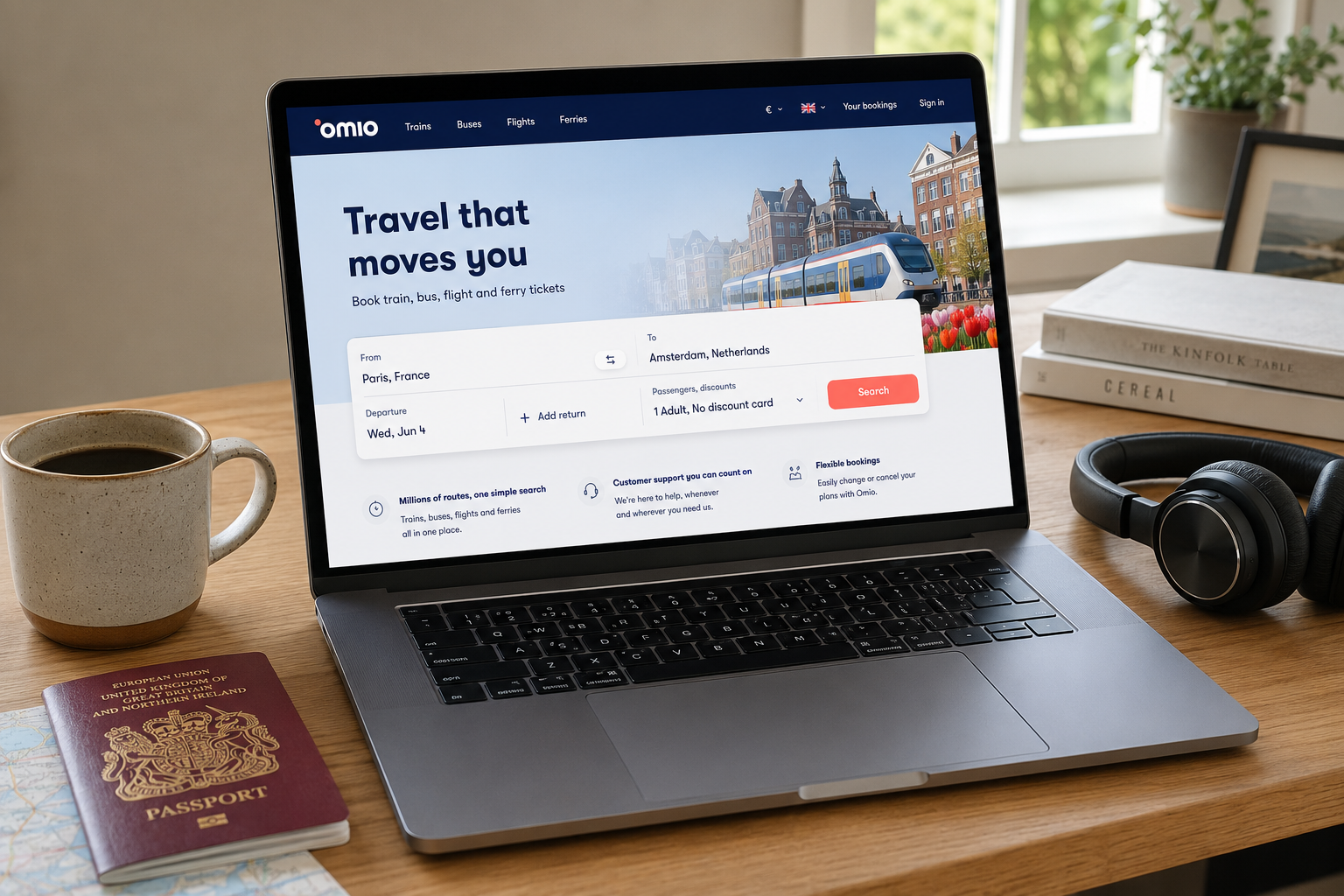
Omio is a travel planning and booking platform that lets you search buses, trains, ferries, and flights, compare them side by side, and book — all in one place. You can use it as a website or as an app for iOS, Android, and the Huawei App Gallery.
The key thing to understand, especially if you’re new to this kind of tool, is that Omio doesn’t run any transport itself. It’s an aggregator. It pulls together the routes, schedules, and prices from hundreds of transport companies across a region and shows them to you in a single search. Instead of opening the national railway site, then a bus company, then a budget airline, and trying to line them all up in your head, you do one search and see everything at once. That’s the whole pitch, and after years of using it, it still holds up.
How Omio Works
It couldn’t be much simpler. You type in where you’re starting, where you’re going, and your date, and Omio returns the options across trains, buses, flights, and — increasingly — ferries. You can sort by price or by speed, filter for direct routes, and book the one that suits you. Your ticket then lives in the app, ready to scan at the gate.
The best way to show you is to walk through a few real searches we ran, so let’s do that.
Book your tickets with Omio right here
Testing Omio in Europe
Madrid to Barcelona
We started with Madrid to Barcelona, and it’s a great example of why Omio is so useful in Spain right now. In one search you get the full picture: on our date, trains from around $41 (about three hours), buses from as little as $21 (a slow seven-plus hours), and flights from around $79 (roughly 1h15 in the air). Budget, speed, or somewhere in between — it’s all laid out at a glance.
What really stood out compared to when we first wrote this review is the competition. Spain’s high-speed rail market has opened up, and a single Omio search now stacks Renfe’s AVE against newer operators like iryo and OUIGO, all running the same Madrid–Barcelona corridor and all fighting on price. We saw OUIGO fares from $54 and iryo from the mid-$60s for the fast three-hour run. That competition is genuinely good news for your wallet, and Omio is where you actually see it — three operators side by side instead of three separate websites.
Book your tickets with Omio right here
Madrid to Salamanca
Booking a little ahead still turns up good deals on regional routes. Searching Madrid to Salamanca, we found direct trains from around $35, and Omio’s date strip made it easy to see that nudging the trip a day either way dropped the fare to under $30. If your plans are flexible, that flexibility is money in your pocket. This is exactly the kind of everyday, mid-size-city route where having trains and buses together saves you from digging through the national rail site in Spanish.
Milan to Sicily
For a tougher journey, we searched Milan to Sicily, and this is where an aggregator really earns its keep. It’s a long haul down the length of Italy with a sea crossing at the end, and Omio laid out every possible way to do it in a single view: trains from around $172, buses from $76, flights from around $185, and even ferries from about $90.
Seeing all four modes at once is the entire point. For a route this long, the overnight train is a genuine experience but eats close to 20 hours, while a flight gets you there in about 90 minutes — and Omio shows you both, plus the ferry, so you can weigh time against cost for yourself rather than guessing. One honest note: prices on a route like this swing a lot depending on the date. Our date strip ranged from about $163 to $221 across a single week, so it always pays to check a few days before you book.
What’s New Since We First Reviewed Omio

This is the part that’s changed the most, and it’s the main reason we’ve refreshed the whole review.
When we first published, Omio covered 36 countries. It’s now live in 47, after a big 2025–2026 expansion. The headline addition is Japan — Omio’s first market in East Asia — where you can now book Shinkansen bullet trains, regional rail, buses, domestic flights, and ferries in one place, along with Japan Rail Passes. It also added several Southeast Asian countries (Indonesia, Malaysia, Thailand, Singapore, and Vietnam) and Brazil, plus more rail and bus operators across markets it already served.
A few upgrades worth calling out:
- Ferries are now part of the mix in many regions, which matters more than you’d expect for island travel across Spain, Italy, Greece, and Japan — you’ll even see them turn up in a Milan–Sicily search now.
- Omio Advance lets you reserve Japan train tickets up to twelve months ahead — handy for locking in a seat on popular routes during peak seasons.
- All-in pricing in Japan means the fare you see already includes the base fare, the express fee, and the seat reservation, so there’s no confusing small print at the gate.
- Language and currency support has grown, too — Omio now works in more than 30 languages and over 30 currencies, so you can browse in English and pay in dollars.
If Japan is on your list, we put all of this through a full hands-on test — see our 2026 Japan transport guide for the real routes, prices, and honest trade-offs.
Omio Mobile Tickets
One of the quietly great things about Omio is that once you book, your tickets live in the app — trains, buses, ferries, and flights all in one spot. There’s nothing to print and nothing to lose, and they’re available offline, which is exactly what you want when you’re standing in a busy foreign station with one bar of signal and a train to catch. When it’s time to board, you just pull up the ticket and scan.
(One traveler’s reminder that has nothing to do with Omio: always keep your proper ID on you too — passport, and any visas you need — so the only thing you’re thinking about at the gate is where to find coffee.)
Book your tickets with Omio right here
What Companies Work with Omio
Because Omio is a booking platform rather than a transport company, which operators you’ll see depends entirely on where you’re traveling. Across Europe and beyond, that includes names like Alsa, FlixBus, Renfe, iryo, OUIGO, Regiojet, Trenitalia, Frecciarossa, Italo, Deutsche Bahn, Eurostar, SBB, SNCF, Ryanair, British Airways, Lufthansa, easyJet, and Air France — among many others.
On the rail side you’ll also find the likes of Amtrak, ScotRail, FlixTrain, NS, high-speed services across Europe, and — new since our original review — Japan’s Shinkansen bullet trains and Japan Rail Passes. The list keeps growing as Omio adds operators, which is a big part of why we keep coming back to it.
Features We Love About Omio

Everything in one search. This is the big one. Comparing trains, buses, ferries, and flights side by side, sorted by price or speed, turns what used to be an afternoon of tab-juggling into a two-minute job.
Mobile tickets. Having every ticket in one app, offline and ready to scan, is the kind of small convenience you don’t appreciate until the one time you’d otherwise have been hunting for a printout.
Greener, cheaper options are right there. You don’t always have to fly. Depending on the route, the train or bus is often cheaper, lands you in the city center instead of an airport on the outskirts, and carries a lighter carbon footprint. Omio puts those alternatives in front of you instead of defaulting to flights.
Clear, all-in pricing. Especially in Japan, seeing the true total up front — no surprise fees stacked on at the end — takes real mental load off booking in an unfamiliar country.
Is Omio Worth It? Our Honest Pros and Cons
After years of using it, our honest answer is yes — with a couple of caveats we want to be straight about.
The pros are everything above: one search across every mode, honest side-by-side prices, tickets on your phone, and coverage that now spans Europe, North America, and much of Asia. For the way we travel — a mix of trains, buses, and the occasional ferry, always looking for the local option — it saves real time and hassle on nearly every trip.
The cons, because a review that only gushes isn’t worth much. First, Omio sometimes adds a small booking fee on top of the operator’s own price — usually a few dollars, and the trade-off for having everything in one place, but worth knowing it’s there. If you’re pinching every cent on a single simple route, booking direct can occasionally be marginally cheaper. Second, when something goes wrong with a trip, you’re dealing with Omio’s support rather than the operator directly, which can add a step. And third, coverage still isn’t everywhere. Our original con was that Omio didn’t reach a lot of places we searched — including the Philippines, where we found very little covered. The 2026 expansion has closed a lot of those gaps, but not all of them: the Philippines, for example, still isn’t included. So our honest advice remains what it always was — run your specific route through Omio before you count on it. For Europe, North America, and now much of Asia, though, the coverage is strong and getting stronger.
A Few Tips for First-Time Omio Users
If you’re trying Omio for the first time, here’s the short list we’d give a friend:
- Compare all the modes before you book. The cheapest or fastest option isn’t always the one you’d have guessed — that’s the whole reason to search.
- Play with your dates. The date strip shows how much a day either way changes the fare; flexibility often saves real money.
- Use the app for the tickets. Mobile tickets, offline, mean nothing to print and nothing to lose.
- Pay in your own currency so a rejected foreign card doesn’t derail you at checkout.
- For Japan, book ahead in peak season — not for a discount (rail fares are fixed), but to lock in a seat when trains fill up.
Final Thoughts on Our Omio Review

Omio has been part of our travel toolkit for years, and refreshing this review only reminded us how much it’s grown — more countries, more modes, and genuinely useful new features like ferries and the Japan launch. It’s not perfect, and we’ve been honest about the small fees and the coverage gaps. But for turning the messy logistics of getting around a country into something you can sort in a couple of minutes, we haven’t found anything we trust more.
If you haven’t tried it, we’d say give it a go on a route you’re actually planning and see how the options stack up. And if that route happens to be in Japan, don’t miss our full 2026 Japan test. Let us know if you have any questions — and whether you’ll be using Omio too.
Book your tickets with Omio right here

About the Author: Ruben, co-founder of Gamintraveler.com since 2014, is a seasoned traveler from Spain who has explored over 100 countries since 2009. Known for his extensive travel adventures across South America, Europe, the US, Australia, New Zealand, Asia, and Africa, Ruben combines his passion for adventurous yet sustainable living with his love for cycling, highlighted by his remarkable 5-month bicycle journey from Spain to Norway. He currently resides in Spain, where he continues sharing his travel experiences with his partner, Rachel, and their son, Han.